

9.2 Field Expansion
207
Writing a field theory in terms of | may not be intuitive since in point-particle
QFT, one is used to work with the position or momentum representation. In fact,
there is a very simple way to recover a formulation in terms of spacetime pointparticle fields, which can be used almost whenever there is a doubt about what
is going on. Indeed, as is well-known from standard worldsheet string theory, the
string states behave like a collection of particles. This is because the modes of the
CFT fields (like α
μ
n ) carry spacetime indices (Lorentz, group representation. . . ) such
that the states themselves carry indices. Indeed, these quantum numbers classify
eigenstates of the operators L 0 and ¯
L 0 . On the other hand, positions and shapes are
not eigenstates of any simple CFT operator.
9.2
Field Expansion
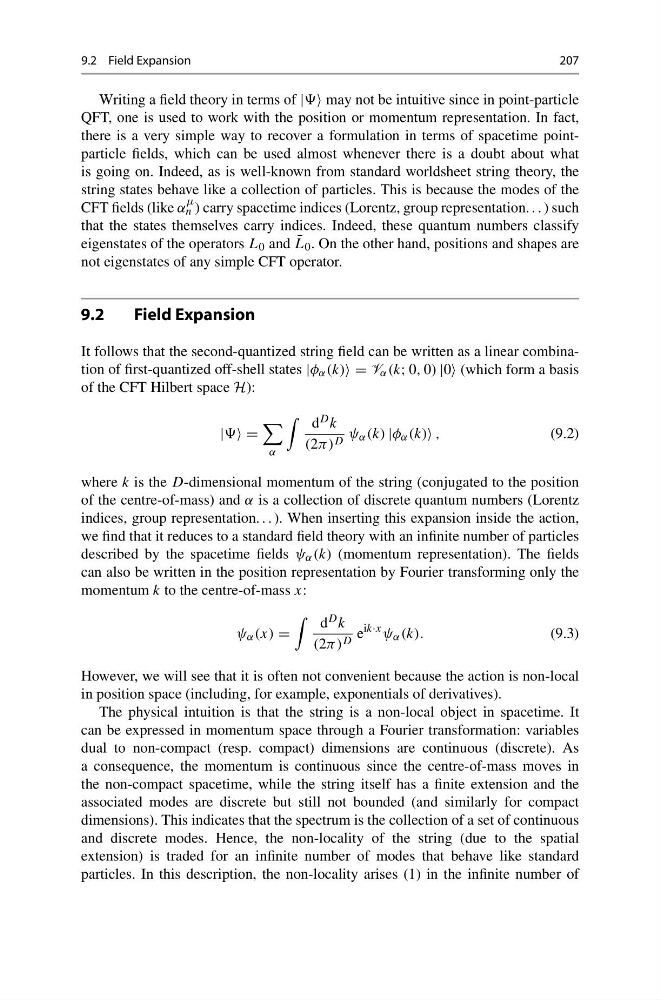
It follows that the second-quantized string field can be written as a linear combination of first-quantized off-shell states |φ α (k) = V α (k; 0, 0) |0 (which form a basis
of the CFT Hilbert space H):
| =
α
d D k
(2π) D ψ α (k) |φ α (k) ,
(9.2)
where k is the D-dimensional momentum of the string (conjugated to the position
of the centre-of-mass) and α is a collection of discrete quantum numbers (Lorentz
indices, group representation. . . ). When inserting this expansion inside the action,
we find that it reduces to a standard field theory with an infinite number of particles
described by the spacetime fields ψ α (k) (momentum representation). The fields
can also be written in the position representation by Fourier transforming only the
momentum k to the centre-of-mass x:
ψ α (x) =
d D k
(2π) D e
ik·x ψ α (k).
(9.3)
However, we will see that it is often not convenient because the action is non-local
in position space (including, for example, exponentials of derivatives).
The physical intuition is that the string is a non-local object in spacetime. It
can be expressed in momentum space through a Fourier transformation: variables
dual to non-compact (resp. compact) dimensions are continuous (discrete). As
a consequence, the momentum is continuous since the centre-of-mass moves in
the non-compact spacetime, while the string itself has a finite extension and the
associated modes are discrete but still not bounded (and similarly for compact
dimensions). This indicates that the spectrum is the collection of a set of continuous
and discrete modes. Hence, the non-locality of the string (due to the spatial
extension) is traded for an infinite number of modes that behave like standard
particles. In this description, the non-locality arises (1) in the infinite number of
207
Writing a field theory in terms of | may not be intuitive since in point-particle
QFT, one is used to work with the position or momentum representation. In fact,
there is a very simple way to recover a formulation in terms of spacetime pointparticle fields, which can be used almost whenever there is a doubt about what
is going on. Indeed, as is well-known from standard worldsheet string theory, the
string states behave like a collection of particles. This is because the modes of the
CFT fields (like α
μ
n ) carry spacetime indices (Lorentz, group representation. . . ) such
that the states themselves carry indices. Indeed, these quantum numbers classify
eigenstates of the operators L 0 and ¯
L 0 . On the other hand, positions and shapes are
not eigenstates of any simple CFT operator.
9.2
Field Expansion
It follows that the second-quantized string field can be written as a linear combination of first-quantized off-shell states |φ α (k) = V α (k; 0, 0) |0 (which form a basis
of the CFT Hilbert space H):
| =
α
d D k
(2π) D ψ α (k) |φ α (k) ,
(9.2)
where k is the D-dimensional momentum of the string (conjugated to the position
of the centre-of-mass) and α is a collection of discrete quantum numbers (Lorentz
indices, group representation. . . ). When inserting this expansion inside the action,
we find that it reduces to a standard field theory with an infinite number of particles
described by the spacetime fields ψ α (k) (momentum representation). The fields
can also be written in the position representation by Fourier transforming only the
momentum k to the centre-of-mass x:
ψ α (x) =
d D k
(2π) D e
ik·x ψ α (k).
(9.3)
However, we will see that it is often not convenient because the action is non-local
in position space (including, for example, exponentials of derivatives).
The physical intuition is that the string is a non-local object in spacetime. It
can be expressed in momentum space through a Fourier transformation: variables
dual to non-compact (resp. compact) dimensions are continuous (discrete). As
a consequence, the momentum is continuous since the centre-of-mass moves in
the non-compact spacetime, while the string itself has a finite extension and the
associated modes are discrete but still not bounded (and similarly for compact
dimensions). This indicates that the spectrum is the collection of a set of continuous
and discrete modes. Hence, the non-locality of the string (due to the spatial
extension) is traded for an infinite number of modes that behave like standard
particles. In this description, the non-locality arises (1) in the infinite number of