

206
9 String Field
should first determine the degrees of freedom of the string and then find the interactions. The simplest way to achieve the first step is to perform a second-quantization
of the string wave functional: the string field is written as a linear combination
of first-quantized states with spacetime wave functionals as coefficients. 2 This
provides a free Hamiltonian; trying to add interactions perturbatively does not work
well.
It is not possible to go very far with this approach, and one is lead to choose
a specific gauge, breaking the manifest invariance under reparametrizations. The
simplest is the light-cone gauge since one works only with the physical degrees of
freedom of the string. While this approach is interesting to gain some intuitions and
show that, in principle, it is possible to build a string field theory, it requires making
various assumptions and ends up with problems (especially for superstrings). 3
Since worldsheet reparametrization invariance is just a kind of gauge
symmetry—maybe less familiar than the non-Abelian gauge symmetries in Yang–
Mills, but still a gauge symmetry—one may surmise that it should be possible
to gauge fix this symmetry and introduce a BRST symmetry in its place. This is
the programme of the BRST (or covariant) string field theory in which the string
field depends not only on the worldsheet (at fixed time) but also on the ghosts:
[X(σ ), c(σ )]. There is no dependence on the b ghost because the latter is the
conjugate momentum of the c ghost: in the operator language, b(σ ) ∼
δ
δc(σ ) .
The BRST formalism has the major advantage to allow to move easily from D =
26 dimensions—described by X μ scalars (μ = 0, . . . , 25)—to a (possibly curved)
D-dimensional spacetime and a string with some internal structure—described by
a more general CFT, in which D scalars X μ represent the non-compact dimensions
and the remaining system with central charge 26 − D describes the compactification
and structure. It is sufficient to consider the string field as a general functional of all
the worldsheet fields. For simplicity, we will continue to write X in the functional
dependence, keeping the other matter fields implicit.
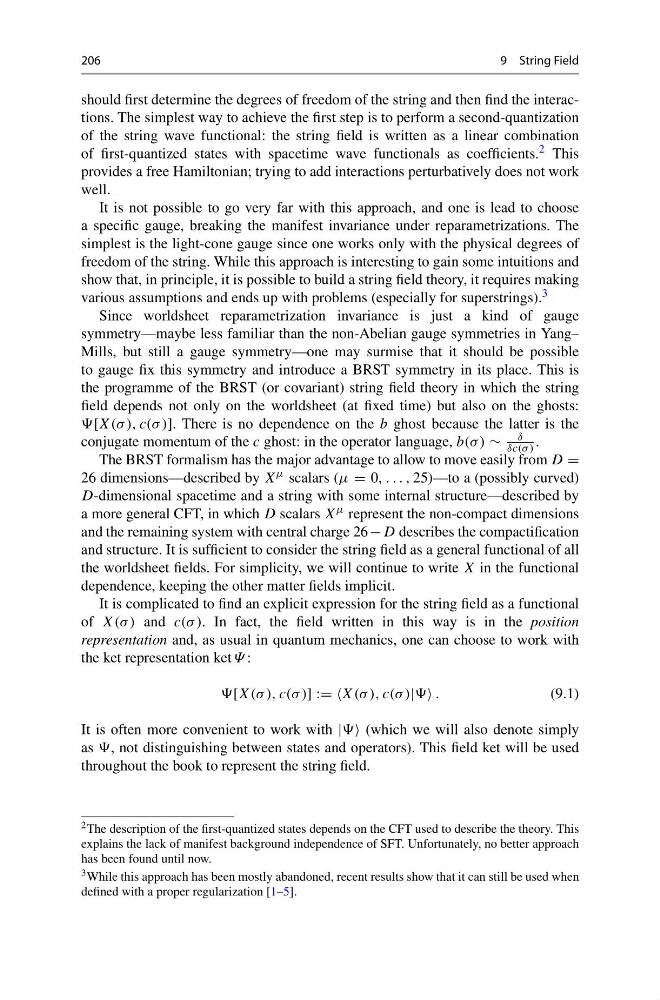
It is complicated to find an explicit expression for the string field as a functional
of X(σ ) and c(σ ). In fact, the field written in this way is in the position
representation and, as usual in quantum mechanics, one can choose to work with
the ket representation ket Ψ :
[X(σ ), c(σ )] := X(σ ), c(σ )| .
(9.1)
It is often more convenient to work with | (which we will also denote simply
as , not distinguishing between states and operators). This field ket will be used
throughout the book to represent the string field.
2 The description of the first-quantized states depends on the CFT used to describe the theory. This
explains the lack of manifest background independence of SFT. Unfortunately, no better approach
has been found until now.
3 While this approach has been mostly abandoned, recent results show that it can still be used when
defined with a proper regularization [1–5].
9 String Field
should first determine the degrees of freedom of the string and then find the interactions. The simplest way to achieve the first step is to perform a second-quantization
of the string wave functional: the string field is written as a linear combination
of first-quantized states with spacetime wave functionals as coefficients. 2 This
provides a free Hamiltonian; trying to add interactions perturbatively does not work
well.
It is not possible to go very far with this approach, and one is lead to choose
a specific gauge, breaking the manifest invariance under reparametrizations. The
simplest is the light-cone gauge since one works only with the physical degrees of
freedom of the string. While this approach is interesting to gain some intuitions and
show that, in principle, it is possible to build a string field theory, it requires making
various assumptions and ends up with problems (especially for superstrings). 3
Since worldsheet reparametrization invariance is just a kind of gauge
symmetry—maybe less familiar than the non-Abelian gauge symmetries in Yang–
Mills, but still a gauge symmetry—one may surmise that it should be possible
to gauge fix this symmetry and introduce a BRST symmetry in its place. This is
the programme of the BRST (or covariant) string field theory in which the string
field depends not only on the worldsheet (at fixed time) but also on the ghosts:
[X(σ ), c(σ )]. There is no dependence on the b ghost because the latter is the
conjugate momentum of the c ghost: in the operator language, b(σ ) ∼
δ
δc(σ ) .
The BRST formalism has the major advantage to allow to move easily from D =
26 dimensions—described by X μ scalars (μ = 0, . . . , 25)—to a (possibly curved)
D-dimensional spacetime and a string with some internal structure—described by
a more general CFT, in which D scalars X μ represent the non-compact dimensions
and the remaining system with central charge 26 − D describes the compactification
and structure. It is sufficient to consider the string field as a general functional of all
the worldsheet fields. For simplicity, we will continue to write X in the functional
dependence, keeping the other matter fields implicit.
It is complicated to find an explicit expression for the string field as a functional
of X(σ ) and c(σ ). In fact, the field written in this way is in the position
representation and, as usual in quantum mechanics, one can choose to work with
the ket representation ket Ψ :
[X(σ ), c(σ )] := X(σ ), c(σ )| .
(9.1)
It is often more convenient to work with | (which we will also denote simply
as , not distinguishing between states and operators). This field ket will be used
throughout the book to represent the string field.
2 The description of the first-quantized states depends on the CFT used to describe the theory. This
explains the lack of manifest background independence of SFT. Unfortunately, no better approach
has been found until now.
3 While this approach has been mostly abandoned, recent results show that it can still be used when
defined with a proper regularization [1–5].