

8.3 BRST Cohomology: Two Flat Directions
195
Hence, Q 0 and Q 2 are both nilpotent and define a cohomology.
One can show that the cohomologies of
Q B and Q 0 are isomorphic 4
H 0 (
Q B ) H 0 (Q 0 )
(8.68)
under general conditions [5], in particular, if the cohomology is ghost-free (i.e. all
states have N gh = 1).
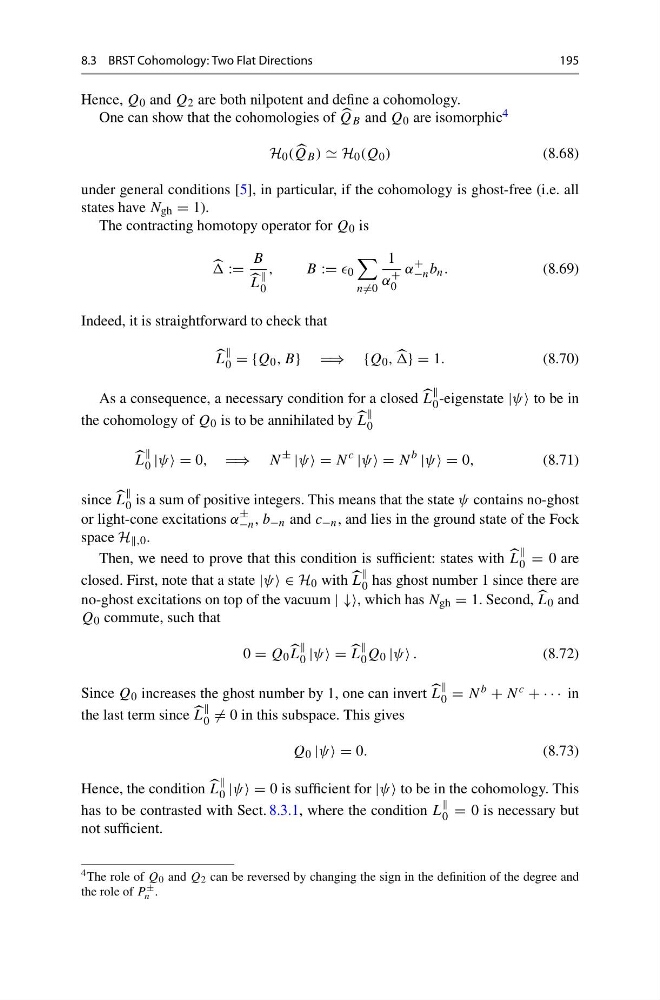
The contracting homotopy operator for Q 0 is
:=
B
L
0
,
B := 0
n =0
1
α
+
0
α
+
−n b n .
(8.69)
Indeed, it is straightforward to check that
L
0 = {Q 0 , B} }⇒ {Q 0 ,
} = 1.
(8.70)
As a consequence, a necessary condition for a closed
L
0 -eigenstate |ψ to be in
the cohomology of Q 0 is to be annihilated by
L
0
L
0 |ψ = 0, ⇒ N
±
|ψ = N
c
|ψ = N
b
|ψ = 0,
(8.71)
since
L
0 is a sum of positive integers. This means that the state ψ contains no-ghost
or light-cone excitations α
±
−n , b −n and c −n , and lies in the ground state of the Fock
space H ,0 .
Then, we need to prove that this condition is sufficient: states with
L
0 = 0 are
closed. First, note that a state |ψ ∈ H 0 with
L
0 has ghost number 1 since there are
no-ghost excitations on top of the vacuum | ↓↓, which has N gh = 1. Second,
L 0 and
Q 0 commute, such that
0 = Q 0
L
0 |ψ =
L
0 Q 0 |ψ .
(8.72)
Since Q 0 increases the ghost number by 1, one can invert
L
0 = N b + N c + · · · in
the last term since
L
0 = 0 in this subspace. This gives
Q 0 |ψ = 0.
(8.73)
Hence, the condition
L
0 |ψ = 0 is sufficient for |ψ to be in the cohomology. This
has to be contrasted with Sect. 8.3.1, where the condition L
0 = 0 is necessary but
not sufficient.
4 The role of Q 0 and Q 2 can be reversed by changing the sign in the definition of the degree and
the role of P ±
n .
195
Hence, Q 0 and Q 2 are both nilpotent and define a cohomology.
One can show that the cohomologies of
Q B and Q 0 are isomorphic 4
H 0 (
Q B ) H 0 (Q 0 )
(8.68)
under general conditions [5], in particular, if the cohomology is ghost-free (i.e. all
states have N gh = 1).
The contracting homotopy operator for Q 0 is
:=
B
L
0
,
B := 0
n =0
1
α
+
0
α
+
−n b n .
(8.69)
Indeed, it is straightforward to check that
L
0 = {Q 0 , B} }⇒ {Q 0 ,
} = 1.
(8.70)
As a consequence, a necessary condition for a closed
L
0 -eigenstate |ψ to be in
the cohomology of Q 0 is to be annihilated by
L
0
L
0 |ψ = 0, ⇒ N
±
|ψ = N
c
|ψ = N
b
|ψ = 0,
(8.71)
since
L
0 is a sum of positive integers. This means that the state ψ contains no-ghost
or light-cone excitations α
±
−n , b −n and c −n , and lies in the ground state of the Fock
space H ,0 .
Then, we need to prove that this condition is sufficient: states with
L
0 = 0 are
closed. First, note that a state |ψ ∈ H 0 with
L
0 has ghost number 1 since there are
no-ghost excitations on top of the vacuum | ↓↓, which has N gh = 1. Second,
L 0 and
Q 0 commute, such that
0 = Q 0
L
0 |ψ =
L
0 Q 0 |ψ .
(8.72)
Since Q 0 increases the ghost number by 1, one can invert
L
0 = N b + N c + · · · in
the last term since
L
0 = 0 in this subspace. This gives
Q 0 |ψ = 0.
(8.73)
Hence, the condition
L
0 |ψ = 0 is sufficient for |ψ to be in the cohomology. This
has to be contrasted with Sect. 8.3.1, where the condition L
0 = 0 is necessary but
not sufficient.
4 The role of Q 0 and Q 2 can be reversed by changing the sign in the definition of the degree and
the role of P ±
n .