

194
8 BRST Quantization
Computation: Equation (8.59)
Using (8.57), one finds
N
0
+ N
1
=
n
n
N
0
n + N
1
n
=
n
n
N
+
n + N
−
n
= N
+
+ N
− .
Reduced Cohomology
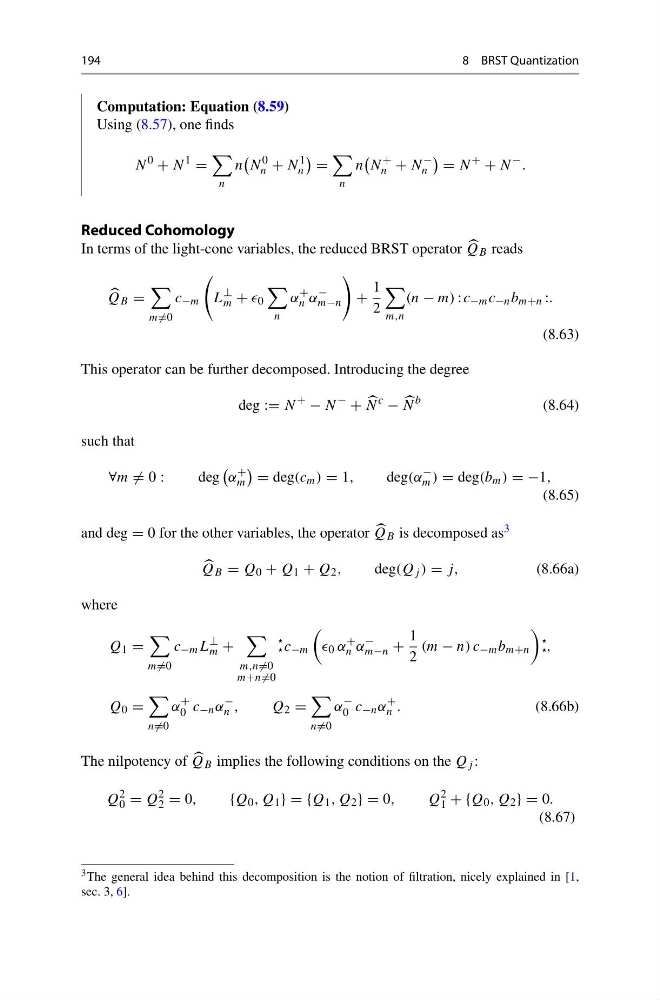
In terms of the light-cone variables, the reduced BRST operator
Q B reads
Q B =
m =0
c −m
L
⊥
m + 0
n
α
+
n α
−
m−n
+
1
2
m,n
(n − m) : c −m c −n b m+n :.
(8.63)
This operator can be further decomposed. Introducing the degree
deg := N
+
− N
−
+
N
c
−
N
b
(8.64)
such that
∀m = 0 :
deg
α
+
m
= deg(c m ) = 1,
deg(α
−
m ) = deg(b m ) = −1,
(8.65)
and deg = 0 for the other variables, the operator
Q B is decomposed as 3
Q B = Q 0 + Q 1 + Q 2 ,
deg(Q j ) = j,
(8.66a)
where
Q 1 =
m =0
c −m L
⊥
m +
m,n =0
m+n =0
c −m
0 α
+
n α
−
m−n +
1
2
(m − n) c −m b m+n
,
Q 0 =
n =0
α
+
0 c −n α
−
n ,
Q 2 =
n =0
α
−
0 c −n α
+
n .
(8.66b)
The nilpotency of
Q B implies the following conditions on the Q j :
Q
2
0 = Q
2
2 = 0,
{Q 0 , Q 1 } = {Q 1 , Q 2 } = 0,
Q
2
1 + {Q 0 , Q 2 } = 0.
(8.67)
3 The general idea behind this decomposition is the notion of filtration, nicely explained in [1,
sec. 3, 6].
8 BRST Quantization
Computation: Equation (8.59)
Using (8.57), one finds
N
0
+ N
1
=
n
n
N
0
n + N
1
n
=
n
n
N
+
n + N
−
n
= N
+
+ N
− .
Reduced Cohomology
In terms of the light-cone variables, the reduced BRST operator
Q B reads
Q B =
m =0
c −m
L
⊥
m + 0
n
α
+
n α
−
m−n
+
1
2
m,n
(n − m) : c −m c −n b m+n :.
(8.63)
This operator can be further decomposed. Introducing the degree
deg := N
+
− N
−
+
N
c
−
N
b
(8.64)
such that
∀m = 0 :
deg
α
+
m
= deg(c m ) = 1,
deg(α
−
m ) = deg(b m ) = −1,
(8.65)
and deg = 0 for the other variables, the operator
Q B is decomposed as 3
Q B = Q 0 + Q 1 + Q 2 ,
deg(Q j ) = j,
(8.66a)
where
Q 1 =
m =0
c −m L
⊥
m +
m,n =0
m+n =0
c −m
0 α
+
n α
−
m−n +
1
2
(m − n) c −m b m+n
,
Q 0 =
n =0
α
+
0 c −n α
−
n ,
Q 2 =
n =0
α
−
0 c −n α
+
n .
(8.66b)
The nilpotency of
Q B implies the following conditions on the Q j :
Q
2
0 = Q
2
2 = 0,
{Q 0 , Q 1 } = {Q 1 , Q 2 } = 0,
Q
2
1 + {Q 0 , Q 2 } = 0.
(8.67)
3 The general idea behind this decomposition is the notion of filtration, nicely explained in [1,
sec. 3, 6].