

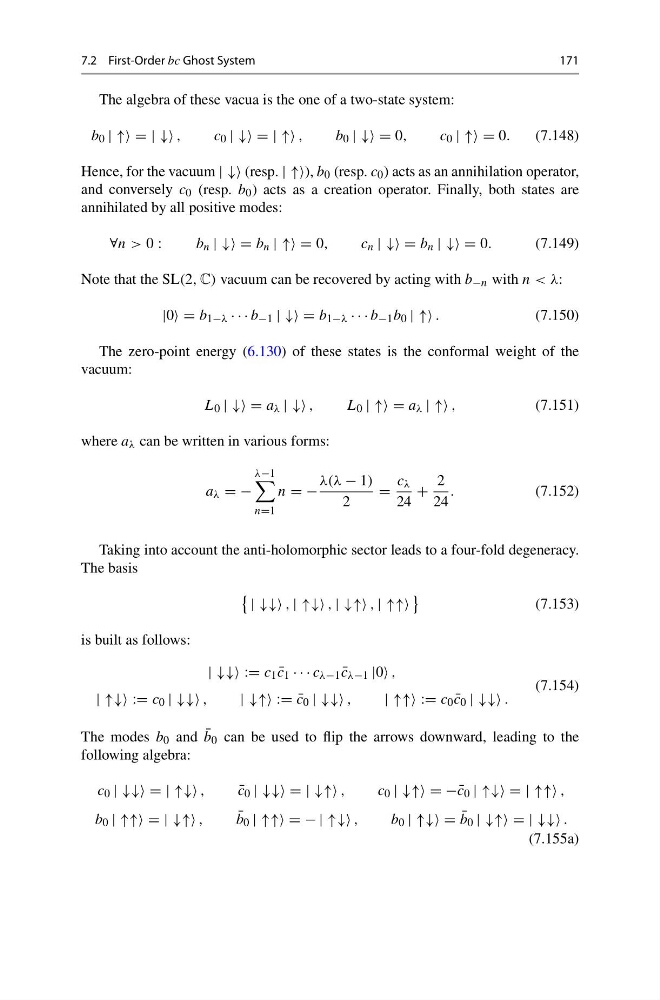
7.2 First-Order bc Ghost System
171
The algebra of these vacua is the one of a two-state system:
b 0 | ↑↑ = | ↓↓ ,
c 0 | ↓↓ = | ↑↑ ,
b 0 | ↓↓ = 0,
c 0 | ↑↑ = 0.
(7.148)
Hence, for the vacuum | ↓↓ (resp. | ↑↑), b 0 (resp. c 0 ) acts as an annihilation operator,
and conversely c 0 (resp. b 0 ) acts as a creation operator. Finally, both states are
annihilated by all positive modes:
∀n > 0 :
b n | ↓↓ = b n | ↑↑ = 0,
c n | ↓↓ = b n | ↓↓ = 0.
(7.149)
Note that the SL(2, C) vacuum can be recovered by acting with b −n with n < λ:
|0 = b 1−λ · · · b −1 | ↓↓ = b 1−λ · · · b −1 b 0 | ↑↑ .
(7.150)
The zero-point energy (6.130) of these states is the conformal weight of the
vacuum:
L 0 | ↓↓ = a λ | ↓↓ ,
L 0 | ↑↑ = a λ | ↑↑ ,
(7.151)
where a λ can be written in various forms:
a λ = −
λ−1
n=1
n = −
λ(λ − 1)
2
=
c λ
24
+
2
24
.
(7.152)
Taking into account the anti-holomorphic sector leads to a four-fold degeneracy.
The basis
| ↓↓↓ , | ↑↓↓ , | ↓↑↑ , | ↑↑↑
(7.153)
is built as follows:
| ↓↓↓ := c 1 ¯
c 1 · · · c λ−1 ¯
c λ−1 |0 ,
| ↑↓↓ := c 0 | ↓↓↓ ,
| ↓↑↑ := ¯
c 0 | ↓↓↓ ,
| ↑↑↑ := c 0 ¯
c 0 | ↓↓↓ .
(7.154)
The modes b 0 and ¯
b 0 can be used to flip the arrows downward, leading to the
following algebra:
c 0 | ↓↓↓ = | ↑↓↓ ,
¯
c 0 | ↓↓↓ = | ↓↑↑ ,
c 0 | ↓↑↑ = − ¯
c 0 | ↑↓↓ = | ↑↑↑ ,
b 0 | ↑↑↑ = | ↓↑↑ ,
¯
b 0 | ↑↑↑ = − | ↑↓↓ ,
b 0 | ↑↓↓ = ¯
b 0 | ↓↑↑ = | ↓↓↓ .
(7.155a)
171
The algebra of these vacua is the one of a two-state system:
b 0 | ↑↑ = | ↓↓ ,
c 0 | ↓↓ = | ↑↑ ,
b 0 | ↓↓ = 0,
c 0 | ↑↑ = 0.
(7.148)
Hence, for the vacuum | ↓↓ (resp. | ↑↑), b 0 (resp. c 0 ) acts as an annihilation operator,
and conversely c 0 (resp. b 0 ) acts as a creation operator. Finally, both states are
annihilated by all positive modes:
∀n > 0 :
b n | ↓↓ = b n | ↑↑ = 0,
c n | ↓↓ = b n | ↓↓ = 0.
(7.149)
Note that the SL(2, C) vacuum can be recovered by acting with b −n with n < λ:
|0 = b 1−λ · · · b −1 | ↓↓ = b 1−λ · · · b −1 b 0 | ↑↑ .
(7.150)
The zero-point energy (6.130) of these states is the conformal weight of the
vacuum:
L 0 | ↓↓ = a λ | ↓↓ ,
L 0 | ↑↑ = a λ | ↑↑ ,
(7.151)
where a λ can be written in various forms:
a λ = −
λ−1
n=1
n = −
λ(λ − 1)
2
=
c λ
24
+
2
24
.
(7.152)
Taking into account the anti-holomorphic sector leads to a four-fold degeneracy.
The basis
| ↓↓↓ , | ↑↓↓ , | ↓↑↑ , | ↑↑↑
(7.153)
is built as follows:
| ↓↓↓ := c 1 ¯
c 1 · · · c λ−1 ¯
c λ−1 |0 ,
| ↑↓↓ := c 0 | ↓↓↓ ,
| ↓↑↑ := ¯
c 0 | ↓↓↓ ,
| ↑↑↑ := c 0 ¯
c 0 | ↓↓↓ .
(7.154)
The modes b 0 and ¯
b 0 can be used to flip the arrows downward, leading to the
following algebra:
c 0 | ↓↓↓ = | ↑↓↓ ,
¯
c 0 | ↓↓↓ = | ↓↑↑ ,
c 0 | ↓↑↑ = − ¯
c 0 | ↑↓↓ = | ↑↑↑ ,
b 0 | ↑↑↑ = | ↓↑↑ ,
¯
b 0 | ↑↑↑ = − | ↑↓↓ ,
b 0 | ↑↓↓ = ¯
b 0 | ↓↑↑ = | ↓↓↓ .
(7.155a)