

170
7 CFT Systems
7.2.6 Hilbert Space
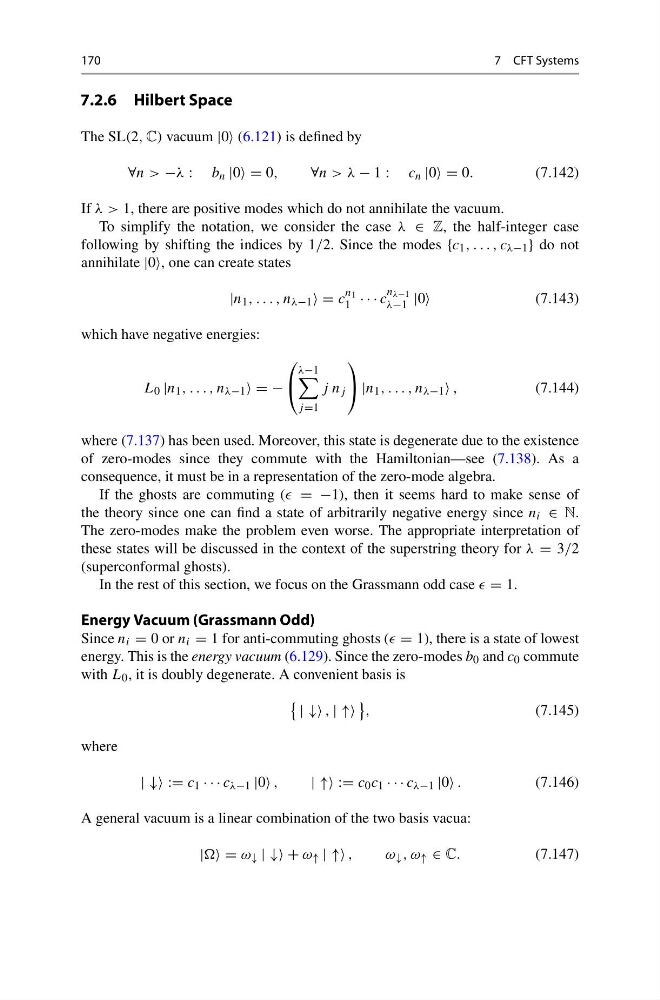
The SL(2, C) vacuum |0 (6.121) is defined by
∀n > −λ : b n |0 = 0,
∀n > λ − 1 : c n |0 = 0.
(7.142)
If λ > 1, there are positive modes which do not annihilate the vacuum.
To simplify the notation, we consider the case λ ∈ Z, the half-integer case
following by shifting the indices by 1/2. Since the modes {c 1 , . . . , c λ−1 } do not
annihilate |0, one can create states
|n 1 , . . . , n λ−1 = c
n 1
1 · · · c
n λ−1
λ−1 |0
(7.143)
which have negative energies:
L 0 |n 1 , . . . , n λ−1 = −
⎛
⎝
λ−1
j =1
j n j
⎞
⎠ |n 1 , . . . , n λ−1 ,
(7.144)
where (7.137) has been used. Moreover, this state is degenerate due to the existence
of zero-modes since they commute with the Hamiltonian—see (7.138). As a
consequence, it must be in a representation of the zero-mode algebra.
If the ghosts are commuting ( = −1), then it seems hard to make sense of
the theory since one can find a state of arbitrarily negative energy since n i ∈ N.
The zero-modes make the problem even worse. The appropriate interpretation of
these states will be discussed in the context of the superstring theory for λ = 3/2
(superconformal ghosts).
In the rest of this section, we focus on the Grassmann odd case = 1.
Energy Vacuum (Grassmann Odd)
Since n i = 0 or n i = 1 for anti-commuting ghosts ( = 1), there is a state of lowest
energy. This is the energy vacuum (6.129). Since the zero-modes b 0 and c 0 commute
with L 0 , it is doubly degenerate. A convenient basis is
| ↓↓ , | ↑↑
,
(7.145)
where
| ↓↓ := c 1 · · · c λ−1 |0 ,
| ↑↑ := c 0 c 1 · · · c λ−1 |0 .
(7.146)
A general vacuum is a linear combination of the two basis vacua:
| = ω ↓ | ↓↓ + ω ↑ | ↑↑ ,
ω ↓ , ω ↑ ∈ C.
(7.147)
7 CFT Systems
7.2.6 Hilbert Space
The SL(2, C) vacuum |0 (6.121) is defined by
∀n > −λ : b n |0 = 0,
∀n > λ − 1 : c n |0 = 0.
(7.142)
If λ > 1, there are positive modes which do not annihilate the vacuum.
To simplify the notation, we consider the case λ ∈ Z, the half-integer case
following by shifting the indices by 1/2. Since the modes {c 1 , . . . , c λ−1 } do not
annihilate |0, one can create states
|n 1 , . . . , n λ−1 = c
n 1
1 · · · c
n λ−1
λ−1 |0
(7.143)
which have negative energies:
L 0 |n 1 , . . . , n λ−1 = −
⎛
⎝
λ−1
j =1
j n j
⎞
⎠ |n 1 , . . . , n λ−1 ,
(7.144)
where (7.137) has been used. Moreover, this state is degenerate due to the existence
of zero-modes since they commute with the Hamiltonian—see (7.138). As a
consequence, it must be in a representation of the zero-mode algebra.
If the ghosts are commuting ( = −1), then it seems hard to make sense of
the theory since one can find a state of arbitrarily negative energy since n i ∈ N.
The zero-modes make the problem even worse. The appropriate interpretation of
these states will be discussed in the context of the superstring theory for λ = 3/2
(superconformal ghosts).
In the rest of this section, we focus on the Grassmann odd case = 1.
Energy Vacuum (Grassmann Odd)
Since n i = 0 or n i = 1 for anti-commuting ghosts ( = 1), there is a state of lowest
energy. This is the energy vacuum (6.129). Since the zero-modes b 0 and c 0 commute
with L 0 , it is doubly degenerate. A convenient basis is
| ↓↓ , | ↑↑
,
(7.145)
where
| ↓↓ := c 1 · · · c λ−1 |0 ,
| ↑↑ := c 0 c 1 · · · c λ−1 |0 .
(7.146)
A general vacuum is a linear combination of the two basis vacua:
| = ω ↓ | ↓↓ + ω ↑ | ↑↑ ,
ω ↓ , ω ↑ ∈ C.
(7.147)