

7.1 Free Scalar
159
7.1.7 Euclidean and BPZ Conjugates
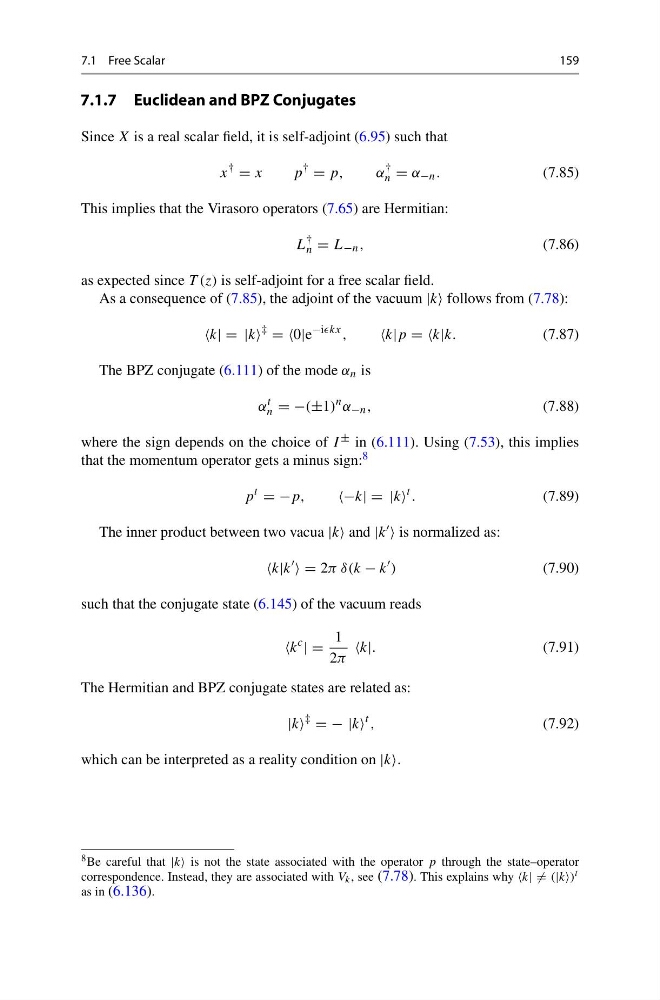
Since X is a real scalar field, it is self-adjoint (6.95) such that
x
†
= x
p
†
= p,
α
†
n = α −n .
(7.85)
This implies that the Virasoro operators (7.65) are Hermitian:
L
†
n = L −n ,
(7.86)
as expected since T (z) is self-adjoint for a free scalar field.
As a consequence of (7.85), the adjoint of the vacuum |k follows from (7.78):
k| = |k
‡
= =0|e
−i ,
k|p = =k|k.
(7.87)
The BPZ conjugate (6.111) of the mode α n is
α
t
n = −(±1)
n α −n ,
(7.88)
where the sign depends on the choice of I ± in (6.111). Using (7.53), this implies
that the momentum operator gets a minus sign: 8
p
t
= −p,
−k| = |k
t .
(7.89)
The inner product between two vacua |k and |k is normalized as:
k|k
= 2π δ(k − k
)
(7.90)
such that the conjugate state (6.145) of the vacuum reads
k
c
| =
1
2π
k|.
(7.91)
The Hermitian and BPZ conjugate states are related as:
|k
‡
= − |k
t ,
(7.92)
which can be interpreted as a reality condition on |k.
8 Be careful that |k is not the state associated with the operator p through the state–operator
correspondence. Instead, they are associated with V k , see (7.78). This explains why k| = (|k) t
as in (6.136).
159
7.1.7 Euclidean and BPZ Conjugates
Since X is a real scalar field, it is self-adjoint (6.95) such that
x
†
= x
p
†
= p,
α
†
n = α −n .
(7.85)
This implies that the Virasoro operators (7.65) are Hermitian:
L
†
n = L −n ,
(7.86)
as expected since T (z) is self-adjoint for a free scalar field.
As a consequence of (7.85), the adjoint of the vacuum |k follows from (7.78):
k| = |k
‡
= =0|e
−i ,
k|p = =k|k.
(7.87)
The BPZ conjugate (6.111) of the mode α n is
α
t
n = −(±1)
n α −n ,
(7.88)
where the sign depends on the choice of I ± in (6.111). Using (7.53), this implies
that the momentum operator gets a minus sign: 8
p
t
= −p,
−k| = |k
t .
(7.89)
The inner product between two vacua |k and |k is normalized as:
k|k
= 2π δ(k − k
)
(7.90)
such that the conjugate state (6.145) of the vacuum reads
k
c
| =
1
2π
k|.
(7.91)
The Hermitian and BPZ conjugate states are related as:
|k
‡
= − |k
t ,
(7.92)
which can be interpreted as a reality condition on |k.
8 Be careful that |k is not the state associated with the operator p through the state–operator
correspondence. Instead, they are associated with V k , see (7.78). This explains why k| = (|k) t
as in (6.136).