

158
7 CFT Systems
(we do not distinguish the notations between the number operators and their
eigenvalues). The full Hilbert space is given by
H =
R
dk F(k).
(7.84)
Computation: Equation (7.78)
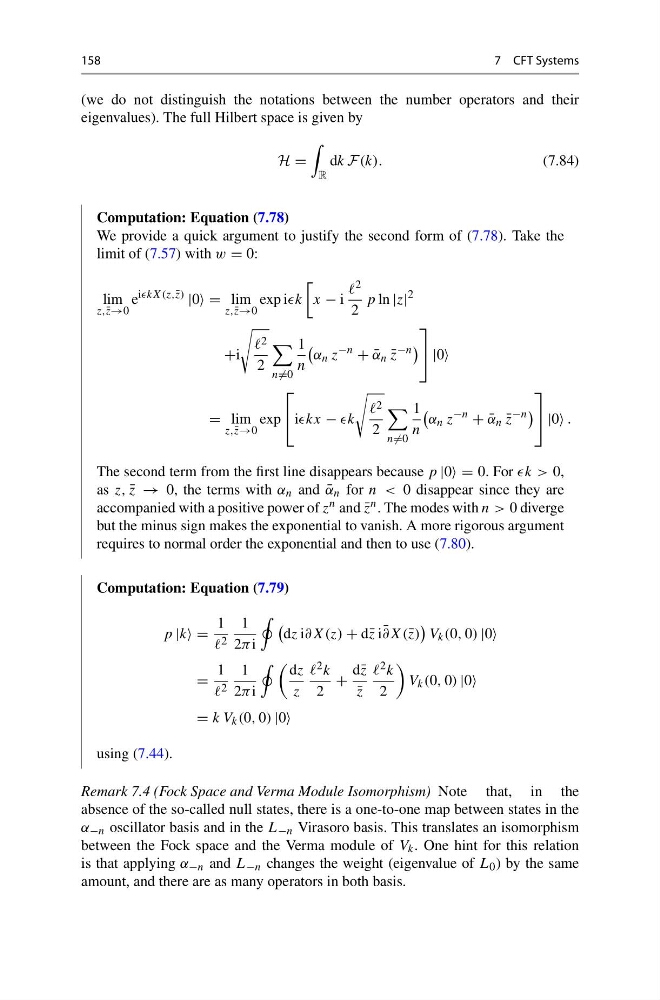
We provide a quick argument to justify the second form of (7.78). Take the
limit of (7.57) with w = 0:
lim
z,¯ z→0
e
ikX(z,¯ z)
|0 = lim
z,¯ z→0
exp ik
x − i
2
2
p ln |z|
2
+i
2
2
n =0
1
n
α n z
−n
+ ¯
α n ¯
z
−n
⎤
⎦ |0
= lim
z,¯ z→0
exp
⎡
⎣ ikx − k
2
2
n =0
1
n
α n z
−n
+ ¯
α n ¯
z
−n
⎤
⎦ |0 .
The second term from the first line disappears because p |0 = 0. For k > 0,
as z, ¯
z → 0, the terms with α n and ¯
α n for n < 0 disappear since they are
accompanied with a positive power of z n and ¯
z n . The modes with n > 0 diverge
but the minus sign makes the exponential to vanish. A more rigorous argument
requires to normal order the exponential and then to use (7.80).
Computation: Equation (7.79)
p |k =
1
2
1
2π i
dz i∂X(z) + d¯ z i ¯
∂X(¯ z)
V k (0, 0) |0
=
1
2
1
2π i
dz
z
2 k
2
+
d¯ z
¯
z
2 k
2
V k (0, 0) |0
= k V k (0, 0) |0
using (7.44).
Remark 7.4 (Fock Space and Verma Module Isomorphism) Note that, in the
absence of the so-called null states, there is a one-to-one map between states in the
α −n oscillator basis and in the L −n Virasoro basis. This translates an isomorphism
between the Fock space and the Verma module of V k . One hint for this relation
is that applying α −n and L −n changes the weight (eigenvalue of L 0 ) by the same
amount, and there are as many operators in both basis.
7 CFT Systems
(we do not distinguish the notations between the number operators and their
eigenvalues). The full Hilbert space is given by
H =
R
dk F(k).
(7.84)
Computation: Equation (7.78)
We provide a quick argument to justify the second form of (7.78). Take the
limit of (7.57) with w = 0:
lim
z,¯ z→0
e
ikX(z,¯ z)
|0 = lim
z,¯ z→0
exp ik
x − i
2
2
p ln |z|
2
+i
2
2
n =0
1
n
α n z
−n
+ ¯
α n ¯
z
−n
⎤
⎦ |0
= lim
z,¯ z→0
exp
⎡
⎣ ikx − k
2
2
n =0
1
n
α n z
−n
+ ¯
α n ¯
z
−n
⎤
⎦ |0 .
The second term from the first line disappears because p |0 = 0. For k > 0,
as z, ¯
z → 0, the terms with α n and ¯
α n for n < 0 disappear since they are
accompanied with a positive power of z n and ¯
z n . The modes with n > 0 diverge
but the minus sign makes the exponential to vanish. A more rigorous argument
requires to normal order the exponential and then to use (7.80).
Computation: Equation (7.79)
p |k =
1
2
1
2π i
dz i∂X(z) + d¯ z i ¯
∂X(¯ z)
V k (0, 0) |0
=
1
2
1
2π i
dz
z
2 k
2
+
d¯ z
¯
z
2 k
2
V k (0, 0) |0
= k V k (0, 0) |0
using (7.44).
Remark 7.4 (Fock Space and Verma Module Isomorphism) Note that, in the
absence of the so-called null states, there is a one-to-one map between states in the
α −n oscillator basis and in the L −n Virasoro basis. This translates an isomorphism
between the Fock space and the Verma module of V k . One hint for this relation
is that applying α −n and L −n changes the weight (eigenvalue of L 0 ) by the same
amount, and there are as many operators in both basis.