

7.1 Free Scalar
155
They count the number of excitations at level n weighted by the level itself. This
corresponds to the total energy due to the oscillations (the higher the level, the more
energy it needs to be excited).
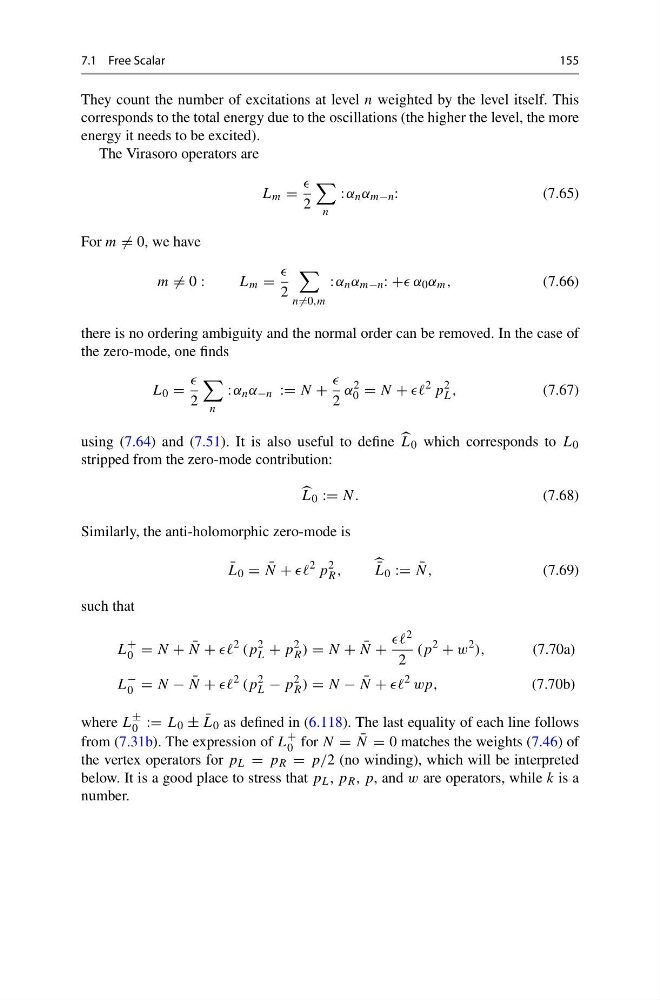
The Virasoro operators are
L m =
2
n
: α n α m−n :
(7.65)
For m = 0, we have
m = 0 :
L m =
2
n =0,m
: α n α m−n : + α 0 α m ,
(7.66)
there is no ordering ambiguity and the normal order can be removed. In the case of
the zero-mode, one finds
L 0 =
2
n
: α n α −n := N +
2
α
2
0 = N +
2 p
2
L ,
(7.67)
using (7.64) and (7.51). It is also useful to define
L 0 which corresponds to L 0
stripped from the zero-mode contribution:
L 0 := N.
(7.68)
Similarly, the anti-holomorphic zero-mode is
¯
L 0 = ¯
N +
2 p
2
R ,
¯
L 0 := ¯
N,
(7.69)
such that
L
+
0 = N + ¯
N +
2 (p
2
L + p
2
R ) = N + ¯
N +
2
2
(p
2
+ w
2 ),
(7.70a)
L
−
0 = N − ¯
N +
2 (p
2
L − p
2
R ) = N − ¯
N +
2 wp,
(7.70b)
where L
±
0 := L 0 ± ¯
L 0 as defined in (6.118). The last equality of each line follows
from (7.31b). The expression of L
+
0 for N = ¯
N = 0 matches the weights (7.46) of
the vertex operators for p L = p R = p/2 (no winding), which will be interpreted
below. It is a good place to stress that p L , p R , p, and w are operators, while k is a
number.
155
They count the number of excitations at level n weighted by the level itself. This
corresponds to the total energy due to the oscillations (the higher the level, the more
energy it needs to be excited).
The Virasoro operators are
L m =
2
n
: α n α m−n :
(7.65)
For m = 0, we have
m = 0 :
L m =
2
n =0,m
: α n α m−n : + α 0 α m ,
(7.66)
there is no ordering ambiguity and the normal order can be removed. In the case of
the zero-mode, one finds
L 0 =
2
n
: α n α −n := N +
2
α
2
0 = N +
2 p
2
L ,
(7.67)
using (7.64) and (7.51). It is also useful to define
L 0 which corresponds to L 0
stripped from the zero-mode contribution:
L 0 := N.
(7.68)
Similarly, the anti-holomorphic zero-mode is
¯
L 0 = ¯
N +
2 p
2
R ,
¯
L 0 := ¯
N,
(7.69)
such that
L
+
0 = N + ¯
N +
2 (p
2
L + p
2
R ) = N + ¯
N +
2
2
(p
2
+ w
2 ),
(7.70a)
L
−
0 = N − ¯
N +
2 (p
2
L − p
2
R ) = N − ¯
N +
2 wp,
(7.70b)
where L
±
0 := L 0 ± ¯
L 0 as defined in (6.118). The last equality of each line follows
from (7.31b). The expression of L
+
0 for N = ¯
N = 0 matches the weights (7.46) of
the vertex operators for p L = p R = p/2 (no winding), which will be interpreted
below. It is a good place to stress that p L , p R , p, and w are operators, while k is a
number.