

136
6 Conformal Field Theory on the Plane
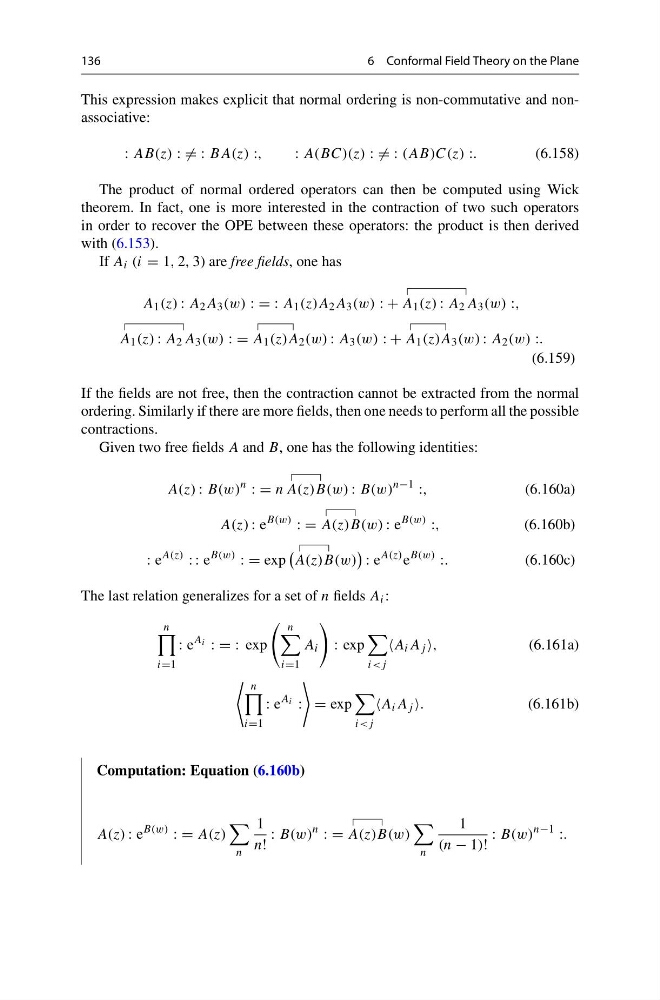
This expression makes explicit that normal ordering is non-commutative and nonassociative:
: AB(z) : = : BA(z) :,
: A(BC)(z) : = : (AB)C(z) :.
(6.158)
The product of normal ordered operators can then be computed using Wick
theorem. In fact, one is more interested in the contraction of two such operators
in order to recover the OPE between these operators: the product is then derived
with (6.153).
If A i (i = 1, 2, 3) are free fields, one has
A 1 (z) : A 2 A 3 (w) : = : A 1 (z)A 2 A 3 (w) : + A 1 (z) : A 2 A 3 (w) :,
A 1 (z) : A 2 A 3 (w) : = A 1 (z)A 2 (w) : A 3 (w) : + A 1 (z)A 3 (w) : A 2 (w) :.
(6.159)
If the fields are not free, then the contraction cannot be extracted from the normal
ordering. Similarly if there are more fields, then one needs to perform all the possible
contractions.
Given two free fields A and B, one has the following identities:
A(z) : B(w)
n
: = n A(z)B(w) : B(w)
n−1
:,
(6.160a)
A(z) : e
B(w)
: = A(z)B(w) : e
B(w)
:,
(6.160b)
: e
A(z)
: : e
B(w)
: = exp
A(z)B(w)
: e
A(z) e
B(w)
:.
(6.160c)
The last relation generalizes for a set of n fields A i :
n
i=1
: e
A i : = : exp
n
i=1
A i
: exp
i
(6.161a)
n
i=1
: e
A i :
= exp
i
(6.161b)
Computation: Equation (6.160b)
A(z) : e
B(w)
: = A(z)
n
1
n!
: B(w)
n
: = A(z)B(w)
n
1
(n − 1)!
: B(w)
n−1
:.
6 Conformal Field Theory on the Plane
This expression makes explicit that normal ordering is non-commutative and nonassociative:
: AB(z) : = : BA(z) :,
: A(BC)(z) : = : (AB)C(z) :.
(6.158)
The product of normal ordered operators can then be computed using Wick
theorem. In fact, one is more interested in the contraction of two such operators
in order to recover the OPE between these operators: the product is then derived
with (6.153).
If A i (i = 1, 2, 3) are free fields, one has
A 1 (z) : A 2 A 3 (w) : = : A 1 (z)A 2 A 3 (w) : + A 1 (z) : A 2 A 3 (w) :,
A 1 (z) : A 2 A 3 (w) : = A 1 (z)A 2 (w) : A 3 (w) : + A 1 (z)A 3 (w) : A 2 (w) :.
(6.159)
If the fields are not free, then the contraction cannot be extracted from the normal
ordering. Similarly if there are more fields, then one needs to perform all the possible
contractions.
Given two free fields A and B, one has the following identities:
A(z) : B(w)
n
: = n A(z)B(w) : B(w)
n−1
:,
(6.160a)
A(z) : e
B(w)
: = A(z)B(w) : e
B(w)
:,
(6.160b)
: e
A(z)
: : e
B(w)
: = exp
A(z)B(w)
: e
A(z) e
B(w)
:.
(6.160c)
The last relation generalizes for a set of n fields A i :
n
i=1
: e
A i : = : exp
n
i=1
A i
: exp
i
(6.161a)
n
i=1
: e
A i :
= exp
i
(6.161b)
Computation: Equation (6.160b)
A(z) : e
B(w)
: = A(z)
n
1
n!
: B(w)
n
: = A(z)B(w)
n
1
(n − 1)!
: B(w)
n−1
:.