

6.4 Operator Formalism and Radial Quantization
135
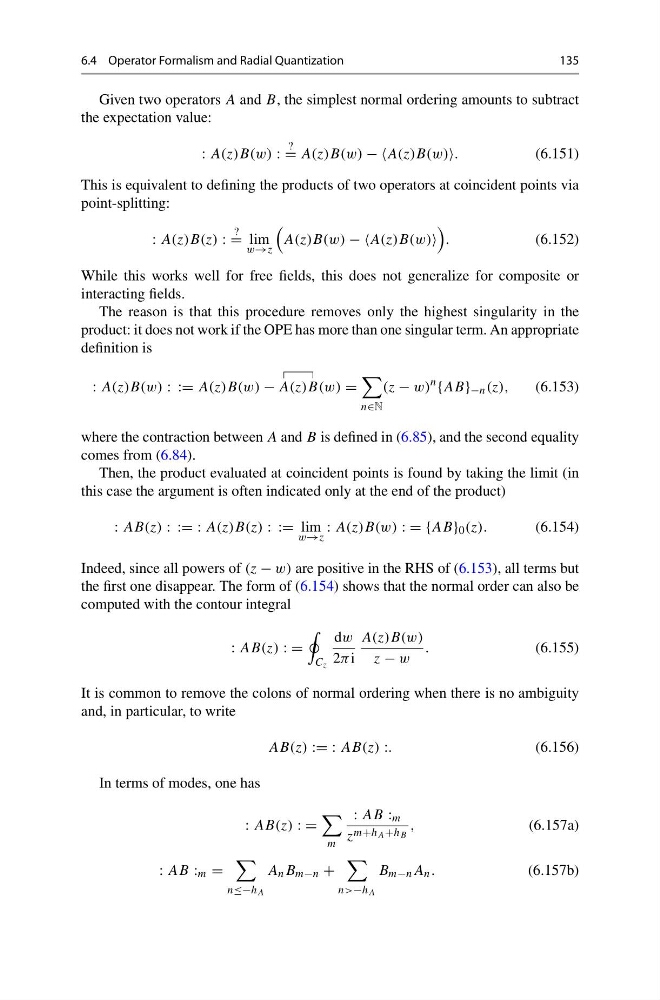
Given two operators A and B, the simplest normal ordering amounts to subtract
the expectation value:
: A(z)B(w) :
?
= A(z)B(w) − −A(z)B(w).
(6.151)
This is equivalent to defining the products of two operators at coincident points via
point-splitting:
: A(z)B(z) :
?
= lim
w→z
A(z)B(w) − −A(z)B(w)
.
(6.152)
While this works well for free fields, this does not generalize for composite or
interacting fields.
The reason is that this procedure removes only the highest singularity in the
product: it does not work if the OPE has more than one singular term. An appropriate
definition is
: A(z)B(w) : := A(z)B(w) − A(z)B(w) =
n∈N
(z − w)
n
{AB} −n (z),
(6.153)
where the contraction between A and B is defined in (6.85), and the second equality
comes from (6.84).
Then, the product evaluated at coincident points is found by taking the limit (in
this case the argument is often indicated only at the end of the product)
: AB(z) : := : A(z)B(z) : := lim
w→z
: A(z)B(w) : = {AB} 0 (z).
(6.154)
Indeed, since all powers of (z − w) are positive in the RHS of (6.153), all terms but
the first one disappear. The form of (6.154) shows that the normal order can also be
computed with the contour integral
: AB(z) : =
C z
dw
2π i
A(z)B(w)
z − w
.
(6.155)
It is common to remove the colons of normal ordering when there is no ambiguity
and, in particular, to write
AB(z) := : AB(z) :.
(6.156)
In terms of modes, one has
: AB(z) : =
m
: AB : m
z m+h A +h B
,
(6.157a)
: AB : m =
n≤−h A
A n B m−n +
n>−h A
B m−n A n .
(6.157b)
135
Given two operators A and B, the simplest normal ordering amounts to subtract
the expectation value:
: A(z)B(w) :
?
= A(z)B(w) − −A(z)B(w).
(6.151)
This is equivalent to defining the products of two operators at coincident points via
point-splitting:
: A(z)B(z) :
?
= lim
w→z
A(z)B(w) − −A(z)B(w)
.
(6.152)
While this works well for free fields, this does not generalize for composite or
interacting fields.
The reason is that this procedure removes only the highest singularity in the
product: it does not work if the OPE has more than one singular term. An appropriate
definition is
: A(z)B(w) : := A(z)B(w) − A(z)B(w) =
n∈N
(z − w)
n
{AB} −n (z),
(6.153)
where the contraction between A and B is defined in (6.85), and the second equality
comes from (6.84).
Then, the product evaluated at coincident points is found by taking the limit (in
this case the argument is often indicated only at the end of the product)
: AB(z) : := : A(z)B(z) : := lim
w→z
: A(z)B(w) : = {AB} 0 (z).
(6.154)
Indeed, since all powers of (z − w) are positive in the RHS of (6.153), all terms but
the first one disappear. The form of (6.154) shows that the normal order can also be
computed with the contour integral
: AB(z) : =
C z
dw
2π i
A(z)B(w)
z − w
.
(6.155)
It is common to remove the colons of normal ordering when there is no ambiguity
and, in particular, to write
AB(z) := : AB(z) :.
(6.156)
In terms of modes, one has
: AB(z) : =
m
: AB : m
z m+h A +h B
,
(6.157a)
: AB : m =
n≤−h A
A n B m−n +
n>−h A
B m−n A n .
(6.157b)