

6.4 Operator Formalism and Radial Quantization
133
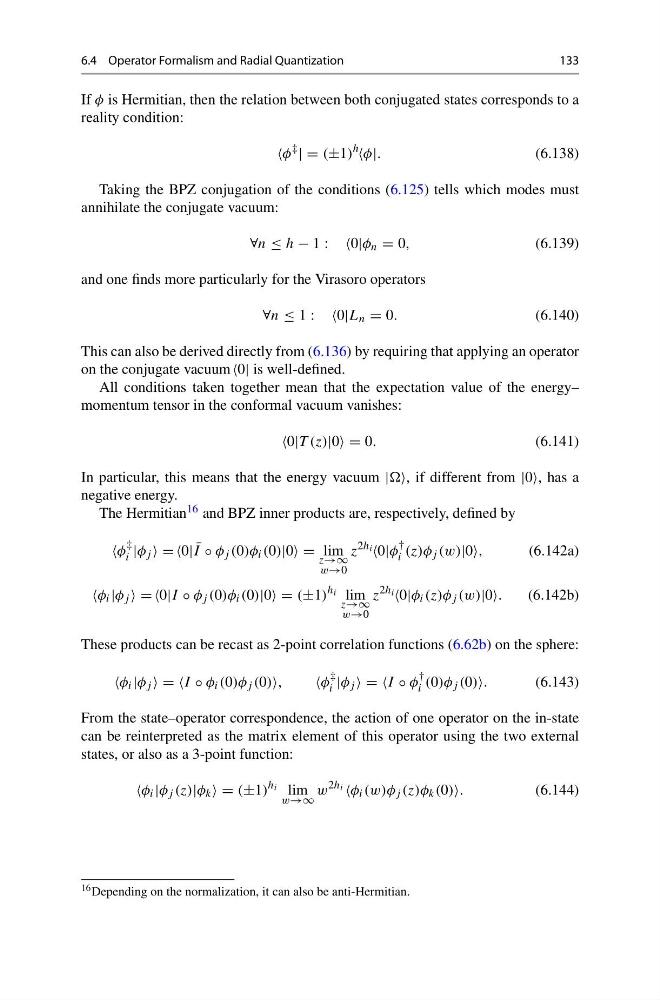
If φ is Hermitian, then the relation between both conjugated states corresponds to a
reality condition:
φ
‡
| = (±1)
h
φ|.
(6.138)
Taking the BPZ conjugation of the conditions (6.125) tells which modes must
annihilate the conjugate vacuum:
∀n ≤ h − 1 : :0|φ n = 0,
(6.139)
and one finds more particularly for the Virasoro operators
∀n ≤ 1 : :0|L n = 0.
(6.140)
This can also be derived directly from (6.136) by requiring that applying an operator
on the conjugate vacuum 0| is well-defined.
All conditions taken together mean that the expectation value of the energy–
momentum tensor in the conformal vacuum vanishes:
0|T (z)|0 = 0.
(6.141)
In particular, this means that the energy vacuum |, if different from |0, has a
negative energy.
The Hermitian 16 and BPZ inner products are, respectively, defined by
φ
‡
i |φ j ==0| ¯
I ◦ φ j (0)φ i (0)|0 = lim
z→∞
w→0
z
2h i 0|φ
†
i (z)φ j (w)|0,
(6.142a)
φ i |φ j ==0|I ◦ φ j (0)φ i (0)|0 = (±1)
h i lim
z→∞
w→0
z
2h i 0|φ i (z)φ j (w)|0.
(6.142b)
These products can be recast as 2-point correlation functions (6.62b) on the sphere:
φ i |φ j = =I ◦ φ i (0)φ j (0),
φ
‡
i |φ j = =I ◦ φ
†
i (0)φ j (0).
(6.143)
From the state–operator correspondence, the action of one operator on the in-state
can be reinterpreted as the matrix element of this operator using the two external
states, or also as a 3-point function:
φ i |φ j (z)|φ k = (±1)
h i lim
w→∞
w
2h i φ i (w)φ j (z)φ k (0).
(6.144)
16 Depending on the normalization, it can also be anti-Hermitian.
133
If φ is Hermitian, then the relation between both conjugated states corresponds to a
reality condition:
φ
‡
| = (±1)
h
φ|.
(6.138)
Taking the BPZ conjugation of the conditions (6.125) tells which modes must
annihilate the conjugate vacuum:
∀n ≤ h − 1 : :0|φ n = 0,
(6.139)
and one finds more particularly for the Virasoro operators
∀n ≤ 1 : :0|L n = 0.
(6.140)
This can also be derived directly from (6.136) by requiring that applying an operator
on the conjugate vacuum 0| is well-defined.
All conditions taken together mean that the expectation value of the energy–
momentum tensor in the conformal vacuum vanishes:
0|T (z)|0 = 0.
(6.141)
In particular, this means that the energy vacuum |, if different from |0, has a
negative energy.
The Hermitian 16 and BPZ inner products are, respectively, defined by
φ
‡
i |φ j ==0| ¯
I ◦ φ j (0)φ i (0)|0 = lim
z→∞
w→0
z
2h i 0|φ
†
i (z)φ j (w)|0,
(6.142a)
φ i |φ j ==0|I ◦ φ j (0)φ i (0)|0 = (±1)
h i lim
z→∞
w→0
z
2h i 0|φ i (z)φ j (w)|0.
(6.142b)
These products can be recast as 2-point correlation functions (6.62b) on the sphere:
φ i |φ j = =I ◦ φ i (0)φ j (0),
φ
‡
i |φ j = =I ◦ φ
†
i (0)φ j (0).
(6.143)
From the state–operator correspondence, the action of one operator on the in-state
can be reinterpreted as the matrix element of this operator using the two external
states, or also as a 3-point function:
φ i |φ j (z)|φ k = (±1)
h i lim
w→∞
w
2h i φ i (w)φ j (z)φ k (0).
(6.144)
16 Depending on the normalization, it can also be anti-Hermitian.