

132
6 Conformal Field Theory on the Plane
since both leave the identity invariant. It is also annihilated by the sl(2, C)
subalgebra:
0|L 0 = 0,
0|L ±1 = 0.
(6.132)
Since there are two kinds of conjugation, two different conjugated states can be
defined. They are also called “out” states since they are located at τ → ∞ on the
cylinder (Fig. 6.2).
Euclidean and BPZ Conjugations and Inner Products
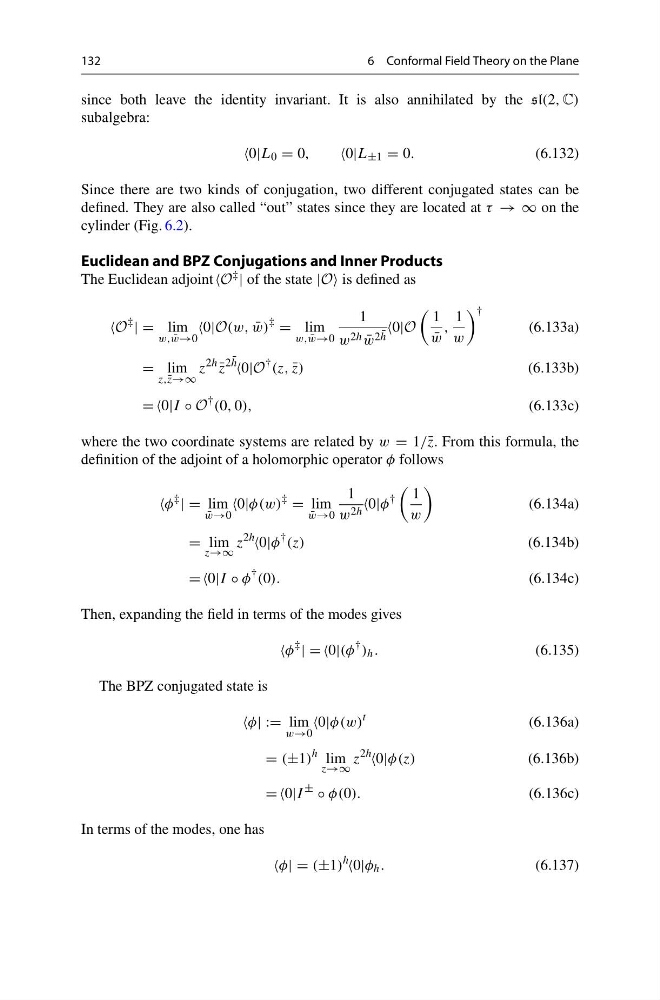
The Euclidean adjoint O ‡ | of the state |O is defined as
O
‡
| = lim
w, ¯
w→0
0|O(w, ¯
w)
‡
= lim
w, ¯
w→0
1
w 2h ¯
w 2 ¯
h
0|O
1
¯
w
,
1
w
†
(6.133a)
= lim
z,¯ z→∞
z
2h
¯
z
2 ¯
h
0|O
† (z, ¯
z)
(6.133b)
= =0|I ◦ O
† (0, 0),
(6.133c)
where the two coordinate systems are related by w = 1/¯ z. From this formula, the
definition of the adjoint of a holomorphic operator φ follows
φ
‡
| = lim
¯
w→0
0|φ(w)
‡
= lim
¯
w→0
1
w 2h 0|φ
†
1
w
(6.134a)
= lim
z→∞
z
2h
0|φ
† (z)
(6.134b)
= =0|I ◦ φ
† (0).
(6.134c)
Then, expanding the field in terms of the modes gives
φ
‡
| ==0|(φ
† ) h .
(6.135)
The BPZ conjugated state is
φ| := lim
w→0
0|φ(w)
t
(6.136a)
= (±1)
h lim
z→∞
z
2h
0|φ(z)
(6.136b)
= =0|I
±
◦ φ(0).
(6.136c)
In terms of the modes, one has
φ| = (±1)
h
0|φ h .
(6.137)
6 Conformal Field Theory on the Plane
since both leave the identity invariant. It is also annihilated by the sl(2, C)
subalgebra:
0|L 0 = 0,
0|L ±1 = 0.
(6.132)
Since there are two kinds of conjugation, two different conjugated states can be
defined. They are also called “out” states since they are located at τ → ∞ on the
cylinder (Fig. 6.2).
Euclidean and BPZ Conjugations and Inner Products
The Euclidean adjoint O ‡ | of the state |O is defined as
O
‡
| = lim
w, ¯
w→0
0|O(w, ¯
w)
‡
= lim
w, ¯
w→0
1
w 2h ¯
w 2 ¯
h
0|O
1
¯
w
,
1
w
†
(6.133a)
= lim
z,¯ z→∞
z
2h
¯
z
2 ¯
h
0|O
† (z, ¯
z)
(6.133b)
= =0|I ◦ O
† (0, 0),
(6.133c)
where the two coordinate systems are related by w = 1/¯ z. From this formula, the
definition of the adjoint of a holomorphic operator φ follows
φ
‡
| = lim
¯
w→0
0|φ(w)
‡
= lim
¯
w→0
1
w 2h 0|φ
†
1
w
(6.134a)
= lim
z→∞
z
2h
0|φ
† (z)
(6.134b)
= =0|I ◦ φ
† (0).
(6.134c)
Then, expanding the field in terms of the modes gives
φ
‡
| ==0|(φ
† ) h .
(6.135)
The BPZ conjugated state is
φ| := lim
w→0
0|φ(w)
t
(6.136a)
= (±1)
h lim
z→∞
z
2h
0|φ(z)
(6.136b)
= =0|I
±
◦ φ(0).
(6.136c)
In terms of the modes, one has
φ| = (±1)
h
0|φ h .
(6.137)