

96
4 Worldsheet Path Integral: Complex Coordinates
4.2
Complex Representation of Path Integral
In the previous section, we have found that tensors of a given rank are naturally
decomposed into different subspaces thanks to the complex structure of the manifold. Accordingly, complex coordinates are natural and one can expect most objects
in string theory to split similarly into holomorphic and anti-holomorphic sectors
(or left- and right-moving). This will be particularly clear using the CFT language
(Chap. 6). The main difficulty for this program is due to the matter zero-modes. In
this section, we focus on the path integral measure and expression of the ghosts.
There is, however, a subtlety in displaying explicitly the factorization: the notion
of “holomorphicity” depends on the metric (because the complex structure must be
compatible with the metric for a Hermitian manifold). Since the metric depends on
the moduli which are integrated over in the path integral, it is not clear that there is
a consistent holomorphic factorization. We will not push the question of achieving
a global factorization further (but see Remark 4.1) to focus instead on the integrand.
The latter is local (in moduli space) and there is no ambiguity.
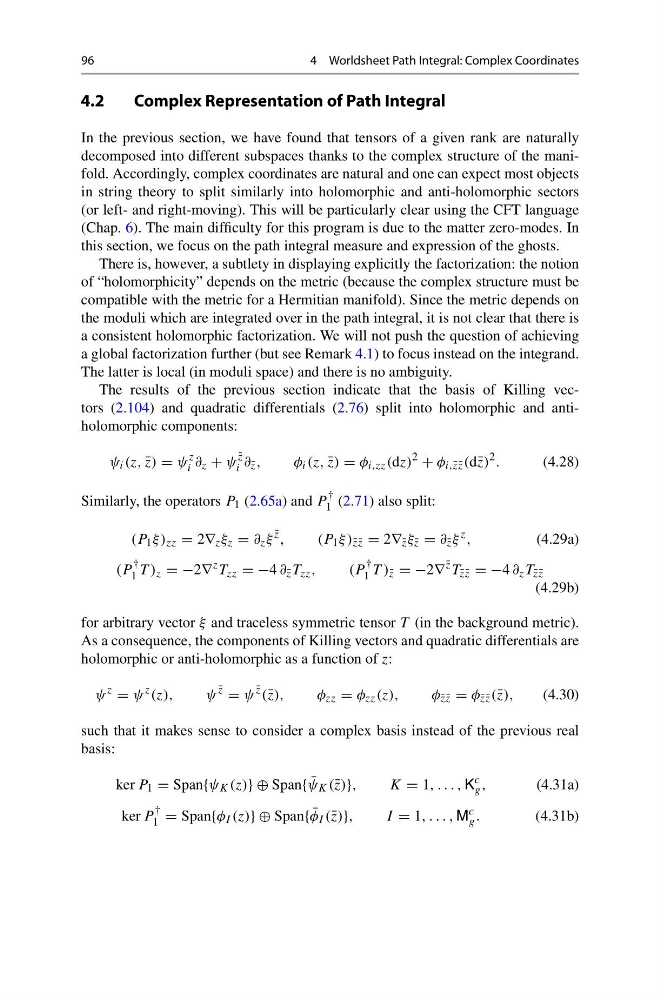
The results of the previous section indicate that the basis of Killing vectors (2.104) and quadratic differentials (2.76) split into holomorphic and antiholomorphic components:
ψ i (z, ¯
z) = ψ
z
i ∂ z + ψ
¯
z
i ∂ ¯
z ,
φ i (z, ¯
z) = φ i,zz (dz)
2
+ φ i,¯ z¯ z (d¯ z)
2 .
(4.28)
Similarly, the operators P 1 (2.65a) and P
†
1 (2.71) also split:
(P 1 ξ) zz = 2∇ z ξ z = ∂ z ξ
¯
z ,
(P 1 ξ) ¯
z¯ z = 2∇ ¯
z ξ ¯
z = ∂ ¯
z ξ
z ,
(4.29a)
(P
†
1 T ) z = −2∇
z T zz = −4 ∂ ¯
z T zz ,
(P
†
1 T ) ¯
z = −2∇
¯
z T ¯
z¯ z = −4 ∂ z T ¯
z¯ z
(4.29b)
for arbitrary vector ξ and traceless symmetric tensor T (in the background metric).
As a consequence, the components of Killing vectors and quadratic differentials are
holomorphic or anti-holomorphic as a function of z:
ψ
z
= ψ
z (z),
ψ
¯
z
= ψ
¯
z (¯ z),
φ zz = φ zz (z),
φ ¯
z¯ z = φ ¯
z¯ z (¯ z),
(4.30)
such that it makes sense to consider a complex basis instead of the previous real
basis:
ker P 1 = Span{ψ K (z)} ⊕ Span{ ¯
ψ K (¯ z)},
K = 1, . . . , K
c
g ,
(4.31a)
ker P
†
1 = Span{φ I (z)} ⊕ Span{ ¯
φ I (¯ z)},
I = 1, . . . , M
c
g .
(4.31b)
4 Worldsheet Path Integral: Complex Coordinates
4.2
Complex Representation of Path Integral
In the previous section, we have found that tensors of a given rank are naturally
decomposed into different subspaces thanks to the complex structure of the manifold. Accordingly, complex coordinates are natural and one can expect most objects
in string theory to split similarly into holomorphic and anti-holomorphic sectors
(or left- and right-moving). This will be particularly clear using the CFT language
(Chap. 6). The main difficulty for this program is due to the matter zero-modes. In
this section, we focus on the path integral measure and expression of the ghosts.
There is, however, a subtlety in displaying explicitly the factorization: the notion
of “holomorphicity” depends on the metric (because the complex structure must be
compatible with the metric for a Hermitian manifold). Since the metric depends on
the moduli which are integrated over in the path integral, it is not clear that there is
a consistent holomorphic factorization. We will not push the question of achieving
a global factorization further (but see Remark 4.1) to focus instead on the integrand.
The latter is local (in moduli space) and there is no ambiguity.
The results of the previous section indicate that the basis of Killing vectors (2.104) and quadratic differentials (2.76) split into holomorphic and antiholomorphic components:
ψ i (z, ¯
z) = ψ
z
i ∂ z + ψ
¯
z
i ∂ ¯
z ,
φ i (z, ¯
z) = φ i,zz (dz)
2
+ φ i,¯ z¯ z (d¯ z)
2 .
(4.28)
Similarly, the operators P 1 (2.65a) and P
†
1 (2.71) also split:
(P 1 ξ) zz = 2∇ z ξ z = ∂ z ξ
¯
z ,
(P 1 ξ) ¯
z¯ z = 2∇ ¯
z ξ ¯
z = ∂ ¯
z ξ
z ,
(4.29a)
(P
†
1 T ) z = −2∇
z T zz = −4 ∂ ¯
z T zz ,
(P
†
1 T ) ¯
z = −2∇
¯
z T ¯
z¯ z = −4 ∂ z T ¯
z¯ z
(4.29b)
for arbitrary vector ξ and traceless symmetric tensor T (in the background metric).
As a consequence, the components of Killing vectors and quadratic differentials are
holomorphic or anti-holomorphic as a function of z:
ψ
z
= ψ
z (z),
ψ
¯
z
= ψ
¯
z (¯ z),
φ zz = φ zz (z),
φ ¯
z¯ z = φ ¯
z¯ z (¯ z),
(4.30)
such that it makes sense to consider a complex basis instead of the previous real
basis:
ker P 1 = Span{ψ K (z)} ⊕ Span{ ¯
ψ K (¯ z)},
K = 1, . . . , K
c
g ,
(4.31a)
ker P
†
1 = Span{φ I (z)} ⊕ Span{ ¯
φ I (¯ z)},
I = 1, . . . , M
c
g .
(4.31b)