

4.1 Geometry of Complex Manifolds
95
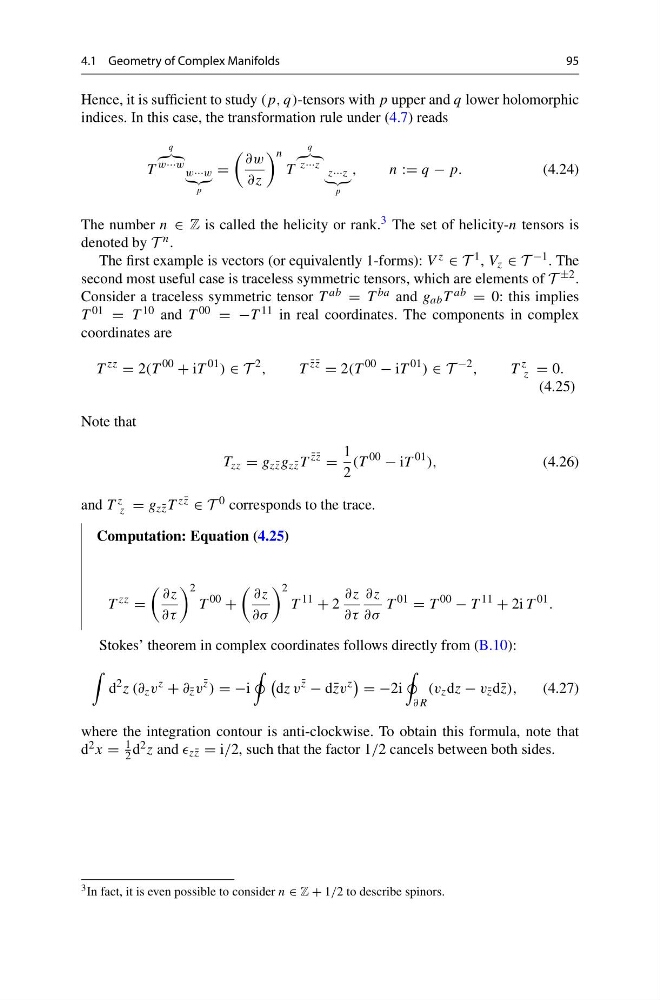
Hence, it is sufficient to study (p, q)-tensors with p upper and q lower holomorphic
indices. In this case, the transformation rule under (4.7) reads
T
q
w···w
w···w
p
=
∂w
∂z
n
T
q
z···z
z···z
p
,
n:= q − p.
(4.24)
The number n ∈ Z is called the helicity or rank. 3 The set of helicity-n tensors is
denoted by T n .
The first example is vectors (or equivalently 1-forms): V z ∈ T 1 , V z ∈ T −1 . The
second most useful case is traceless symmetric tensors, which are elements of T ±2 .
Consider a traceless symmetric tensor T ab = T ba and g ab T ab = 0: this implies
T 01 = T 10 and T 00 = −T 11 in real coordinates. The components in complex
coordinates are
T
zz
= 2(T
00
+ iT
01 ) ∈ T
2 ,
T
¯
z¯ z
= 2(T
00
− iT
01 ) ∈ T
−2 ,
T
z
z = 0.
(4.25)
Note that
T zz = g z¯ z g z¯ z T
¯
z¯ z
=
1
2
(T
00
− iT
01 ),
(4.26)
and T z
z = g z¯ z T z¯ z ∈ T 0 corresponds to the trace.
Computation: Equation (4.25)
T
zz
=
∂z
∂τ
2
T
00
+
∂z
∂σ
2
T
11
+ 2
∂z
∂τ
∂z
∂σ
T
01
= T
00
− T
11
+ 2i T
01 .
Stokes’ theorem in complex coordinates follows directly from (B.10):
d
2 z (∂ z v
z
+ ∂ ¯
z v
¯
z ) = −i
dz v
¯
z
− d¯ zv
z
= −2i
∂R
(v z dz − v ¯
z d¯ z),
(4.27)
where the integration contour is anti-clockwise. To obtain this formula, note that
d 2 x =
1
2 d 2 z and z¯ z = i/2, such that the factor 1/2 cancels between both sides.
3 In fact, it is even possible to consider n ∈ Z + 1/2 to describe spinors.
95
Hence, it is sufficient to study (p, q)-tensors with p upper and q lower holomorphic
indices. In this case, the transformation rule under (4.7) reads
T
q
w···w
w···w
p
=
∂w
∂z
n
T
q
z···z
z···z
p
,
n:= q − p.
(4.24)
The number n ∈ Z is called the helicity or rank. 3 The set of helicity-n tensors is
denoted by T n .
The first example is vectors (or equivalently 1-forms): V z ∈ T 1 , V z ∈ T −1 . The
second most useful case is traceless symmetric tensors, which are elements of T ±2 .
Consider a traceless symmetric tensor T ab = T ba and g ab T ab = 0: this implies
T 01 = T 10 and T 00 = −T 11 in real coordinates. The components in complex
coordinates are
T
zz
= 2(T
00
+ iT
01 ) ∈ T
2 ,
T
¯
z¯ z
= 2(T
00
− iT
01 ) ∈ T
−2 ,
T
z
z = 0.
(4.25)
Note that
T zz = g z¯ z g z¯ z T
¯
z¯ z
=
1
2
(T
00
− iT
01 ),
(4.26)
and T z
z = g z¯ z T z¯ z ∈ T 0 corresponds to the trace.
Computation: Equation (4.25)
T
zz
=
∂z
∂τ
2
T
00
+
∂z
∂σ
2
T
11
+ 2
∂z
∂τ
∂z
∂σ
T
01
= T
00
− T
11
+ 2i T
01 .
Stokes’ theorem in complex coordinates follows directly from (B.10):
d
2 z (∂ z v
z
+ ∂ ¯
z v
¯
z ) = −i
dz v
¯
z
− d¯ zv
z
= −2i
∂R
(v z dz − v ¯
z d¯ z),
(4.27)
where the integration contour is anti-clockwise. To obtain this formula, note that
d 2 x =
1
2 d 2 z and z¯ z = i/2, such that the factor 1/2 cancels between both sides.
3 In fact, it is even possible to consider n ∈ Z + 1/2 to describe spinors.