

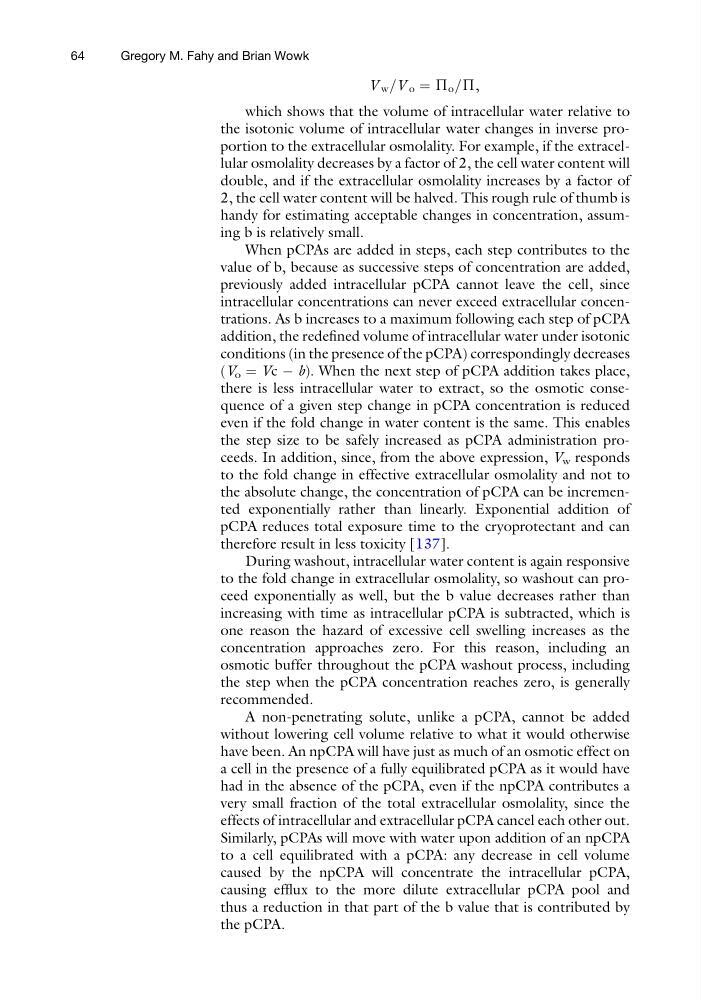
V w =V o ¼ ∏ o =∏,
which shows that the volume of intracellular water relative to
the isotonic volume of intracellular water changes in inverse proportion to the extracellular osmolality. For example, if the extracellular osmolality decreases by a factor of 2, the cell water content will
double, and if the extracellular osmolality increases by a factor of
2, the cell water content will be halved. This rough rule of thumb is
handy for estimating acceptable changes in concentration, assuming b is relatively small.
When pCPAs are added in steps, each step contributes to the
value of b, because as successive steps of concentration are added,
previously added intracellular pCPA cannot leave the cell, since
intracellular concentrations can never exceed extracellular concentrations. As b increases to a maximum following each step of pCPA
addition, the redefined volume of intracellular water under isotonic
conditions (in the presence of the pCPA) correspondingly decreases
(V o ¼ Vc À b). When the next step of pCPA addition takes place,
there is less intracellular water to extract, so the osmotic consequence of a given step change in pCPA concentration is reduced
even if the fold change in water content is the same. This enables
the step size to be safely increased as pCPA administration proceeds. In addition, since, from the above expression, V w responds
to the fold change in effective extracellular osmolality and not to
the absolute change, the concentration of pCPA can be incremented exponentially rather than linearly. Exponential addition of
pCPA reduces total exposure time to the cryoprotectant and can
therefore result in less toxicity [137].
During washout, intracellular water content is again responsive
to the fold change in extracellular osmolality, so washout can proceed exponentially as well, but the b value decreases rather than
increasing with time as intracellular pCPA is subtracted, which is
one reason the hazard of excessive cell swelling increases as the
concentration approaches zero. For this reason, including an
osmotic buffer throughout the pCPA washout process, including
the step when the pCPA concentration reaches zero, is generally
recommended.
A non-penetrating solute, unlike a pCPA, cannot be added
without lowering cell volume relative to what it would otherwise
have been. An npCPA will have just as much of an osmotic effect on
a cell in the presence of a fully equilibrated pCPA as it would have
had in the absence of the pCPA, even if the npCPA contributes a
very small fraction of the total extracellular osmolality, since the
effects of intracellular and extracellular pCPA cancel each other out.
Similarly, pCPAs will move with water upon addition of an npCPA
to a cell equilibrated with a pCPA: any decrease in cell volume
caused by the npCPA will concentrate the intracellular pCPA,
causing efflux to the more dilute extracellular pCPA pool and
thus a reduction in that part of the b value that is contributed by
the pCPA.
64
Gregory M. Fahy and Brian Wowk
which shows that the volume of intracellular water relative to
the isotonic volume of intracellular water changes in inverse proportion to the extracellular osmolality. For example, if the extracellular osmolality decreases by a factor of 2, the cell water content will
double, and if the extracellular osmolality increases by a factor of
2, the cell water content will be halved. This rough rule of thumb is
handy for estimating acceptable changes in concentration, assuming b is relatively small.
When pCPAs are added in steps, each step contributes to the
value of b, because as successive steps of concentration are added,
previously added intracellular pCPA cannot leave the cell, since
intracellular concentrations can never exceed extracellular concentrations. As b increases to a maximum following each step of pCPA
addition, the redefined volume of intracellular water under isotonic
conditions (in the presence of the pCPA) correspondingly decreases
(V o ¼ Vc À b). When the next step of pCPA addition takes place,
there is less intracellular water to extract, so the osmotic consequence of a given step change in pCPA concentration is reduced
even if the fold change in water content is the same. This enables
the step size to be safely increased as pCPA administration proceeds. In addition, since, from the above expression, V w responds
to the fold change in effective extracellular osmolality and not to
the absolute change, the concentration of pCPA can be incremented exponentially rather than linearly. Exponential addition of
pCPA reduces total exposure time to the cryoprotectant and can
therefore result in less toxicity [137].
During washout, intracellular water content is again responsive
to the fold change in extracellular osmolality, so washout can proceed exponentially as well, but the b value decreases rather than
increasing with time as intracellular pCPA is subtracted, which is
one reason the hazard of excessive cell swelling increases as the
concentration approaches zero. For this reason, including an
osmotic buffer throughout the pCPA washout process, including
the step when the pCPA concentration reaches zero, is generally
recommended.
A non-penetrating solute, unlike a pCPA, cannot be added
without lowering cell volume relative to what it would otherwise
have been. An npCPA will have just as much of an osmotic effect on
a cell in the presence of a fully equilibrated pCPA as it would have
had in the absence of the pCPA, even if the npCPA contributes a
very small fraction of the total extracellular osmolality, since the
effects of intracellular and extracellular pCPA cancel each other out.
Similarly, pCPAs will move with water upon addition of an npCPA
to a cell equilibrated with a pCPA: any decrease in cell volume
caused by the npCPA will concentrate the intracellular pCPA,
causing efflux to the more dilute extracellular pCPA pool and
thus a reduction in that part of the b value that is contributed by
the pCPA.
64
Gregory M. Fahy and Brian Wowk