

concentrated [60, 105, 202], but this strategy will not be
completely efficient if the carrier solution has been diluted during
the shrinkage phase. The third reason it is important to understand
how to adjust tonicity in the presence of CPAs is that chilling injury
and its avoidance or minimization can depend on the effective
tonicity of the vitrification solution [23].
When the extracellular pCPA concentration is diluted, extracellular water at first enters the cell down its concentration gradient,
causing the cell to swell. Over time, as the pCPA in the cell diffuses
to the extracellular space, the cell water concentration increases,
now causing water to flow out of the cell to maintain equilibrium,
and the cell volume begins to return back toward normal. Eventually, if the extracellular carrier solution is isotonic (unchanged in
molarity from its molarity in the absence of pCPA), the cell will in
principle return to its original volume. This “swell-shrink”
sequence is the reverse of the “shrink-swell” behavior observed
during pCPA administration.
Although cells can be damaged by either excessive shrinkage or
excessive swelling, cells can generally withstand about a fourfold
increase in extracellular osmolality but only around a twofold
decrease in extracellular osmolality (the “osmotic limits” of the
cell) [287] because cells can in general survive a smaller fold-change
increase in their volumes than their tolerated fold-change decrease
in volume. This means that a given fold change in extracellular
concentration is more hazardous during the removal of pCPA
than during its introduction. To offset cell swelling during pCPA
removal, a non-penetrating agent such as mannitol, sucrose, or
trehalose (an osmolyte) can be included in the carrier solution to
increase the effective osmolality of the extracellular medium and
thus reduce, to some extent, the change in transmembrane osmolality caused by dilution of the pCPA, thus limiting the extent of cell
swelling [287]. Used in this way, extracellular osmolytes are sometimes referred to as “osmotic buffers.”
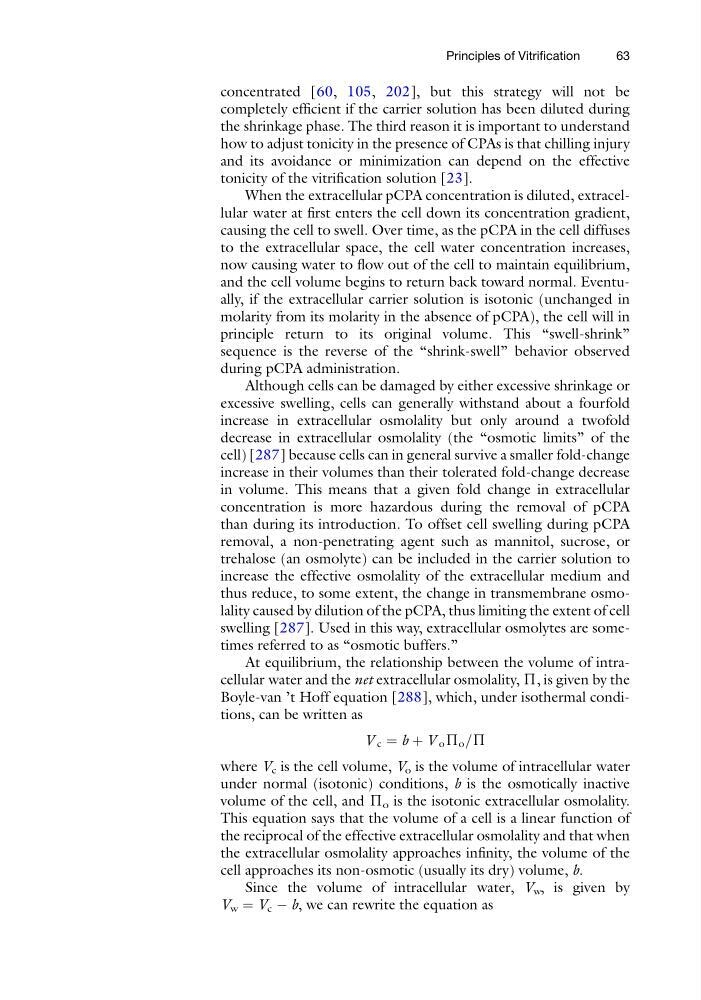
At equilibrium, the relationship between the volume of intracellular water and the net extracellular osmolality, ∏, is given by the
Boyle-van ’t Hoff equation [288], which, under isothermal conditions, can be written as
V c ¼ b þ V o ∏ o =∏
where V c is the cell volume, V o is the volume of intracellular water
under normal (isotonic) conditions, b is the osmotically inactive
volume of the cell, and ∏ o is the isotonic extracellular osmolality.
This equation says that the volume of a cell is a linear function of
the reciprocal of the effective extracellular osmolality and that when
the extracellular osmolality approaches infinity, the volume of the
cell approaches its non-osmotic (usually its dry) volume, b.
Since the volume of intracellular water, V w , is given by
V w ¼ V c À b, we can rewrite the equation as
Principles of Vitrification
63
completely efficient if the carrier solution has been diluted during
the shrinkage phase. The third reason it is important to understand
how to adjust tonicity in the presence of CPAs is that chilling injury
and its avoidance or minimization can depend on the effective
tonicity of the vitrification solution [23].
When the extracellular pCPA concentration is diluted, extracellular water at first enters the cell down its concentration gradient,
causing the cell to swell. Over time, as the pCPA in the cell diffuses
to the extracellular space, the cell water concentration increases,
now causing water to flow out of the cell to maintain equilibrium,
and the cell volume begins to return back toward normal. Eventually, if the extracellular carrier solution is isotonic (unchanged in
molarity from its molarity in the absence of pCPA), the cell will in
principle return to its original volume. This “swell-shrink”
sequence is the reverse of the “shrink-swell” behavior observed
during pCPA administration.
Although cells can be damaged by either excessive shrinkage or
excessive swelling, cells can generally withstand about a fourfold
increase in extracellular osmolality but only around a twofold
decrease in extracellular osmolality (the “osmotic limits” of the
cell) [287] because cells can in general survive a smaller fold-change
increase in their volumes than their tolerated fold-change decrease
in volume. This means that a given fold change in extracellular
concentration is more hazardous during the removal of pCPA
than during its introduction. To offset cell swelling during pCPA
removal, a non-penetrating agent such as mannitol, sucrose, or
trehalose (an osmolyte) can be included in the carrier solution to
increase the effective osmolality of the extracellular medium and
thus reduce, to some extent, the change in transmembrane osmolality caused by dilution of the pCPA, thus limiting the extent of cell
swelling [287]. Used in this way, extracellular osmolytes are sometimes referred to as “osmotic buffers.”
At equilibrium, the relationship between the volume of intracellular water and the net extracellular osmolality, ∏, is given by the
Boyle-van ’t Hoff equation [288], which, under isothermal conditions, can be written as
V c ¼ b þ V o ∏ o =∏
where V c is the cell volume, V o is the volume of intracellular water
under normal (isotonic) conditions, b is the osmotically inactive
volume of the cell, and ∏ o is the isotonic extracellular osmolality.
This equation says that the volume of a cell is a linear function of
the reciprocal of the effective extracellular osmolality and that when
the extracellular osmolality approaches infinity, the volume of the
cell approaches its non-osmotic (usually its dry) volume, b.
Since the volume of intracellular water, V w , is given by
V w ¼ V c À b, we can rewrite the equation as
Principles of Vitrification
63