

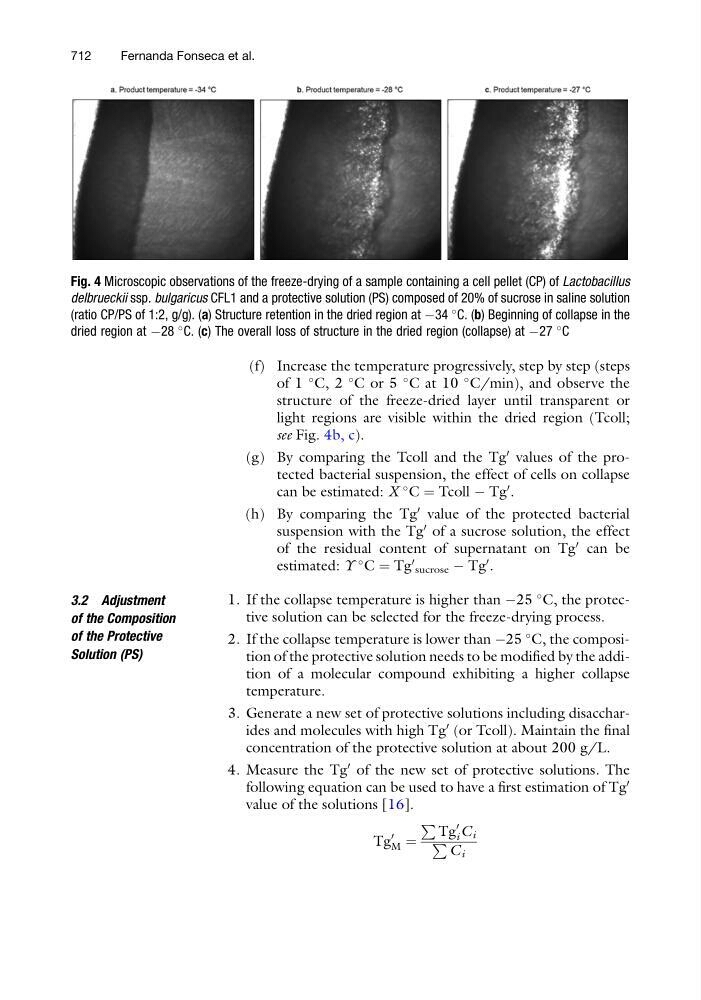
(f) Increase the temperature progressively, step by step (steps
of 1
C, 2
C or 5
C at 10
C/min), and observe the
structure of the freeze-dried layer until transparent or
light regions are visible within the dried region (Tcoll;
see Fig. 4b, c).
(g) By comparing the Tcoll and the Tg
0 values of the protected bacterial suspension, the effect of cells on collapse
can be estimated: X
C ¼ Tcoll À Tg
0 .
(h) By comparing the Tg
0 value of the protected bacterial
suspension with the Tg
0 of a sucrose solution, the effect
of the residual content of supernatant on Tg
0 can be
estimated: Y
C ¼ Tg
0
sucrose À Tg
0 .
3.2 Adjustment
of the Composition
of the Protective
Solution (PS)
1. If the collapse temperature is higher than À25
C, the protective solution can be selected for the freeze-drying process.
2. If the collapse temperature is lower than À25
C, the composition of the protective solution needs to be modified by the addition of a molecular compound exhibiting a higher collapse
temperature.
3. Generate a new set of protective solutions including disaccharides and molecules with high Tg
0 (or Tcoll). Maintain the final
concentration of the protective solution at about 200 g/L.
4. Measure the Tg
0 of the new set of protective solutions. The
following equation can be used to have a first estimation of Tg
0
value of the solutions [16].
Tg
0
M ¼
P
Tg
0
i C i
P
C i
Fig. 4 Microscopic observations of the freeze-drying of a sample containing a cell pellet (CP) of Lactobacillus
delbrueckii ssp. bulgaricus CFL1 and a protective solution (PS) composed of 20% of sucrose in saline solution
(ratio CP/PS of 1:2, g/g). (a) Structure retention in the dried region at À34
C. (b) Beginning of collapse in the
dried region at À28
C. (c) The overall loss of structure in the dried region (collapse) at À27
C
712
Fernanda Fonseca et al.