

quite high, desorption of bound water requires a higher temperature and sufficient heat. The temperature should not be
too high to avoid protein denaturation.
14. For protein pharmaceuticals, the maximum allowable temperature should generally be lower than 40
C. For food products,
such as meats, fruits, and vegetables, the maximum permissible
temperature may be 60–70
C or higher.
15. At the end of the desorption process, the sample reaches its
remaining moisture final (RMF). The optimum residual water
content of dried proteins should be determined on a case-bycase basis. If the RMF is too high or too low, this can be
detrimental to the protein. An RMF that is too high may result
in degradation during storage. On the other hand, if the RMF
is too low, this can also harm the active material [13]. The
samples need to be kept at an optimum water content to
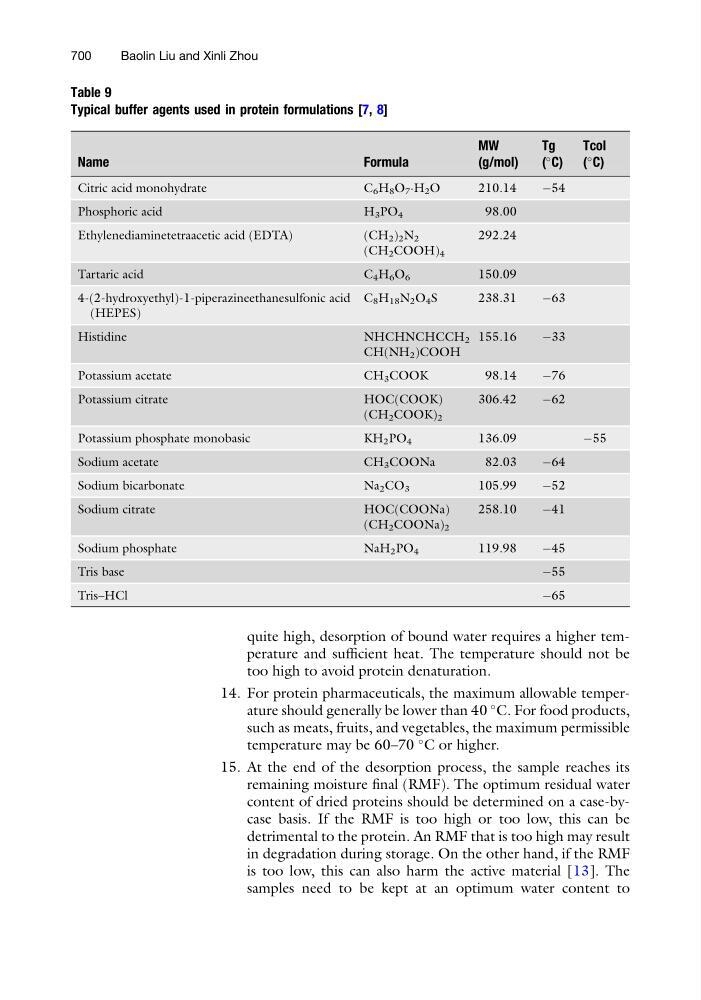
Table 9
Typical buffer agents used in protein formulations [7, 8]
Name
Formula
MW
(g/mol)
Tg
(
C)
Tcol
(
C)
Citric acid monohydrate
C 6 H 8 O 7 ·H 2 O
210.14
À54
Phosphoric acid
H 3 PO 4
98.00
Ethylenediaminetetraacetic acid (EDTA)
(CH 2 ) 2 N 2
(CH 2 COOH) 4
292.24
Tartaric acid
C 4 H 6 O 6
150.09
4-(2-hydroxyethyl)-1-piperazineethanesulfonic acid
(HEPES)
C 8 H 18 N 2 O 4 S
238.31
À63
Histidine
NHCHNCHCCH 2
CH(NH 2 )COOH
155.16
À33
Potassium acetate
CH 3 COOK
98.14
À76
Potassium citrate
HOC(COOK)
(CH 2 COOK) 2
306.42
À62
Potassium phosphate monobasic
KH 2 PO 4
136.09
À55
Sodium acetate
CH 3 COONa
82.03
À64
Sodium bicarbonate
Na 2 CO 3
105.99
À52
Sodium citrate
HOC(COONa)
(CH 2 COONa) 2
258.10
À41
Sodium phosphate
NaH 2 PO 4
119.98
À45
Tris base
À55
Tris–HCl
À65
700
Baolin Liu and Xinli Zhou