

sample after the freezing step should be lower than the eutectic
temperature, Te, or the glass transition temperature, Tg (see
Fig. 1).
11. As shown in Fig. 1, the highest permissible temperature, Tmax,
is the glass transition temperature Tg or the eutectic temperature Te. If the sublimation temperature is too high, the material will appear as softened or collapsed.
12. Two basic conditions must be satisfied to assure the progress of
the sublimation process: the vapor must be moved away
unceasingly from the sublimation interface; and heat must be
provided for sublimation. If either of the two is not met,
softening, thawing, bulging, or collapse may occur. In fact
sublimation is a process where heat and mass transfer simultaneously take place. Only when the heat that is transferred to the
interface of sublimation is equal to the heat needed for the
vapor to escape from the interface, sublimation carries on
smoothly.
13. At the end of primary drying, there is still unfrozen water
adsorbed on the porous structure surface and on the polar
groups of the proteins. Secondary drying is conducted at a
higher temperature, so that the bound unfrozen water absorbs
the heat of desorption and becomes free water. Then the free
water absorbs the heat needed for evaporation and finally turns
into vapor escaping the material. Since the adsorption energy is
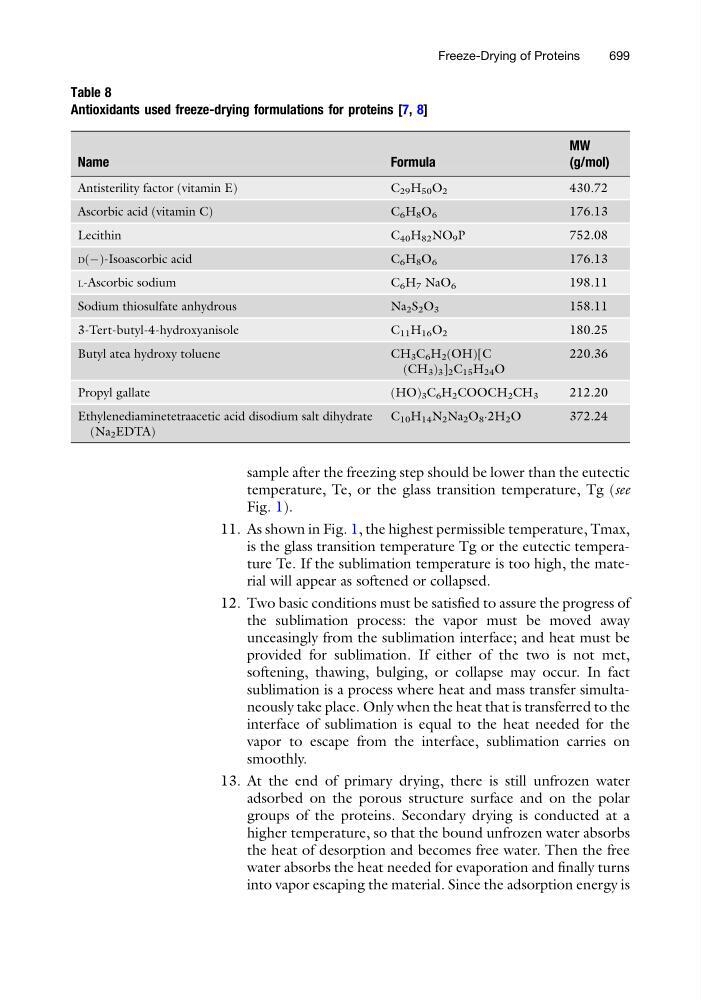
Table 8
Antioxidants used freeze-drying formulations for proteins [7, 8]
Name
Formula
MW
(g/mol)
Antisterility factor (vitamin E)
C 29 H 50 O 2
430.72
Ascorbic acid (vitamin C)
C 6 H 8 O 6
176.13
Lecithin
C 40 H 82 NO 9 P
752.08
D(À)-Isoascorbic acid
C 6 H 8 O 6
176.13
L-Ascorbic sodium
C 6 H 7 NaO 6
198.11
Sodium thiosulfate anhydrous
Na 2 S 2 O 3
158.11
3-Tert-butyl-4-hydroxyanisole
C 11 H 16 O 2
180.25
Butyl atea hydroxy toluene
CH 3 C 6 H 2 (OH)[C
(CH 3 ) 3 ] 2 C 15 H 24 O
220.36
Propyl gallate
(HO) 3 C 6 H 2 COOCH 2 CH 3
212.20
Ethylenediaminetetraacetic acid disodium salt dihydrate
(Na 2 EDTA)
C 10 H 14 N 2 Na 2 O 8 ·2H 2 O
372.24
Freeze-Drying of Proteins
699