

(d) Increase viscosity of the solution.
(e) Increase the glass transition temperature significantly.
(f) Restrain crystallization of excipients with small molecules
(e.g., sucrose).
(g) Keep the pH value of solutions.
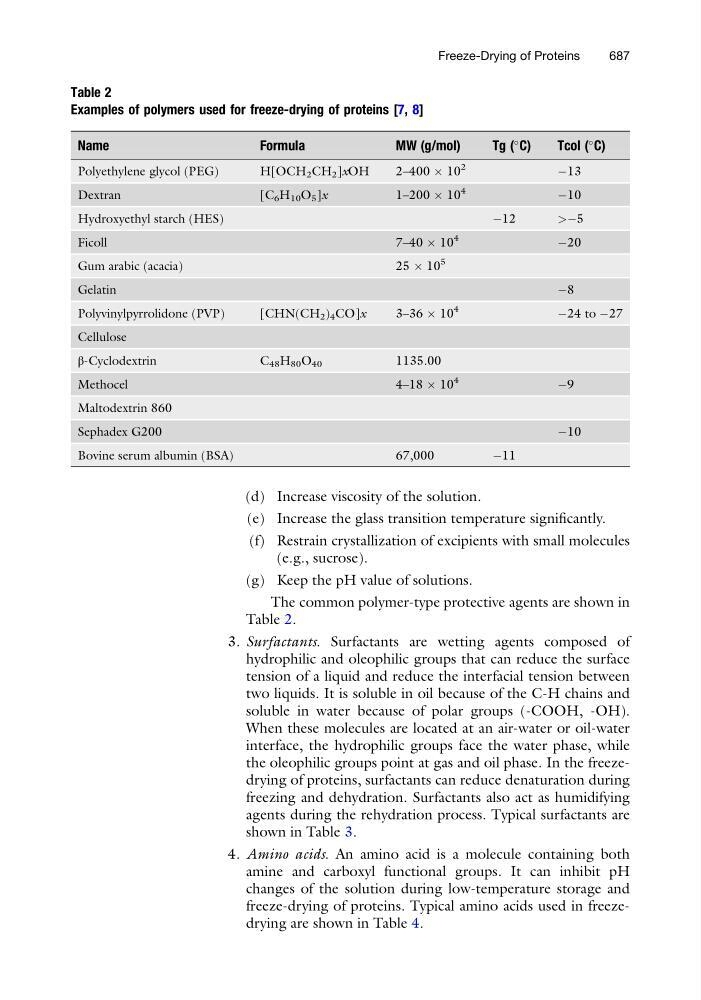
The common polymer-type protective agents are shown in
Table 2.
3. Surfactants. Surfactants are wetting agents composed of
hydrophilic and oleophilic groups that can reduce the surface
tension of a liquid and reduce the interfacial tension between
two liquids. It is soluble in oil because of the C-H chains and
soluble in water because of polar groups (-COOH, -OH).
When these molecules are located at an air-water or oil-water
interface, the hydrophilic groups face the water phase, while
the oleophilic groups point at gas and oil phase. In the freezedrying of proteins, surfactants can reduce denaturation during
freezing and dehydration. Surfactants also act as humidifying
agents during the rehydration process. Typical surfactants are
shown in Table 3.
4. Amino acids. An amino acid is a molecule containing both
amine and carboxyl functional groups. It can inhibit pH
changes of the solution during low-temperature storage and
freeze-drying of proteins. Typical amino acids used in freezedrying are shown in Table 4.
Table 2
Examples of polymers used for freeze-drying of proteins [7, 8]
Name
Formula
MW (g/mol)
Tg (
C)
Tcol (
C)
Polyethylene glycol (PEG)
H[OCH 2 CH 2 ]xOH
2–400 Â 10
2
À13
Dextran
[C 6 H 10 O 5 ]x
1–200 Â 10
4
À10
Hydroxyethyl starch (HES)
À12
>À5
Ficoll
7–40 Â 10
4
À20
Gum arabic (acacia)
25 Â 10
5
Gelatin
À8
Polyvinylpyrrolidone (PVP)
[CHN(CH 2 ) 4 CO]x
3–36 Â 10
4
À24 to À27
Cellulose
β-Cyclodextrin
C 48 H 80 O 40
1135.00
Methocel
4–18 Â 10
4
À9
Maltodextrin 860
Sephadex G200
À10
Bovine serum albumin (BSA)
67,000
À11
Freeze-Drying of Proteins
687