

1.3 Stabilizers for
Cryo- and
Lyoprotection of
Protein
To protect a protein from freezing (cryoprotection) and/or dehydration (lyoprotection) damage, protein stabilizers may be used.
1. Sugars/polyols. Sugar and polyol have similar protective
mechanisms because they have the same functional groups
(hydroxyls). When they are added to the protein formulation,
the hydroxyl groups in the stabilizers can form hydrogen bonds
to the surface of protein molecule as water does, and “substitute” for the hydrogen-bonding interaction with water that is
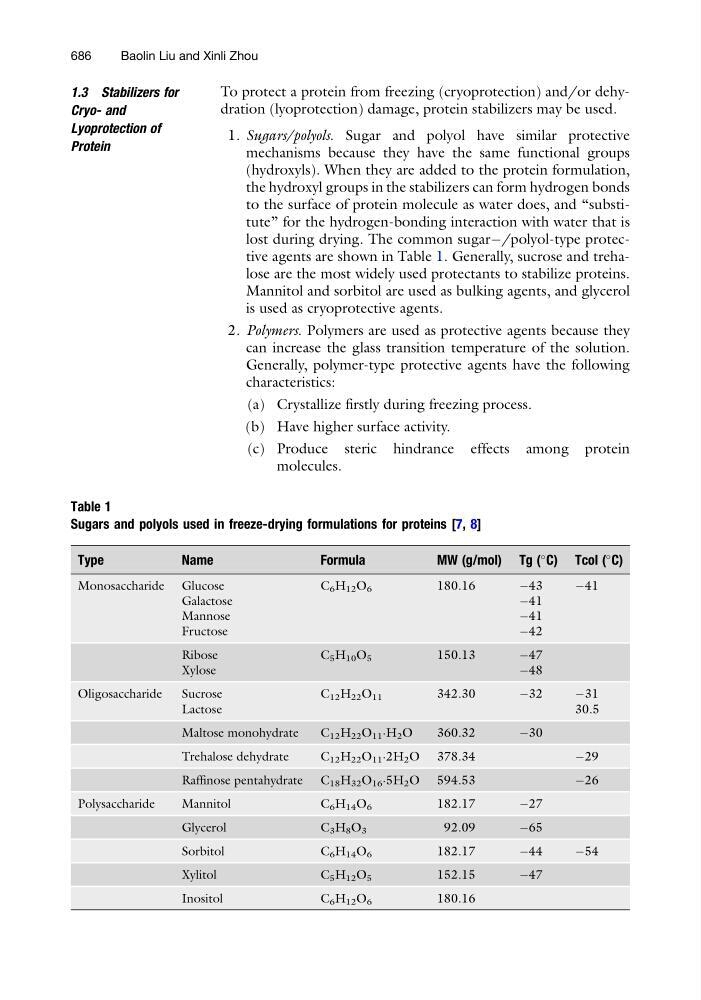
lost during drying. The common sugarÀ/polyol-type protective agents are shown in Table 1. Generally, sucrose and trehalose are the most widely used protectants to stabilize proteins.
Mannitol and sorbitol are used as bulking agents, and glycerol
is used as cryoprotective agents.
2. Polymers. Polymers are used as protective agents because they
can increase the glass transition temperature of the solution.
Generally, polymer-type protective agents have the following
characteristics:
(a) Crystallize firstly during freezing process.
(b) Have higher surface activity.
(c) Produce steric hindrance effects among protein
molecules.
Table 1
Sugars and polyols used in freeze-drying formulations for proteins [7, 8]
Type
Name
Formula
MW (g/mol) Tg (
C) Tcol (
C)
Monosaccharide Glucose
Galactose
Mannose
Fructose
C 6 H 12 O 6
180.16
À43
À41
À41
À42
À41
Ribose
Xylose
C 5 H 10 O 5
150.13
À47
À48
Oligosaccharide
Sucrose
Lactose
C 12 H 22 O 11
342.30
À32
À31
30.5
Maltose monohydrate
C 12 H 22 O 11 ·H 2 O
360.32
À30
Trehalose dehydrate
C 12 H 22 O 11 ·2H 2 O 378.34
À29
Raffinose pentahydrate C 18 H 32 O 16 ·5H 2 O 594.53
À26
Polysaccharide
Mannitol
C 6 H 14 O 6
182.17
À27
Glycerol
C 3 H 8 O 3
92.09
À65
Sorbitol
C 6 H 14 O 6
182.17
À44
À54
Xylitol
C 5 H 12 O 5
152.15
À47
Inositol
C 6 H 12 O 6
180.16
686
Baolin Liu and Xinli Zhou