

after cooling to below the glass transition temperature. Devitrification manifests as an exothermic peak centered at temperature T d
followed by an endothermic ice melting peak at temperature T m .
When T m and T d are expressed in kelvins, Boutron showed that T d /
T m ¼ 0.95 if approximately 0.5% of the sample mass devitrifies as ice
[40]. The warming rate at which this happens, or is extrapolated to
happen, can be regarded as a critical warming rate.
The nucleation [233] and growth [234] rates of ice in vitrification solutions are also dependent on the carrier solution. Carrier
solutions based on NaCl, which include many typical culture
media, have minimal effects, but carrier solutions based on sugars,
which displace more water and have a stronger effect on solution
viscosity, are comparable in effect to CPAs, gram for gram, in
increasing vitrification tendency and reducing the critical warming
rate [89, 233].
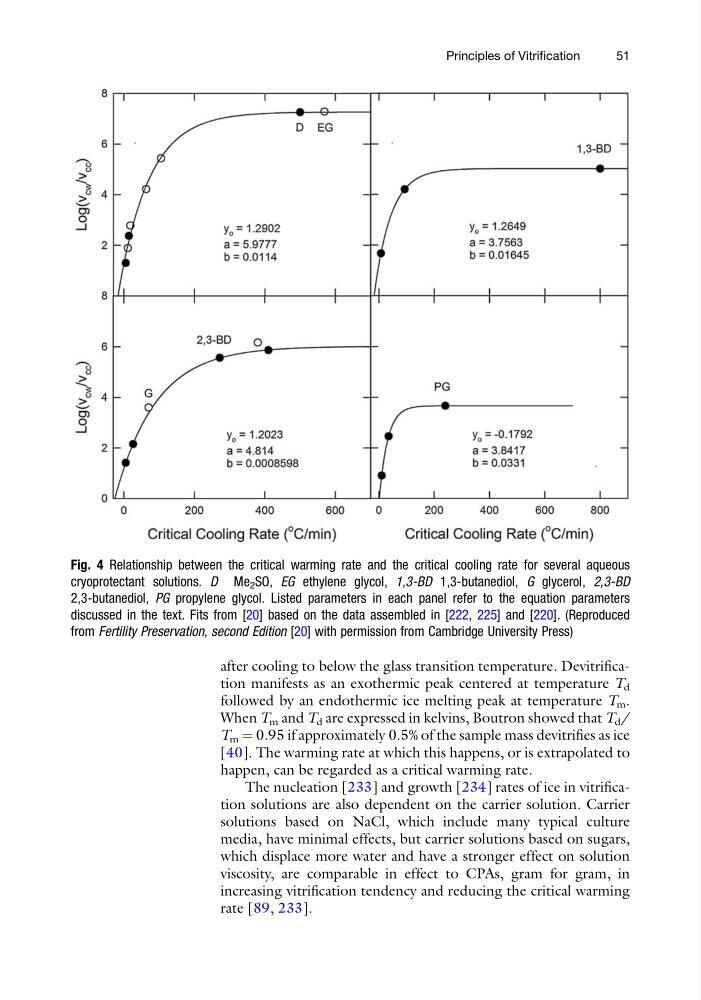
Fig. 4 Relationship between the critical warming rate and the critical cooling rate for several aqueous
cryoprotectant solutions. D Me 2 SO, EG ethylene glycol, 1,3-BD 1,3-butanediol, G glycerol, 2,3-BD
2,3-butanediol, PG propylene glycol. Listed parameters in each panel refer to the equation parameters
discussed in the text. Fits from [20] based on the data assembled in [222, 225] and [220]. (Reproduced
from Fertility Preservation, second Edition [20] with permission from Cambridge University Press)
Principles of Vitrification
51
followed by an endothermic ice melting peak at temperature T m .
When T m and T d are expressed in kelvins, Boutron showed that T d /
T m ¼ 0.95 if approximately 0.5% of the sample mass devitrifies as ice
[40]. The warming rate at which this happens, or is extrapolated to
happen, can be regarded as a critical warming rate.
The nucleation [233] and growth [234] rates of ice in vitrification solutions are also dependent on the carrier solution. Carrier
solutions based on NaCl, which include many typical culture
media, have minimal effects, but carrier solutions based on sugars,
which displace more water and have a stronger effect on solution
viscosity, are comparable in effect to CPAs, gram for gram, in
increasing vitrification tendency and reducing the critical warming
rate [89, 233].
Fig. 4 Relationship between the critical warming rate and the critical cooling rate for several aqueous
cryoprotectant solutions. D Me 2 SO, EG ethylene glycol, 1,3-BD 1,3-butanediol, G glycerol, 2,3-BD
2,3-butanediol, PG propylene glycol. Listed parameters in each panel refer to the equation parameters
discussed in the text. Fits from [20] based on the data assembled in [222, 225] and [220]. (Reproduced
from Fertility Preservation, second Edition [20] with permission from Cambridge University Press)
Principles of Vitrification
51