

during a rapid warming scan [221]. Under these conditions, the
amount of ice that melts will equal the amount of ice that formed
during slow cooling, and rapid warming is appropriate because
faster DSC scans have higher sensitivity.
The critical cooling rate required for successful vitrification of
living systems can be calculated from k4 and q max . In this case, the
cooling rate can be defined as the cooling rate sufficient to reduce
x to whatever any particular living system can tolerate. In the limit
of low x, which is the limit of interest for vitrification, the above
equation becomes simplified. If x ¼ 10
À6 , for example, then the
equation reduces to the following [220].
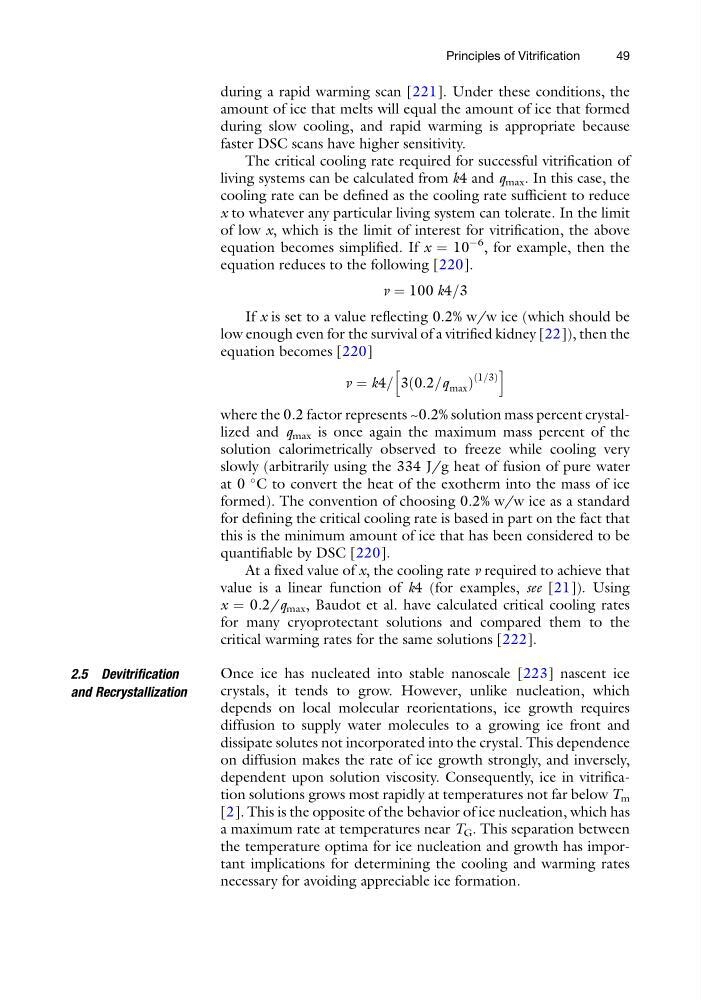
v ¼ 100 k4=3
If x is set to a value reflecting 0.2% w/w ice (which should be
low enough even for the survival of a vitrified kidney [22]), then the
equation becomes [220]
v ¼ k4= 3 0:2=q max
ð
Þ
1=3
ð
Þ
h
i
where the 0.2 factor represents ~0.2% solution mass percent crystallized and q max is once again the maximum mass percent of the
solution calorimetrically observed to freeze while cooling very
slowly (arbitrarily using the 334 J/g heat of fusion of pure water
at 0
C to convert the heat of the exotherm into the mass of ice
formed). The convention of choosing 0.2% w/w ice as a standard
for defining the critical cooling rate is based in part on the fact that
this is the minimum amount of ice that has been considered to be
quantifiable by DSC [220].
At a fixed value of x, the cooling rate v required to achieve that
value is a linear function of k4 (for examples, see [21]). Using
x ¼ 0.2/q max , Baudot et al. have calculated critical cooling rates
for many cryoprotectant solutions and compared them to the
critical warming rates for the same solutions [222].
2.5 Devitrification
and Recrystallization
Once ice has nucleated into stable nanoscale [223] nascent ice
crystals, it tends to grow. However, unlike nucleation, which
depends on local molecular reorientations, ice growth requires
diffusion to supply water molecules to a growing ice front and
dissipate solutes not incorporated into the crystal. This dependence
on diffusion makes the rate of ice growth strongly, and inversely,
dependent upon solution viscosity. Consequently, ice in vitrification solutions grows most rapidly at temperatures not far below T m
[2]. This is the opposite of the behavior of ice nucleation, which has
a maximum rate at temperatures near T G . This separation between
the temperature optima for ice nucleation and growth has important implications for determining the cooling and warming rates
necessary for avoiding appreciable ice formation.
Principles of Vitrification
49
amount of ice that melts will equal the amount of ice that formed
during slow cooling, and rapid warming is appropriate because
faster DSC scans have higher sensitivity.
The critical cooling rate required for successful vitrification of
living systems can be calculated from k4 and q max . In this case, the
cooling rate can be defined as the cooling rate sufficient to reduce
x to whatever any particular living system can tolerate. In the limit
of low x, which is the limit of interest for vitrification, the above
equation becomes simplified. If x ¼ 10
À6 , for example, then the
equation reduces to the following [220].
v ¼ 100 k4=3
If x is set to a value reflecting 0.2% w/w ice (which should be
low enough even for the survival of a vitrified kidney [22]), then the
equation becomes [220]
v ¼ k4= 3 0:2=q max
ð
Þ
1=3
ð
Þ
h
i
where the 0.2 factor represents ~0.2% solution mass percent crystallized and q max is once again the maximum mass percent of the
solution calorimetrically observed to freeze while cooling very
slowly (arbitrarily using the 334 J/g heat of fusion of pure water
at 0
C to convert the heat of the exotherm into the mass of ice
formed). The convention of choosing 0.2% w/w ice as a standard
for defining the critical cooling rate is based in part on the fact that
this is the minimum amount of ice that has been considered to be
quantifiable by DSC [220].
At a fixed value of x, the cooling rate v required to achieve that
value is a linear function of k4 (for examples, see [21]). Using
x ¼ 0.2/q max , Baudot et al. have calculated critical cooling rates
for many cryoprotectant solutions and compared them to the
critical warming rates for the same solutions [222].
2.5 Devitrification
and Recrystallization
Once ice has nucleated into stable nanoscale [223] nascent ice
crystals, it tends to grow. However, unlike nucleation, which
depends on local molecular reorientations, ice growth requires
diffusion to supply water molecules to a growing ice front and
dissipate solutes not incorporated into the crystal. This dependence
on diffusion makes the rate of ice growth strongly, and inversely,
dependent upon solution viscosity. Consequently, ice in vitrification solutions grows most rapidly at temperatures not far below T m
[2]. This is the opposite of the behavior of ice nucleation, which has
a maximum rate at temperatures near T G . This separation between
the temperature optima for ice nucleation and growth has important implications for determining the cooling and warming rates
necessary for avoiding appreciable ice formation.
Principles of Vitrification
49