

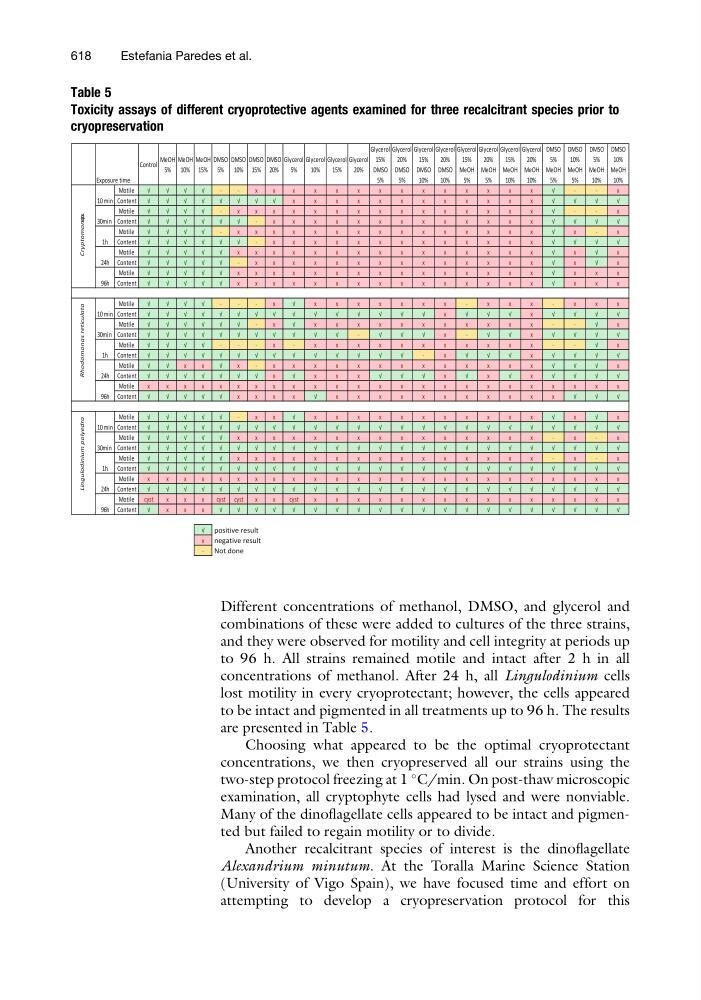
Different concentrations of methanol, DMSO, and glycerol and
combinations of these were added to cultures of the three strains,
and they were observed for motility and cell integrity at periods up
to 96 h. All strains remained motile and intact after 2 h in all
concentrations of methanol. After 24 h, all Lingulodinium cells
lost motility in every cryoprotectant; however, the cells appeared
to be intact and pigmented in all treatments up to 96 h. The results
are presented in Table 5.
Choosing what appeared to be the optimal cryoprotectant
concentrations, we then cryopreserved all our strains using the
two-step protocol freezing at 1
C/min. On post-thaw microscopic
examination, all cryptophyte cells had lysed and were nonviable.
Many of the dinoflagellate cells appeared to be intact and pigmented but failed to regain motility or to divide.
Another recalcitrant species of interest is the dinoflagellate
Alexandrium minutum. At the Toralla Marine Science Station
(University of Vigo Spain), we have focused time and effort on
attempting to develop a cryopreservation protocol for this
Table 5
Toxicity assays of different cryoprotective agents examined for three recalcitrant species prior to
cryopreservation
Exposure time
Control
MeOH
5%
MeOH
10%
MeOH
15%
DMSO
5%
DMSO
10%
DMSO
15%
DMSO
20%
Glycerol
5%
Glycerol
10%
Glycerol
15%
Glycerol
20%
Glycerol
15%
DMSO
5%
Glycerol
20%
DMSO
5%
Glycerol
15%
DMSO
10%
Glycerol
20%
DMSO
10%
Glycerol
15%
MeOH
5%
Glycerol
20%
MeOH
5%
Glycerol
15%
MeOH
10%
Glycerol
20%
MeOH
10%
DMSO
5%
MeOH
5%
DMSO
10%
MeOH
5%
DMSO
5%
MeOH
10%
DMSO
10%
MeOH
10%
Motile
√
√
√
√
-
-
x
x
x
x
x
x
x
x
x
x
x
x
x
x
√
-
-
x
Content √
√
√
√
√
√
√
√
x
x
x
x
x
x
x
x
x
x
x
x
√
√
√
√
Motile
√
√
√
√
-
x
x
x
x
x
x
x
x
x
x
x
x
x
x
x
√
-
-
x
Content √
√
√
√
√
√
-
x
x
x
x
x
x
x
x
x
x
x
x
x
√
√
√
√
Motile
√
√
√
√
-
x
x
x
x
x
x
x
x
x
x
x
x
x
x
x
√
x
-
x
Content √
√
√
√
√
√
-
x
x
x
x
x
x
x
x
x
x
x
x
x
√
√
√
√
Motile
√
√
√
√
√
x
x
x
x
x
x
x
x
x
x
x
x
x
x
x
√
x
√
x
Content √
√
√
√
√
-
x
x
x
x
x
x
x
x
x
x
x
x
x
x
√
x
√
x
Motile
√
√
√
√
√
x
x
x
x
x
x
x
x
x
x
x
x
x
x
x
√
x
x
x
Content √
√
√
√
√
x
x
x
x
x
x
x
x
x
x
x
x
x
x
x
√
x
x
x
Motile
√
√
√
√
-
-
-
x
√
x
x
x
x
x
x
x
-
x
x
x
-
x
x
x
Content √
√
√
√
√
√
√
√
√
√
√
√
√
√
√
x
√
√
√
x
√
√
√
√
Motile
√
√
√
√
√
√
-
x
√
x
x
x
x
x
x
x
x
x
x
x
-
-
√
x
Content √
√
√
√
√
√
√
√
√
√
√
-
√
√
√
x
-
√
√
x
√
√
√
√
Motile
√
√
√
√
-
-
-
x
-
x
x
x
x
x
x
x
x
x
x
x
-
-
√
x
Content √
√
√
√
√
√
√
√
√
√
√
√
√
√
-
x
√
√
√
x
√
√
√
√
Motile
√
√
x
x
√
x
-
x
x
x
x
x
x
x
x
x
x
x
x
x
√
√
√
x
Content √
√
√
√
√
√
√
x
√
x
x
x
√
√
√
x
√
x
√
x
√
√
√
√
Motile
x
x
x
x
x
x
x
x
x
x
x
x
x
x
x
x
x
x
x
x
x
x
x
x
Content √
√
√
√
√
x
x
x
x
√
x
x
x
x
x
x
x
x
x
x
x
√
√
√
Motile
√
√
√
√
√
-
x
x
√
x
x
x
x
x
x
x
x
x
x
x
√
x
√
x
Content √
√
√
√
√
√
√
√
√
√
√
√
√
√
√
√
√
√
√
√
√
√
√
√
Motile
√
√
√
√
√
x
x
x
x
x
x
x
x
x
x
x
x
x
x
x
-
x
-
x
Content √
√
√
√
√
√
√
√
√
√
√
√
√
√
√
√
√
√
√
√
√
√
√
√
Motile
√
√
√
√
√
x
x
x
x
x
x
x
x
x
x
x
x
x
x
x
-
x
-
x
Content √
√
√
√
√
√
√
√
√
√
√
√
√
√
√
√
√
√
√
√
√
√
√
√
Motile
x
x
x
x
x
x
x
x
x
x
x
x
x
x
x
x
x
x
x
x
x
x
x
x
Content √
√
√
√
√
√
√
√
√
√
√
√
√
√
√
√
√
√
√
√
√
√
√
√
Motile cyst
x
x
x
cyst cyst x
x
cyst
x
x
x
x
x
x
x
x
x
x
x
x
x
x
x
Content √
x
x
x
√
√
√
√
√
√
√
√
√
√
√
√
√
√
√
√
√
√
√
√
√ positive result
x negative result
- Not done
Lingulodinium polyedra
10 min
30min
1h
24h
96h
Rhodomonas reticulata
10 min
30min
1h
24h
96h
Cryptomonas
sp.
10 min
30min
1h
24h
96h
618
Estefania Paredes et al.