

3.5 Recalcitrant
Species
There are many types of algae that do not survive cryopreservation,
termed “cryo-recalcitrant” strains. As experiments to attempt to
freeze them fail to provide positive results, these tend not to be
reported in the literature. In the CCAP, experiments were carried
out to attempt to cryopreserve three examples of typically recalcitrant taxa and to observe the effect of applying cryoprotectants. We
chose two cryptophyte strains, the freshwater Cryptomonas CCAP
979/44 and the marine Rhodomonas CCAP 995/2, as well as the
marine dinoflagellate Lingulodinium polyedra CCAP 1121/5.
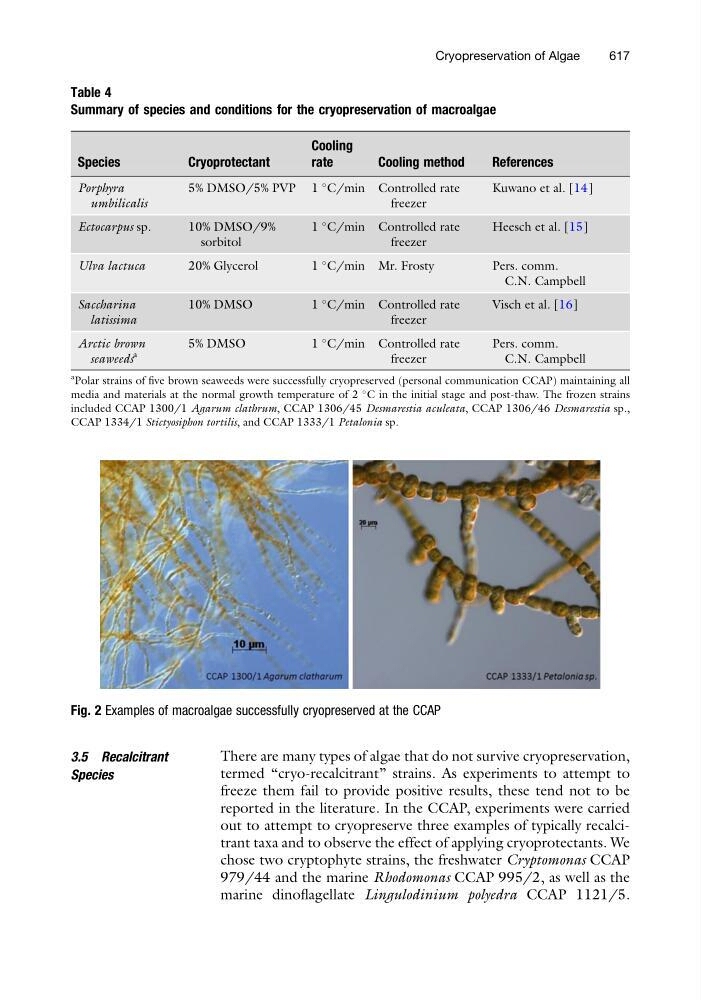
Fig. 2 Examples of macroalgae successfully cryopreserved at the CCAP
Table 4
Summary of species and conditions for the cryopreservation of macroalgae
Species
Cryoprotectant
Cooling
rate
Cooling method
References
Porphyra
umbilicalis
5% DMSO/5% PVP 1
C/min Controlled rate
freezer
Kuwano et al. [14]
Ectocarpus sp.
10% DMSO/9%
sorbitol
1
C/min Controlled rate
freezer
Heesch et al. [15]
Ulva lactuca
20% Glycerol
1
C/min Mr. Frosty
Pers. comm.
C.N. Campbell
Saccharina
latissima
10% DMSO
1
C/min Controlled rate
freezer
Visch et al. [16]
Arctic brown
seaweeds
a
5% DMSO
1
C/min Controlled rate
freezer
Pers. comm.
C.N. Campbell
a
Polar strains of five brown seaweeds were successfully cryopreserved (personal communication CCAP) maintaining all
media and materials at the normal growth temperature of 2
C in the initial stage and post-thaw. The frozen strains
included CCAP 1300/1 Agarum clathrum, CCAP 1306/45 Desmarestia aculeata, CCAP 1306/46 Desmarestia sp.,
CCAP 1334/1 Stictyosiphon tortilis, and CCAP 1333/1 Petalonia sp.
Cryopreservation of Algae
617
Species
There are many types of algae that do not survive cryopreservation,
termed “cryo-recalcitrant” strains. As experiments to attempt to
freeze them fail to provide positive results, these tend not to be
reported in the literature. In the CCAP, experiments were carried
out to attempt to cryopreserve three examples of typically recalcitrant taxa and to observe the effect of applying cryoprotectants. We
chose two cryptophyte strains, the freshwater Cryptomonas CCAP
979/44 and the marine Rhodomonas CCAP 995/2, as well as the
marine dinoflagellate Lingulodinium polyedra CCAP 1121/5.
Fig. 2 Examples of macroalgae successfully cryopreserved at the CCAP
Table 4
Summary of species and conditions for the cryopreservation of macroalgae
Species
Cryoprotectant
Cooling
rate
Cooling method
References
Porphyra
umbilicalis
5% DMSO/5% PVP 1
C/min Controlled rate
freezer
Kuwano et al. [14]
Ectocarpus sp.
10% DMSO/9%
sorbitol
1
C/min Controlled rate
freezer
Heesch et al. [15]
Ulva lactuca
20% Glycerol
1
C/min Mr. Frosty
Pers. comm.
C.N. Campbell
Saccharina
latissima
10% DMSO
1
C/min Controlled rate
freezer
Visch et al. [16]
Arctic brown
seaweeds
a
5% DMSO
1
C/min Controlled rate
freezer
Pers. comm.
C.N. Campbell
a
Polar strains of five brown seaweeds were successfully cryopreserved (personal communication CCAP) maintaining all
media and materials at the normal growth temperature of 2
C in the initial stage and post-thaw. The frozen strains
included CCAP 1300/1 Agarum clathrum, CCAP 1306/45 Desmarestia aculeata, CCAP 1306/46 Desmarestia sp.,
CCAP 1334/1 Stictyosiphon tortilis, and CCAP 1333/1 Petalonia sp.
Cryopreservation of Algae
617