

permeation has occurred relatively, slow cooling and warming rates
can be employed below, slower than the critical cooling and warming rates reported for VS55 in the literature. At this time we do not
know whether tissues cryopreserved by Protocol 1 or 4 have
reduced immunogenicity. We suspect that the impact of high concentrations of cryoprotectants on cytokines illustrated in Fig. 1 may
be masked by immune reactions to living cell components.
2 Materials
Prepare all solutions using deionized water (prepared with an activated carbon filter, mixed bed working deionizer, and a mixed bed
polishing deionizer to attain a sensitivity of 10 MΩ cm at room
temperature). The solutions are prepared with raw materials that
meet or exceed requirements of the American Chemical Society. If
no such specifications exist, chemicals of the highest purity available
should be used. The solutions are made at room temperature and
stored at 4
C for up to 4 weeks. The solution formulations
described are for 1 L batches.
2.1 Preparation
of EuroCollins
Solutions
1. For preparing EuroCollins solution (EC), put 0.5 L water in a
container (graduated cylinder or glass beaker), then add a stir
bar followed by addition of each component in the following
order, 174.76 g dextrose, 10.2 g KH 2 PO 4 , 36.5 g K 2 HPO 4 ,
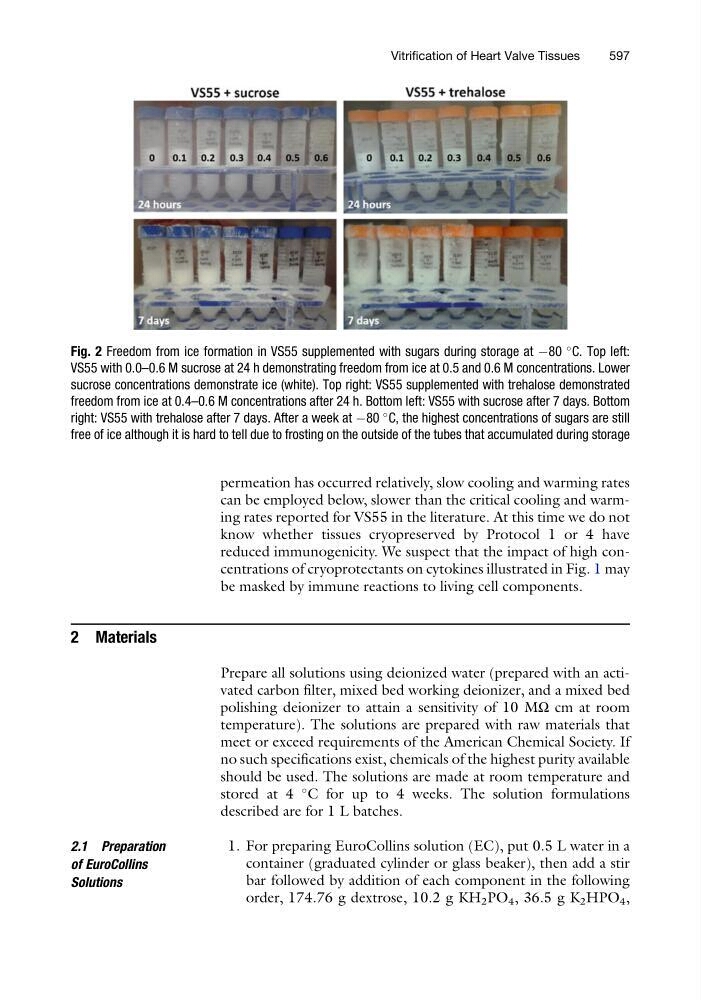
Fig. 2 Freedom from ice formation in VS55 supplemented with sugars during storage at À80
C. Top left:
VS55 with 0.0–0.6 M sucrose at 24 h demonstrating freedom from ice at 0.5 and 0.6 M concentrations. Lower
sucrose concentrations demonstrate ice (white). Top right: VS55 supplemented with trehalose demonstrated
freedom from ice at 0.4–0.6 M concentrations after 24 h. Bottom left: VS55 with sucrose after 7 days. Bottom
right: VS55 with trehalose after 7 days. After a week at À80
C, the highest concentrations of sugars are still
free of ice although it is hard to tell due to frosting on the outside of the tubes that accumulated during storage
Vitrification of Heart Valve Tissues
597
can be employed below, slower than the critical cooling and warming rates reported for VS55 in the literature. At this time we do not
know whether tissues cryopreserved by Protocol 1 or 4 have
reduced immunogenicity. We suspect that the impact of high concentrations of cryoprotectants on cytokines illustrated in Fig. 1 may
be masked by immune reactions to living cell components.
2 Materials
Prepare all solutions using deionized water (prepared with an activated carbon filter, mixed bed working deionizer, and a mixed bed
polishing deionizer to attain a sensitivity of 10 MΩ cm at room
temperature). The solutions are prepared with raw materials that
meet or exceed requirements of the American Chemical Society. If
no such specifications exist, chemicals of the highest purity available
should be used. The solutions are made at room temperature and
stored at 4
C for up to 4 weeks. The solution formulations
described are for 1 L batches.
2.1 Preparation
of EuroCollins
Solutions
1. For preparing EuroCollins solution (EC), put 0.5 L water in a
container (graduated cylinder or glass beaker), then add a stir
bar followed by addition of each component in the following
order, 174.76 g dextrose, 10.2 g KH 2 PO 4 , 36.5 g K 2 HPO 4 ,
Fig. 2 Freedom from ice formation in VS55 supplemented with sugars during storage at À80
C. Top left:
VS55 with 0.0–0.6 M sucrose at 24 h demonstrating freedom from ice at 0.5 and 0.6 M concentrations. Lower
sucrose concentrations demonstrate ice (white). Top right: VS55 supplemented with trehalose demonstrated
freedom from ice at 0.4–0.6 M concentrations after 24 h. Bottom left: VS55 with sucrose after 7 days. Bottom
right: VS55 with trehalose after 7 days. After a week at À80
C, the highest concentrations of sugars are still
free of ice although it is hard to tell due to frosting on the outside of the tubes that accumulated during storage
Vitrification of Heart Valve Tissues
597