

80–100 mL volume, we encountered two problems: (1) cracking at
vapor-phase nitrogen temperatures, particularly in dry nitrogen
shippers, and (2) the VS55 solution demonstrated ice formation
during rewarming [16]. The solution to both problems was development of Protocols 2 and 3 in which the concentrations of the
three cryoprotectants in VS55 were increased from 55% to 83% to
make VS83. Furthermore modulated differential scanning calorimetry studies indicated that this new formulation was potentially
stable at À80
C, free from ice at À80
C [16], which would
make it easier and cheaper to store and ship the tissue samples.
The literature supporting these protocols was previously reviewed
and unpublished studies presented [12].
In the evolution of our vitrification protocols, we started with
Protocol 1 based upon VS55 [reviewed in 17, 18]. This protocol
resulted in excellent avoidance of ice formation with retention of
cell viability and matrix integrity provided that the sample size and
geometry permitted rapid cooling and warming. Ice formed during
slow rewarming of VS55 but not during rewarming of a more
concentrated cryoprotectant solution, VS83 [16]. Use of Protocols
2 and 3 with VS83 permitted the use of large sample volumes and
heart valve tissue storage at À80
C at the expense of cell viability
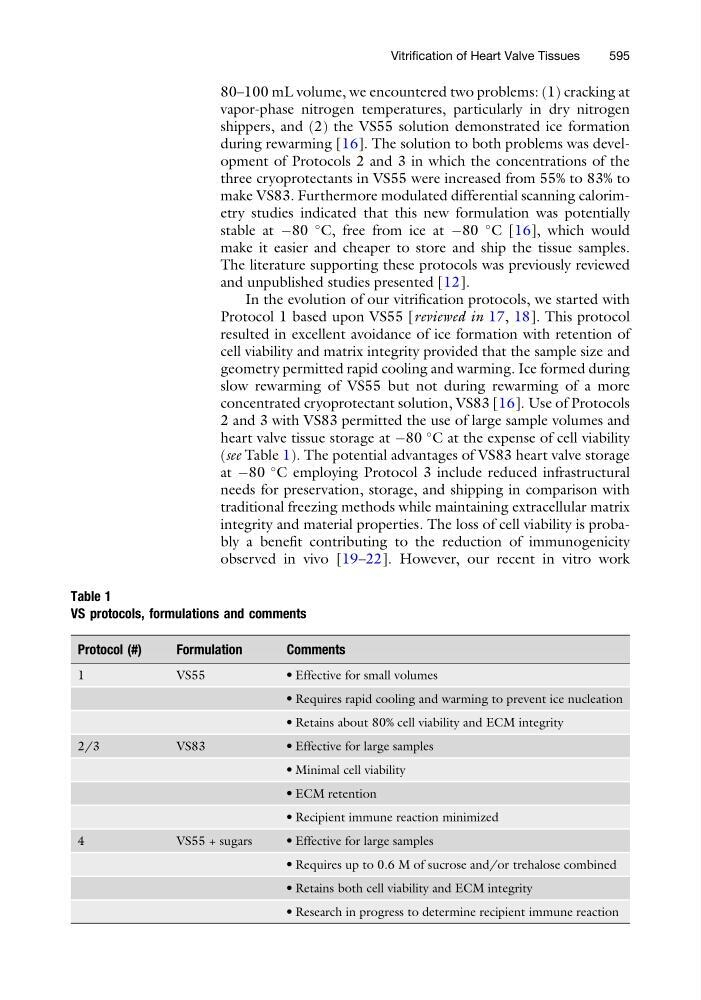
(see Table 1). The potential advantages of VS83 heart valve storage
at À80
C employing Protocol 3 include reduced infrastructural
needs for preservation, storage, and shipping in comparison with
traditional freezing methods while maintaining extracellular matrix
integrity and material properties. The loss of cell viability is probably a benefit contributing to the reduction of immunogenicity
observed in vivo [19–22]. However, our recent in vitro work
Table 1
VS protocols, formulations and comments
Protocol (#)
Formulation
Comments
1
VS55
l Effective for small volumes
l Requires rapid cooling and warming to prevent ice nucleation
l Retains about 80% cell viability and ECM integrity
2/3
VS83
l Effective for large samples
l Minimal cell viability
l ECM retention
l Recipient immune reaction minimized
4
VS55 + sugars
l Effective for large samples
l Requires up to 0.6 M of sucrose and/or trehalose combined
l Retains both cell viability and ECM integrity
l Research in progress to determine recipient immune reaction
Vitrification of Heart Valve Tissues
595
vapor-phase nitrogen temperatures, particularly in dry nitrogen
shippers, and (2) the VS55 solution demonstrated ice formation
during rewarming [16]. The solution to both problems was development of Protocols 2 and 3 in which the concentrations of the
three cryoprotectants in VS55 were increased from 55% to 83% to
make VS83. Furthermore modulated differential scanning calorimetry studies indicated that this new formulation was potentially
stable at À80
C, free from ice at À80
C [16], which would
make it easier and cheaper to store and ship the tissue samples.
The literature supporting these protocols was previously reviewed
and unpublished studies presented [12].
In the evolution of our vitrification protocols, we started with
Protocol 1 based upon VS55 [reviewed in 17, 18]. This protocol
resulted in excellent avoidance of ice formation with retention of
cell viability and matrix integrity provided that the sample size and
geometry permitted rapid cooling and warming. Ice formed during
slow rewarming of VS55 but not during rewarming of a more
concentrated cryoprotectant solution, VS83 [16]. Use of Protocols
2 and 3 with VS83 permitted the use of large sample volumes and
heart valve tissue storage at À80
C at the expense of cell viability
(see Table 1). The potential advantages of VS83 heart valve storage
at À80
C employing Protocol 3 include reduced infrastructural
needs for preservation, storage, and shipping in comparison with
traditional freezing methods while maintaining extracellular matrix
integrity and material properties. The loss of cell viability is probably a benefit contributing to the reduction of immunogenicity
observed in vivo [19–22]. However, our recent in vitro work
Table 1
VS protocols, formulations and comments
Protocol (#)
Formulation
Comments
1
VS55
l Effective for small volumes
l Requires rapid cooling and warming to prevent ice nucleation
l Retains about 80% cell viability and ECM integrity
2/3
VS83
l Effective for large samples
l Minimal cell viability
l ECM retention
l Recipient immune reaction minimized
4
VS55 + sugars
l Effective for large samples
l Requires up to 0.6 M of sucrose and/or trehalose combined
l Retains both cell viability and ECM integrity
l Research in progress to determine recipient immune reaction
Vitrification of Heart Valve Tissues
595