

occurring in the day 6 blastocysts of group B were significantly
higher than transferring day 6 blastocysts from group A (χ
2 ;
P < 0.001 for any comparison, respectively).
In Table 8 the results for patients under 35 are summarized.
Comparing day 5 from group A (n ¼ 647) with day 5 from group B
(n ¼ 1913), we found the following for IR, cPR, and oPR:
42.8% vs. 55.4%, 52.4% vs. 63.1%, and 45.7% vs. 56.4%. We
observed the same trend and tendency for day 6 blastocysts (see
Table 8).
2 Materials
2.1 Materials
1. HSV (High Security Vitrification Kit (Catalog # 022137; Cryo
Bio System).
2. Heat sealer (Cryo Bio System).
3. Polycarbonate micropipettes, 170 and 140 μm end hole (MidAtlantic Diagnostics# KFPIP-1170-10BS).
4. Brady labeler (BMP 61).
5. Brady labels (PTL-19-427).
6. 90 Â 15 mm Petri dish (Nunclon # 150362).
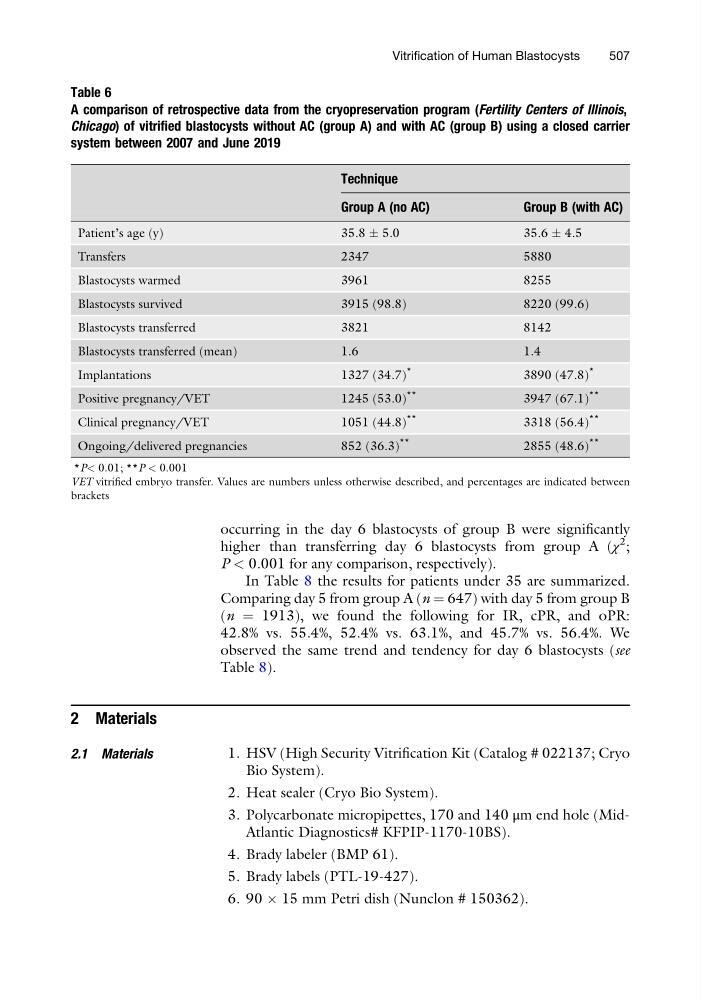
Table 6
A comparison of retrospective data from the cryopreservation program (Fertility Centers of Illinois,
Chicago) of vitrified blastocysts without AC (group A) and with AC (group B) using a closed carrier
system between 2007 and June 2019
Technique
Group A (no AC)
Group B (with AC)
Patient’s age (y)
35.8 Æ 5.0
35.6 Æ 4.5
Transfers
2347
5880
Blastocysts warmed
3961
8255
Blastocysts survived
3915 (98.8)
8220 (99.6)
Blastocysts transferred
3821
8142
Blastocysts transferred (mean)
1.6
1.4
Implantations
1327 (34.7)
*
3890 (47.8)
*
Positive pregnancy/VET
1245 (53.0)
**
3947 (67.1)
**
Clinical pregnancy/VET
1051 (44.8)
**
3318 (56.4)
**
Ongoing/delivered pregnancies
852 (36.3)
**
2855 (48.6)
**
*P< 0.01; **P < 0.001
VET vitrified embryo transfer. Values are numbers unless otherwise described, and percentages are indicated between
brackets
Vitrification of Human Blastocysts
507
higher than transferring day 6 blastocysts from group A (χ
2 ;
P < 0.001 for any comparison, respectively).
In Table 8 the results for patients under 35 are summarized.
Comparing day 5 from group A (n ¼ 647) with day 5 from group B
(n ¼ 1913), we found the following for IR, cPR, and oPR:
42.8% vs. 55.4%, 52.4% vs. 63.1%, and 45.7% vs. 56.4%. We
observed the same trend and tendency for day 6 blastocysts (see
Table 8).
2 Materials
2.1 Materials
1. HSV (High Security Vitrification Kit (Catalog # 022137; Cryo
Bio System).
2. Heat sealer (Cryo Bio System).
3. Polycarbonate micropipettes, 170 and 140 μm end hole (MidAtlantic Diagnostics# KFPIP-1170-10BS).
4. Brady labeler (BMP 61).
5. Brady labels (PTL-19-427).
6. 90 Â 15 mm Petri dish (Nunclon # 150362).
Table 6
A comparison of retrospective data from the cryopreservation program (Fertility Centers of Illinois,
Chicago) of vitrified blastocysts without AC (group A) and with AC (group B) using a closed carrier
system between 2007 and June 2019
Technique
Group A (no AC)
Group B (with AC)
Patient’s age (y)
35.8 Æ 5.0
35.6 Æ 4.5
Transfers
2347
5880
Blastocysts warmed
3961
8255
Blastocysts survived
3915 (98.8)
8220 (99.6)
Blastocysts transferred
3821
8142
Blastocysts transferred (mean)
1.6
1.4
Implantations
1327 (34.7)
*
3890 (47.8)
*
Positive pregnancy/VET
1245 (53.0)
**
3947 (67.1)
**
Clinical pregnancy/VET
1051 (44.8)
**
3318 (56.4)
**
Ongoing/delivered pregnancies
852 (36.3)
**
2855 (48.6)
**
*P< 0.01; **P < 0.001
VET vitrified embryo transfer. Values are numbers unless otherwise described, and percentages are indicated between
brackets
Vitrification of Human Blastocysts
507