

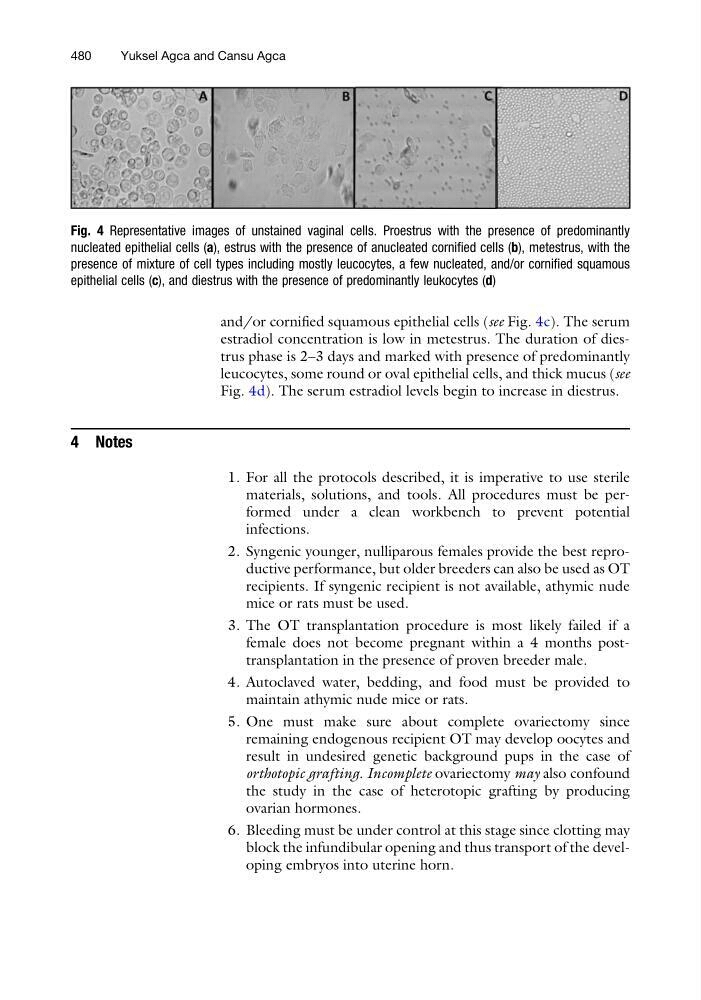
and/or cornified squamous epithelial cells (see Fig. 4c). The serum
estradiol concentration is low in metestrus. The duration of diestrus phase is 2–3 days and marked with presence of predominantly
leucocytes, some round or oval epithelial cells, and thick mucus (see
Fig. 4d). The serum estradiol levels begin to increase in diestrus.
4 Notes
1. For all the protocols described, it is imperative to use sterile
materials, solutions, and tools. All procedures must be performed under a clean workbench to prevent potential
infections.
2. Syngenic younger, nulliparous females provide the best reproductive performance, but older breeders can also be used as OT
recipients. If syngenic recipient is not available, athymic nude
mice or rats must be used.
3. The OT transplantation procedure is most likely failed if a
female does not become pregnant within a 4 months posttransplantation in the presence of proven breeder male.
4. Autoclaved water, bedding, and food must be provided to
maintain athymic nude mice or rats.
5. One must make sure about complete ovariectomy since
remaining endogenous recipient OT may develop oocytes and
result in undesired genetic background pups in the case of
orthotopic grafting. Incomplete ovariectomy may also confound
the study in the case of heterotopic grafting by producing
ovarian hormones.
6. Bleeding must be under control at this stage since clotting may
block the infundibular opening and thus transport of the developing embryos into uterine horn.
Fig. 4 Representative images of unstained vaginal cells. Proestrus with the presence of predominantly
nucleated epithelial cells (a), estrus with the presence of anucleated cornified cells (b), metestrus, with the
presence of mixture of cell types including mostly leucocytes, a few nucleated, and/or cornified squamous
epithelial cells (c), and diestrus with the presence of predominantly leukocytes (d)
480
Yuksel Agca and Cansu Agca
estradiol concentration is low in metestrus. The duration of diestrus phase is 2–3 days and marked with presence of predominantly
leucocytes, some round or oval epithelial cells, and thick mucus (see
Fig. 4d). The serum estradiol levels begin to increase in diestrus.
4 Notes
1. For all the protocols described, it is imperative to use sterile
materials, solutions, and tools. All procedures must be performed under a clean workbench to prevent potential
infections.
2. Syngenic younger, nulliparous females provide the best reproductive performance, but older breeders can also be used as OT
recipients. If syngenic recipient is not available, athymic nude
mice or rats must be used.
3. The OT transplantation procedure is most likely failed if a
female does not become pregnant within a 4 months posttransplantation in the presence of proven breeder male.
4. Autoclaved water, bedding, and food must be provided to
maintain athymic nude mice or rats.
5. One must make sure about complete ovariectomy since
remaining endogenous recipient OT may develop oocytes and
result in undesired genetic background pups in the case of
orthotopic grafting. Incomplete ovariectomy may also confound
the study in the case of heterotopic grafting by producing
ovarian hormones.
6. Bleeding must be under control at this stage since clotting may
block the infundibular opening and thus transport of the developing embryos into uterine horn.
Fig. 4 Representative images of unstained vaginal cells. Proestrus with the presence of predominantly
nucleated epithelial cells (a), estrus with the presence of anucleated cornified cells (b), metestrus, with the
presence of mixture of cell types including mostly leucocytes, a few nucleated, and/or cornified squamous
epithelial cells (c), and diestrus with the presence of predominantly leukocytes (d)
480
Yuksel Agca and Cansu Agca