

6. Check osmolarity (275–290 mOsm/kg) and record. Filter into
sterile bottle using a 0.22 μm pore size filter. If the osmolarity is
significantly different than 275–290 mOsm/kg or precipitates
form in the solution, remake the solution.
7. Aliquot into desired volume, label the tubes, and include expiration date, initials, and batch number. TL-HEPES can be
stored for a maximum of 4 weeks at 4
C or for up to 3 months
in À20
C.
3.2 Preparation
of Freezing Solution
Cryopreservation solution consists of 1.5 M dimethyl sulfoxide
(DMSO) in TL-HEPES, supplemented with 10% fetal bovine
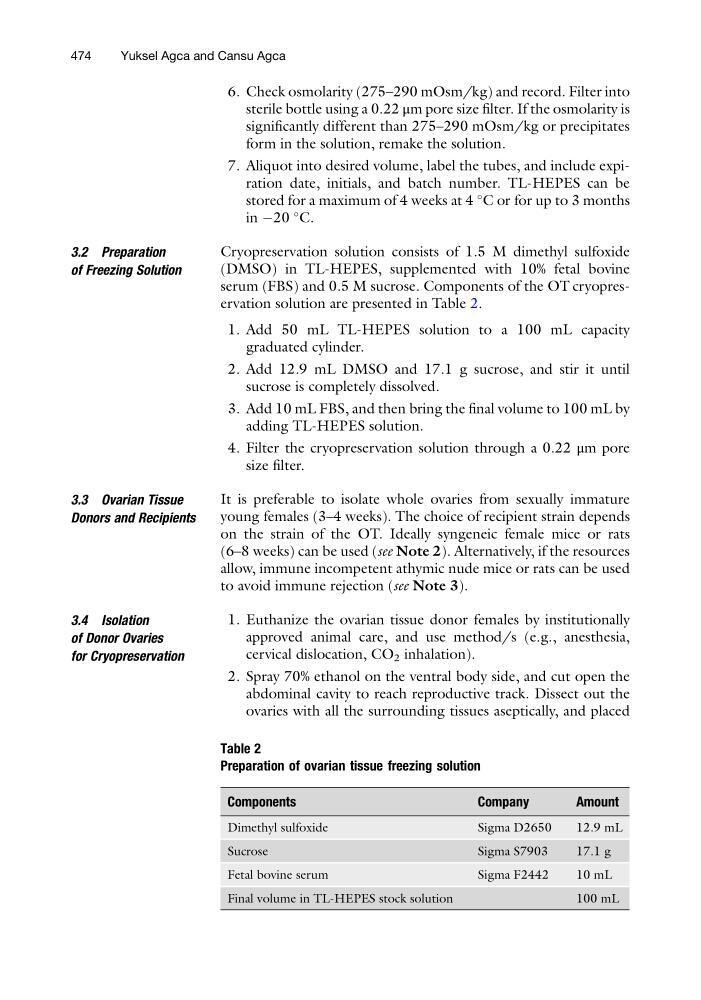
serum (FBS) and 0.5 M sucrose. Components of the OT cryopreservation solution are presented in Table 2.
1. Add 50 mL TL-HEPES solution to a 100 mL capacity
graduated cylinder.
2. Add 12.9 mL DMSO and 17.1 g sucrose, and stir it until
sucrose is completely dissolved.
3. Add 10 mL FBS, and then bring the final volume to 100 mL by
adding TL-HEPES solution.
4. Filter the cryopreservation solution through a 0.22 μm pore
size filter.
3.3 Ovarian Tissue
Donors and Recipients
It is preferable to isolate whole ovaries from sexually immature
young females (3–4 weeks). The choice of recipient strain depends
on the strain of the OT. Ideally syngeneic female mice or rats
(6–8 weeks) can be used (see Note 2). Alternatively, if the resources
allow, immune incompetent athymic nude mice or rats can be used
to avoid immune rejection (see Note 3).
3.4 Isolation
of Donor Ovaries
for Cryopreservation
1. Euthanize the ovarian tissue donor females by institutionally
approved animal care, and use method/s (e.g., anesthesia,
cervical dislocation, CO 2 inhalation).
2. Spray 70% ethanol on the ventral body side, and cut open the
abdominal cavity to reach reproductive track. Dissect out the
ovaries with all the surrounding tissues aseptically, and placed
Table 2
Preparation of ovarian tissue freezing solution
Components
Company
Amount
Dimethyl sulfoxide
Sigma D2650
12.9 mL
Sucrose
Sigma S7903
17.1 g
Fetal bovine serum
Sigma F2442
10 mL
Final volume in TL-HEPES stock solution
100 mL
474
Yuksel Agca and Cansu Agca
sterile bottle using a 0.22 μm pore size filter. If the osmolarity is
significantly different than 275–290 mOsm/kg or precipitates
form in the solution, remake the solution.
7. Aliquot into desired volume, label the tubes, and include expiration date, initials, and batch number. TL-HEPES can be
stored for a maximum of 4 weeks at 4
C or for up to 3 months
in À20
C.
3.2 Preparation
of Freezing Solution
Cryopreservation solution consists of 1.5 M dimethyl sulfoxide
(DMSO) in TL-HEPES, supplemented with 10% fetal bovine
serum (FBS) and 0.5 M sucrose. Components of the OT cryopreservation solution are presented in Table 2.
1. Add 50 mL TL-HEPES solution to a 100 mL capacity
graduated cylinder.
2. Add 12.9 mL DMSO and 17.1 g sucrose, and stir it until
sucrose is completely dissolved.
3. Add 10 mL FBS, and then bring the final volume to 100 mL by
adding TL-HEPES solution.
4. Filter the cryopreservation solution through a 0.22 μm pore
size filter.
3.3 Ovarian Tissue
Donors and Recipients
It is preferable to isolate whole ovaries from sexually immature
young females (3–4 weeks). The choice of recipient strain depends
on the strain of the OT. Ideally syngeneic female mice or rats
(6–8 weeks) can be used (see Note 2). Alternatively, if the resources
allow, immune incompetent athymic nude mice or rats can be used
to avoid immune rejection (see Note 3).
3.4 Isolation
of Donor Ovaries
for Cryopreservation
1. Euthanize the ovarian tissue donor females by institutionally
approved animal care, and use method/s (e.g., anesthesia,
cervical dislocation, CO 2 inhalation).
2. Spray 70% ethanol on the ventral body side, and cut open the
abdominal cavity to reach reproductive track. Dissect out the
ovaries with all the surrounding tissues aseptically, and placed
Table 2
Preparation of ovarian tissue freezing solution
Components
Company
Amount
Dimethyl sulfoxide
Sigma D2650
12.9 mL
Sucrose
Sigma S7903
17.1 g
Fetal bovine serum
Sigma F2442
10 mL
Final volume in TL-HEPES stock solution
100 mL
474
Yuksel Agca and Cansu Agca