

“Thawing” is the melting of ice. Reference to the “thawing” of
vitreous systems is common but inaccurate and is to be avoided.
“Rewarming” (the warming of a previously cryopreserved system,
whether frozen or vitrified) is a more accurate term than “thawing”
in the context of vitrified systems.
“Devitrification” is not the reverse of vitrification. Instead, it is
the formation of ice during warming after previous vitrification
[7, 37, 38] and is explained in detail below.
“Recrystallization” is the transfer of water molecules from
small ice crystals to larger crystals (for an early discussion, see
[39]; for particularly illustrative photos, see [40]). This can happen
under isothermal conditions, during which no net change in the
total quantity of ice may occur, or during warming, in which case
the quantity of ice may change even as recrystallization proceeds.
Recrystallization tends to be damaging because it results in the
conversion of a large number of relatively innocuous small ice
crystals into a smaller number of larger and more damaging ice
crystals. As noted below, recrystallization appears to be more
important than devitrification per se in governing the fate of previously vitrified systems.
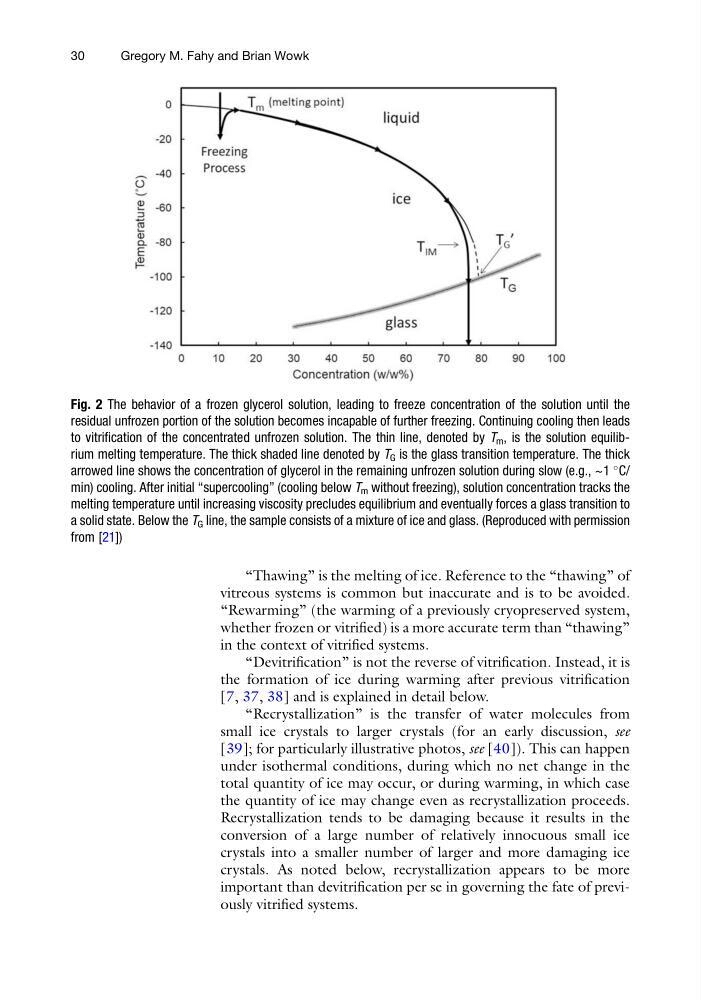
Fig. 2 The behavior of a frozen glycerol solution, leading to freeze concentration of the solution until the
residual unfrozen portion of the solution becomes incapable of further freezing. Continuing cooling then leads
to vitrification of the concentrated unfrozen solution. The thin line, denoted by T m , is the solution equilibrium melting temperature. The thick shaded line denoted by T G is the glass transition temperature. The thick
arrowed line shows the concentration of glycerol in the remaining unfrozen solution during slow (e.g., ~1
C/
min) cooling. After initial “supercooling” (cooling below T m without freezing), solution concentration tracks the
melting temperature until increasing viscosity precludes equilibrium and eventually forces a glass transition to
a solid state. Below the T G line, the sample consists of a mixture of ice and glass. (Reproduced with permission
from [21])
30
Gregory M. Fahy and Brian Wowk
vitreous systems is common but inaccurate and is to be avoided.
“Rewarming” (the warming of a previously cryopreserved system,
whether frozen or vitrified) is a more accurate term than “thawing”
in the context of vitrified systems.
“Devitrification” is not the reverse of vitrification. Instead, it is
the formation of ice during warming after previous vitrification
[7, 37, 38] and is explained in detail below.
“Recrystallization” is the transfer of water molecules from
small ice crystals to larger crystals (for an early discussion, see
[39]; for particularly illustrative photos, see [40]). This can happen
under isothermal conditions, during which no net change in the
total quantity of ice may occur, or during warming, in which case
the quantity of ice may change even as recrystallization proceeds.
Recrystallization tends to be damaging because it results in the
conversion of a large number of relatively innocuous small ice
crystals into a smaller number of larger and more damaging ice
crystals. As noted below, recrystallization appears to be more
important than devitrification per se in governing the fate of previously vitrified systems.
Fig. 2 The behavior of a frozen glycerol solution, leading to freeze concentration of the solution until the
residual unfrozen portion of the solution becomes incapable of further freezing. Continuing cooling then leads
to vitrification of the concentrated unfrozen solution. The thin line, denoted by T m , is the solution equilibrium melting temperature. The thick shaded line denoted by T G is the glass transition temperature. The thick
arrowed line shows the concentration of glycerol in the remaining unfrozen solution during slow (e.g., ~1
C/
min) cooling. After initial “supercooling” (cooling below T m without freezing), solution concentration tracks the
melting temperature until increasing viscosity precludes equilibrium and eventually forces a glass transition to
a solid state. Below the T G line, the sample consists of a mixture of ice and glass. (Reproduced with permission
from [21])
30
Gregory M. Fahy and Brian Wowk