

increase in late apoptotic cells was observed for the LN
(45.5 Æ 1.8%) and LA (43.7 Æ 2.2%) groups. The fraction
of necrotic cells was found to be slightly increased
( p > 0.1) in the LN (19.5 Æ 2.0%) and LA
(15.0 Æ 1.8%) groups compared to that in the control
group.
4 Notes
1. Sucrose !99.5% MW 342.3 g/mol (Sigma Life Science,
Sigma-Aldrich) should be used. Ideally, the 1 M sucrose solution should be made up in a volumetric flask. From experience,
the total volume of buffer required to make 1000 mL of 1 M
sucrose stock solution is between 780 and 790 mL. When a
0.5 M of stock solution is required, the amount of sucrose can
be reduced pro rata, e.g., 171 g in a final volume of 1000 mL
(requires approximately 880–890 mL buffer). To ensure that
all the sucrose is dissolved, the solution should be shaken
vigorously and left overnight before filtration.
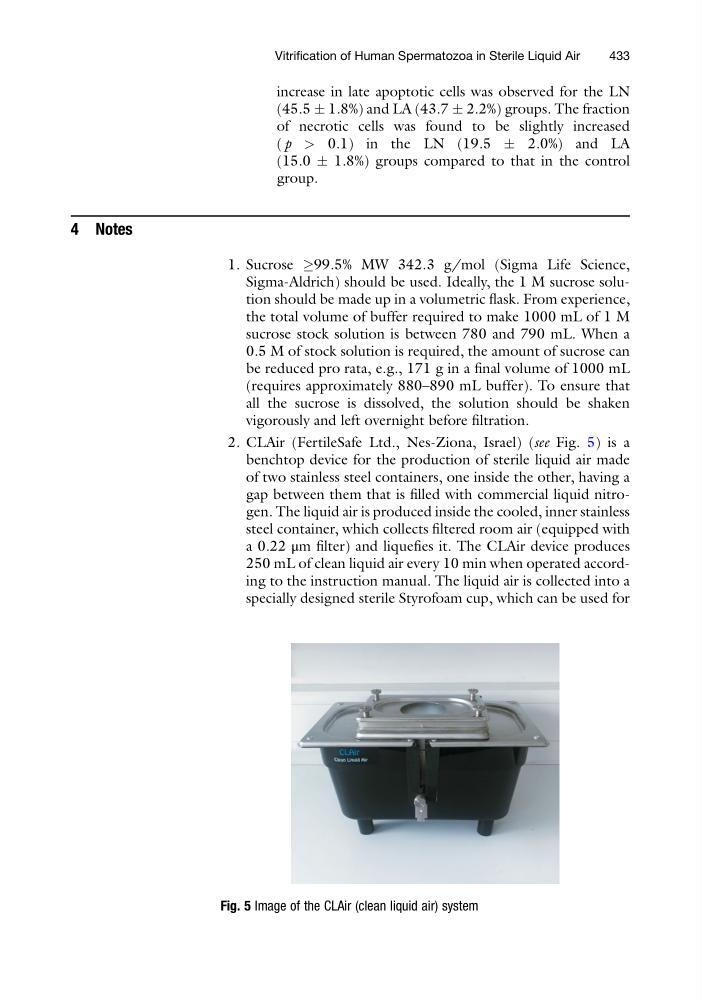
2. CLAir (FertileSafe Ltd., Nes-Ziona, Israel) (see Fig. 5) is a
benchtop device for the production of sterile liquid air made
of two stainless steel containers, one inside the other, having a
gap between them that is filled with commercial liquid nitrogen. The liquid air is produced inside the cooled, inner stainless
steel container, which collects filtered room air (equipped with
a 0.22 μm filter) and liquefies it. The CLAir device produces
250 mL of clean liquid air every 10 min when operated according to the instruction manual. The liquid air is collected into a
specially designed sterile Styrofoam cup, which can be used for
Fig. 5 Image of the CLAir (clean liquid air) system
Vitrification of Human Spermatozoa in Sterile Liquid Air
433
(45.5 Æ 1.8%) and LA (43.7 Æ 2.2%) groups. The fraction
of necrotic cells was found to be slightly increased
( p > 0.1) in the LN (19.5 Æ 2.0%) and LA
(15.0 Æ 1.8%) groups compared to that in the control
group.
4 Notes
1. Sucrose !99.5% MW 342.3 g/mol (Sigma Life Science,
Sigma-Aldrich) should be used. Ideally, the 1 M sucrose solution should be made up in a volumetric flask. From experience,
the total volume of buffer required to make 1000 mL of 1 M
sucrose stock solution is between 780 and 790 mL. When a
0.5 M of stock solution is required, the amount of sucrose can
be reduced pro rata, e.g., 171 g in a final volume of 1000 mL
(requires approximately 880–890 mL buffer). To ensure that
all the sucrose is dissolved, the solution should be shaken
vigorously and left overnight before filtration.
2. CLAir (FertileSafe Ltd., Nes-Ziona, Israel) (see Fig. 5) is a
benchtop device for the production of sterile liquid air made
of two stainless steel containers, one inside the other, having a
gap between them that is filled with commercial liquid nitrogen. The liquid air is produced inside the cooled, inner stainless
steel container, which collects filtered room air (equipped with
a 0.22 μm filter) and liquefies it. The CLAir device produces
250 mL of clean liquid air every 10 min when operated according to the instruction manual. The liquid air is collected into a
specially designed sterile Styrofoam cup, which can be used for
Fig. 5 Image of the CLAir (clean liquid air) system
Vitrification of Human Spermatozoa in Sterile Liquid Air
433