

2. Prepare a solution of ethylene glycol and trehalose, at concentrations of 20% (v/v) and 0.8 M, respectively, in filtered
(0.22 μm + UVA) natural seawater or artificial seawater.
3 Methods
3.1 Cryopreservation
of Sea Urchin
(Paracentrotus
lividus) Sperm
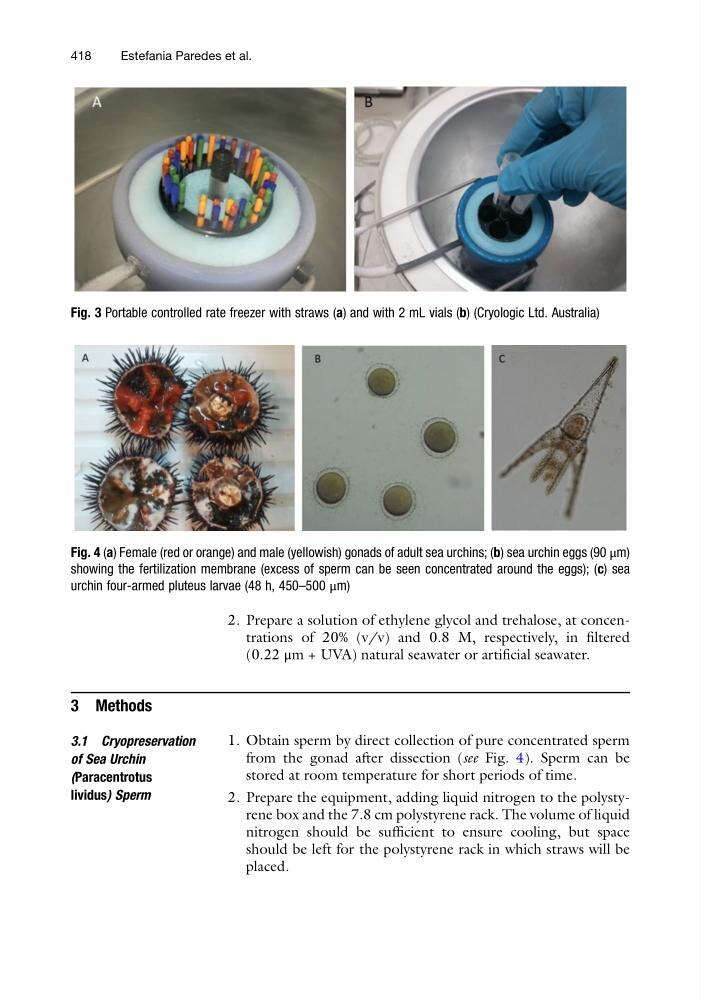
1. Obtain sperm by direct collection of pure concentrated sperm
from the gonad after dissection (see Fig. 4). Sperm can be
stored at room temperature for short periods of time.
2. Prepare the equipment, adding liquid nitrogen to the polystyrene box and the 7.8 cm polystyrene rack. The volume of liquid
nitrogen should be sufficient to ensure cooling, but space
should be left for the polystyrene rack in which straws will be
placed.
Fig. 4 (a) Female (red or orange) and male (yellowish) gonads of adult sea urchins; (b) sea urchin eggs (90 μm)
showing the fertilization membrane (excess of sperm can be seen concentrated around the eggs); (c) sea
urchin four-armed pluteus larvae (48 h, 450–500 μm)
Fig. 3 Portable controlled rate freezer with straws (a) and with 2 mL vials (b) (Cryologic Ltd. Australia)
418
Estefania Paredes et al.
(0.22 μm + UVA) natural seawater or artificial seawater.
3 Methods
3.1 Cryopreservation
of Sea Urchin
(Paracentrotus
lividus) Sperm
1. Obtain sperm by direct collection of pure concentrated sperm
from the gonad after dissection (see Fig. 4). Sperm can be
stored at room temperature for short periods of time.
2. Prepare the equipment, adding liquid nitrogen to the polystyrene box and the 7.8 cm polystyrene rack. The volume of liquid
nitrogen should be sufficient to ensure cooling, but space
should be left for the polystyrene rack in which straws will be
placed.
Fig. 4 (a) Female (red or orange) and male (yellowish) gonads of adult sea urchins; (b) sea urchin eggs (90 μm)
showing the fertilization membrane (excess of sperm can be seen concentrated around the eggs); (c) sea
urchin four-armed pluteus larvae (48 h, 450–500 μm)
Fig. 3 Portable controlled rate freezer with straws (a) and with 2 mL vials (b) (Cryologic Ltd. Australia)
418
Estefania Paredes et al.