

2.4 Cryopreservation
of Oyster (Crassostrea
angulata) Sperm
1. Portable programmable biofreezer (Asymptote Grant EF600,
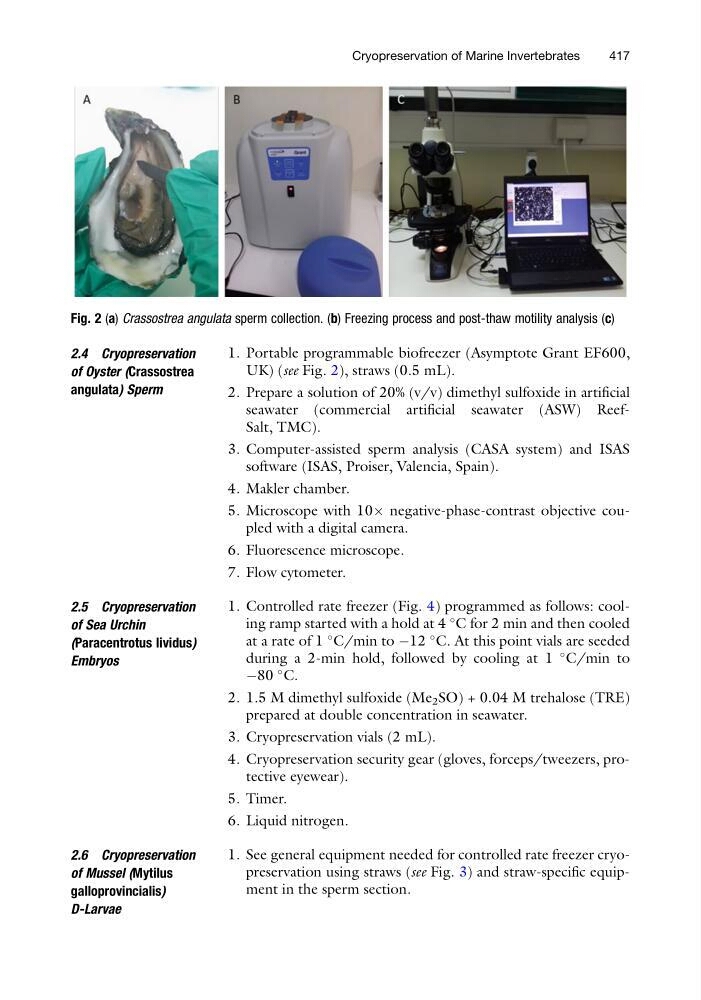
UK) (see Fig. 2), straws (0.5 mL).
2. Prepare a solution of 20% (v/v) dimethyl sulfoxide in artificial
seawater (commercial artificial seawater (ASW) ReefSalt, TMC).
3. Computer-assisted sperm analysis (CASA system) and ISAS
software (ISAS, Proiser, Valencia, Spain).
4. Makler chamber.
5. Microscope with 10Â negative-phase-contrast objective coupled with a digital camera.
6. Fluorescence microscope.
7. Flow cytometer.
2.5 Cryopreservation
of Sea Urchin
(Paracentrotus lividus)
Embryos
1. Controlled rate freezer (Fig. 4) programmed as follows: cooling ramp started with a hold at 4
C for 2 min and then cooled
at a rate of 1
C/min to À12
C. At this point vials are seeded
during a 2-min hold, followed by cooling at 1
C/min to
À80
C.
2. 1.5 M dimethyl sulfoxide (Me 2 SO) + 0.04 M trehalose (TRE)
prepared at double concentration in seawater.
3. Cryopreservation vials (2 mL).
4. Cryopreservation security gear (gloves, forceps/tweezers, protective eyewear).
5. Timer.
6. Liquid nitrogen.
2.6 Cryopreservation
of Mussel (Mytilus
galloprovincialis)
D-Larvae
1. See general equipment needed for controlled rate freezer cryopreservation using straws (see Fig. 3) and straw-specific equipment in the sperm section.
Fig. 2 (a) Crassostrea angulata sperm collection. (b) Freezing process and post-thaw motility analysis (c)
Cryopreservation of Marine Invertebrates
417
of Oyster (Crassostrea
angulata) Sperm
1. Portable programmable biofreezer (Asymptote Grant EF600,
UK) (see Fig. 2), straws (0.5 mL).
2. Prepare a solution of 20% (v/v) dimethyl sulfoxide in artificial
seawater (commercial artificial seawater (ASW) ReefSalt, TMC).
3. Computer-assisted sperm analysis (CASA system) and ISAS
software (ISAS, Proiser, Valencia, Spain).
4. Makler chamber.
5. Microscope with 10Â negative-phase-contrast objective coupled with a digital camera.
6. Fluorescence microscope.
7. Flow cytometer.
2.5 Cryopreservation
of Sea Urchin
(Paracentrotus lividus)
Embryos
1. Controlled rate freezer (Fig. 4) programmed as follows: cooling ramp started with a hold at 4
C for 2 min and then cooled
at a rate of 1
C/min to À12
C. At this point vials are seeded
during a 2-min hold, followed by cooling at 1
C/min to
À80
C.
2. 1.5 M dimethyl sulfoxide (Me 2 SO) + 0.04 M trehalose (TRE)
prepared at double concentration in seawater.
3. Cryopreservation vials (2 mL).
4. Cryopreservation security gear (gloves, forceps/tweezers, protective eyewear).
5. Timer.
6. Liquid nitrogen.
2.6 Cryopreservation
of Mussel (Mytilus
galloprovincialis)
D-Larvae
1. See general equipment needed for controlled rate freezer cryopreservation using straws (see Fig. 3) and straw-specific equipment in the sperm section.
Fig. 2 (a) Crassostrea angulata sperm collection. (b) Freezing process and post-thaw motility analysis (c)
Cryopreservation of Marine Invertebrates
417