

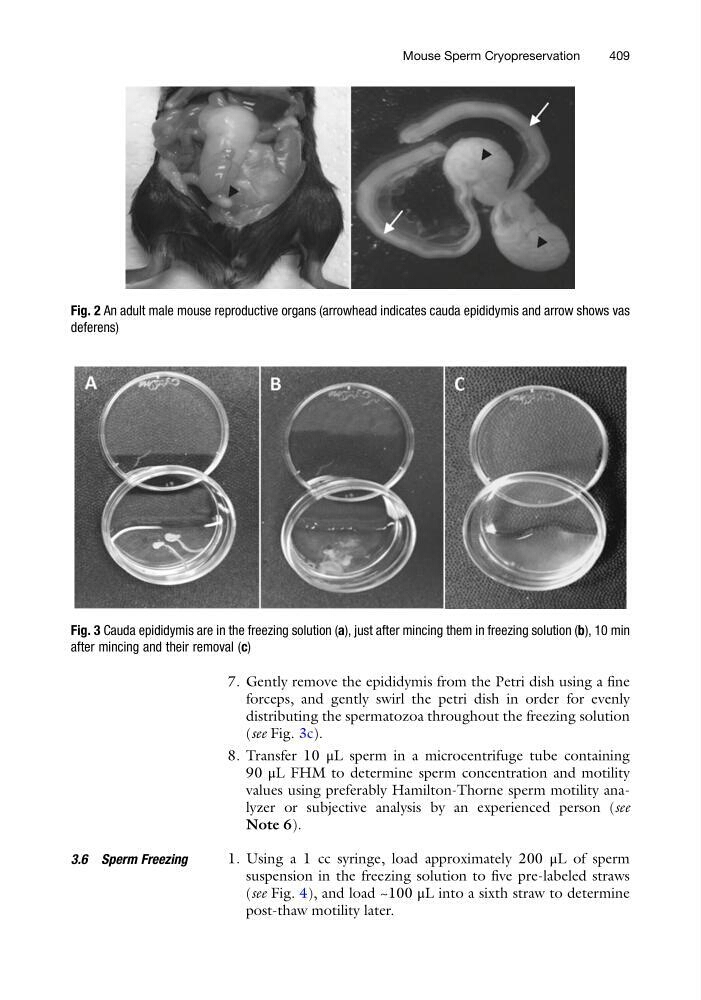
7. Gently remove the epididymis from the Petri dish using a fine
forceps, and gently swirl the petri dish in order for evenly
distributing the spermatozoa throughout the freezing solution
(see Fig. 3c).
8. Transfer 10 μL sperm in a microcentrifuge tube containing
90 μL FHM to determine sperm concentration and motility
values using preferably Hamilton-Thorne sperm motility analyzer or subjective analysis by an experienced person (see
Note 6).
3.6 Sperm Freezing
1. Using a 1 cc syringe, load approximately 200 μL of sperm
suspension in the freezing solution to five pre-labeled straws
(see Fig. 4), and load ~100 μL into a sixth straw to determine
post-thaw motility later.
Fig. 3 Cauda epididymis are in the freezing solution (a), just after mincing them in freezing solution (b), 10 min
after mincing and their removal (c)
Fig. 2 An adult male mouse reproductive organs (arrowhead indicates cauda epididymis and arrow shows vas
deferens)
Mouse Sperm Cryopreservation
409
forceps, and gently swirl the petri dish in order for evenly
distributing the spermatozoa throughout the freezing solution
(see Fig. 3c).
8. Transfer 10 μL sperm in a microcentrifuge tube containing
90 μL FHM to determine sperm concentration and motility
values using preferably Hamilton-Thorne sperm motility analyzer or subjective analysis by an experienced person (see
Note 6).
3.6 Sperm Freezing
1. Using a 1 cc syringe, load approximately 200 μL of sperm
suspension in the freezing solution to five pre-labeled straws
(see Fig. 4), and load ~100 μL into a sixth straw to determine
post-thaw motility later.
Fig. 3 Cauda epididymis are in the freezing solution (a), just after mincing them in freezing solution (b), 10 min
after mincing and their removal (c)
Fig. 2 An adult male mouse reproductive organs (arrowhead indicates cauda epididymis and arrow shows vas
deferens)
Mouse Sperm Cryopreservation
409