

5. Measure the osmolality (280–290 mOsm/kg) and pH (~7.2)
and record, and filter into an appropriately sized sterile bottle
using 0.22 μm pore size filters.
6. Aliquot into a desired volume, and label the tubes with make
and expiration date (3 months from make date), initials, and
batch number.
7. Store in À20
C freezer for up to 3 months (see Note 5).
3.5 Sperm Collection
1. Set up the dissection area with a set of small scissors, fine
forceps, and curved forceps for each donor male (three donor
males preferably 3–6 months old).
2. Before euthanizing the mice, thaw the sperm freezing solution
to 37
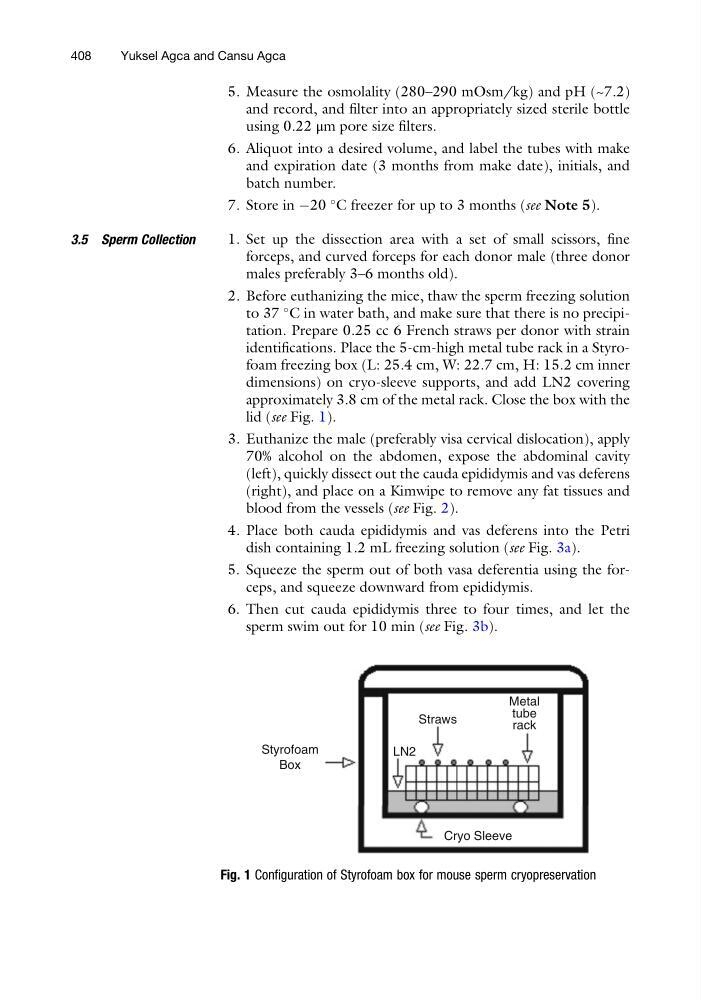
C in water bath, and make sure that there is no precipitation. Prepare 0.25 cc 6 French straws per donor with strain
identifications. Place the 5-cm-high metal tube rack in a Styrofoam freezing box (L: 25.4 cm, W: 22.7 cm, H: 15.2 cm inner
dimensions) on cryo-sleeve supports, and add LN2 covering
approximately 3.8 cm of the metal rack. Close the box with the
lid (see Fig. 1).
3. Euthanize the male (preferably visa cervical dislocation), apply
70% alcohol on the abdomen, expose the abdominal cavity
(left), quickly dissect out the cauda epididymis and vas deferens
(right), and place on a Kimwipe to remove any fat tissues and
blood from the vessels (see Fig. 2).
4. Place both cauda epididymis and vas deferens into the Petri
dish containing 1.2 mL freezing solution (see Fig. 3a).
5. Squeeze the sperm out of both vasa deferentia using the forceps, and squeeze downward from epididymis.
6. Then cut cauda epididymis three to four times, and let the
sperm swim out for 10 min (see Fig. 3b).
LN2
Cryo Sleeve
Styrofoam
Box
Straws
Metal
tube
rack
Fig. 1 Configuration of Styrofoam box for mouse sperm cryopreservation
408
Yuksel Agca and Cansu Agca
and record, and filter into an appropriately sized sterile bottle
using 0.22 μm pore size filters.
6. Aliquot into a desired volume, and label the tubes with make
and expiration date (3 months from make date), initials, and
batch number.
7. Store in À20
C freezer for up to 3 months (see Note 5).
3.5 Sperm Collection
1. Set up the dissection area with a set of small scissors, fine
forceps, and curved forceps for each donor male (three donor
males preferably 3–6 months old).
2. Before euthanizing the mice, thaw the sperm freezing solution
to 37
C in water bath, and make sure that there is no precipitation. Prepare 0.25 cc 6 French straws per donor with strain
identifications. Place the 5-cm-high metal tube rack in a Styrofoam freezing box (L: 25.4 cm, W: 22.7 cm, H: 15.2 cm inner
dimensions) on cryo-sleeve supports, and add LN2 covering
approximately 3.8 cm of the metal rack. Close the box with the
lid (see Fig. 1).
3. Euthanize the male (preferably visa cervical dislocation), apply
70% alcohol on the abdomen, expose the abdominal cavity
(left), quickly dissect out the cauda epididymis and vas deferens
(right), and place on a Kimwipe to remove any fat tissues and
blood from the vessels (see Fig. 2).
4. Place both cauda epididymis and vas deferens into the Petri
dish containing 1.2 mL freezing solution (see Fig. 3a).
5. Squeeze the sperm out of both vasa deferentia using the forceps, and squeeze downward from epididymis.
6. Then cut cauda epididymis three to four times, and let the
sperm swim out for 10 min (see Fig. 3b).
LN2
Cryo Sleeve
Styrofoam
Box
Straws
Metal
tube
rack
Fig. 1 Configuration of Styrofoam box for mouse sperm cryopreservation
408
Yuksel Agca and Cansu Agca