

3 Methods
3.1 CT Calibration at
Room Temperature
1. Prepare the different Me 2 SO solutions in PBS or other solvent,
in several concentrations within the range of concentration you
expect to obtain in your sample, and add a sample of each
concentration in a different container, including a sample of
the solvent with no CPA and a sample with Milli-Q water. Try
to prevent air bubbles when filling the containers. The containers should be the same to the one you are going to use for
analyzing your biological sample. Other CPAs could be used,
depending on the characteristics of the CT device used, but the
difference of attenuation for each concentration will not probably be enough to use it as quantification, as can be seen in
Fig. 3.
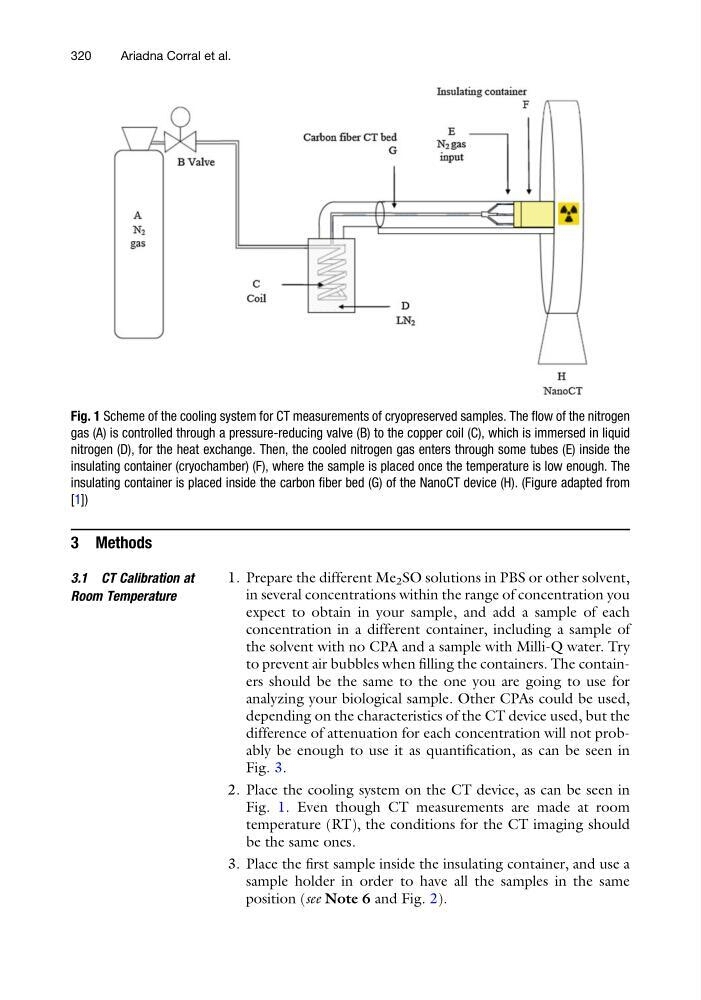
2. Place the cooling system on the CT device, as can be seen in
Fig. 1. Even though CT measurements are made at room
temperature (RT), the conditions for the CT imaging should
be the same ones.
3. Place the first sample inside the insulating container, and use a
sample holder in order to have all the samples in the same
position (see Note 6 and Fig. 2).
Fig. 1 Scheme of the cooling system for CT measurements of cryopreserved samples. The flow of the nitrogen
gas (A) is controlled through a pressure-reducing valve (B) to the copper coil (C), which is immersed in liquid
nitrogen (D), for the heat exchange. Then, the cooled nitrogen gas enters through some tubes (E) inside the
insulating container (cryochamber) (F), where the sample is placed once the temperature is low enough. The
insulating container is placed inside the carbon fiber bed (G) of the NanoCT device (H). (Figure adapted from
[1])
320
Ariadna Corral et al.
3.1 CT Calibration at
Room Temperature
1. Prepare the different Me 2 SO solutions in PBS or other solvent,
in several concentrations within the range of concentration you
expect to obtain in your sample, and add a sample of each
concentration in a different container, including a sample of
the solvent with no CPA and a sample with Milli-Q water. Try
to prevent air bubbles when filling the containers. The containers should be the same to the one you are going to use for
analyzing your biological sample. Other CPAs could be used,
depending on the characteristics of the CT device used, but the
difference of attenuation for each concentration will not probably be enough to use it as quantification, as can be seen in
Fig. 3.
2. Place the cooling system on the CT device, as can be seen in
Fig. 1. Even though CT measurements are made at room
temperature (RT), the conditions for the CT imaging should
be the same ones.
3. Place the first sample inside the insulating container, and use a
sample holder in order to have all the samples in the same
position (see Note 6 and Fig. 2).
Fig. 1 Scheme of the cooling system for CT measurements of cryopreserved samples. The flow of the nitrogen
gas (A) is controlled through a pressure-reducing valve (B) to the copper coil (C), which is immersed in liquid
nitrogen (D), for the heat exchange. Then, the cooled nitrogen gas enters through some tubes (E) inside the
insulating container (cryochamber) (F), where the sample is placed once the temperature is low enough. The
insulating container is placed inside the carbon fiber bed (G) of the NanoCT device (H). (Figure adapted from
[1])
320
Ariadna Corral et al.