

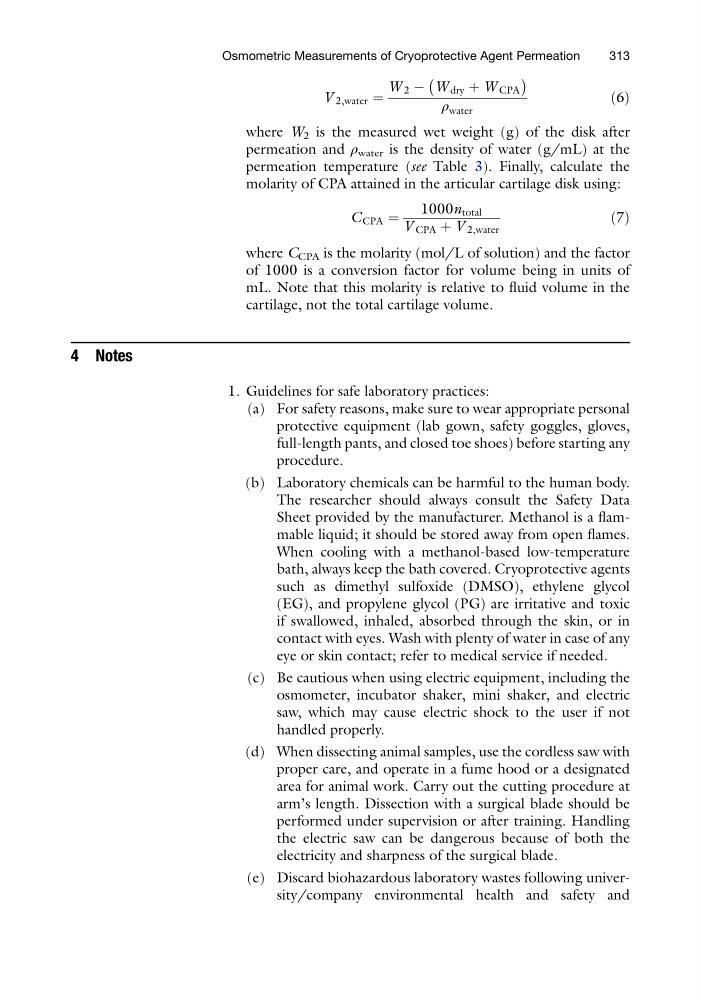
V 2,water ¼
W 2 À W dry þ W CPA
À
Á
ρ water
ð6Þ
where W 2 is the measured wet weight (g) of the disk after
permeation and ρ water is the density of water (g/mL) at the
permeation temperature (see Table 3). Finally, calculate the
molarity of CPA attained in the articular cartilage disk using:
C CPA ¼
1000n total
V CPA þ V 2,water
ð7Þ
where C CPA is the molarity (mol/L of solution) and the factor
of 1000 is a conversion factor for volume being in units of
mL. Note that this molarity is relative to fluid volume in the
cartilage, not the total cartilage volume.
4 Notes
1. Guidelines for safe laboratory practices:
(a) For safety reasons, make sure to wear appropriate personal
protective equipment (lab gown, safety goggles, gloves,
full-length pants, and closed toe shoes) before starting any
procedure.
(b) Laboratory chemicals can be harmful to the human body.
The researcher should always consult the Safety Data
Sheet provided by the manufacturer. Methanol is a flammable liquid; it should be stored away from open flames.
When cooling with a methanol-based low-temperature
bath, always keep the bath covered. Cryoprotective agents
such as dimethyl sulfoxide (DMSO), ethylene glycol
(EG), and propylene glycol (PG) are irritative and toxic
if swallowed, inhaled, absorbed through the skin, or in
contact with eyes. Wash with plenty of water in case of any
eye or skin contact; refer to medical service if needed.
(c) Be cautious when using electric equipment, including the
osmometer, incubator shaker, mini shaker, and electric
saw, which may cause electric shock to the user if not
handled properly.
(d) When dissecting animal samples, use the cordless saw with
proper care, and operate in a fume hood or a designated
area for animal work. Carry out the cutting procedure at
arm’s length. Dissection with a surgical blade should be
performed under supervision or after training. Handling
the electric saw can be dangerous because of both the
electricity and sharpness of the surgical blade.
(e) Discard biohazardous laboratory wastes following university/company environmental health and safety and
Osmometric Measurements of Cryoprotective Agent Permeation
313
W 2 À W dry þ W CPA
À
Á
ρ water
ð6Þ
where W 2 is the measured wet weight (g) of the disk after
permeation and ρ water is the density of water (g/mL) at the
permeation temperature (see Table 3). Finally, calculate the
molarity of CPA attained in the articular cartilage disk using:
C CPA ¼
1000n total
V CPA þ V 2,water
ð7Þ
where C CPA is the molarity (mol/L of solution) and the factor
of 1000 is a conversion factor for volume being in units of
mL. Note that this molarity is relative to fluid volume in the
cartilage, not the total cartilage volume.
4 Notes
1. Guidelines for safe laboratory practices:
(a) For safety reasons, make sure to wear appropriate personal
protective equipment (lab gown, safety goggles, gloves,
full-length pants, and closed toe shoes) before starting any
procedure.
(b) Laboratory chemicals can be harmful to the human body.
The researcher should always consult the Safety Data
Sheet provided by the manufacturer. Methanol is a flammable liquid; it should be stored away from open flames.
When cooling with a methanol-based low-temperature
bath, always keep the bath covered. Cryoprotective agents
such as dimethyl sulfoxide (DMSO), ethylene glycol
(EG), and propylene glycol (PG) are irritative and toxic
if swallowed, inhaled, absorbed through the skin, or in
contact with eyes. Wash with plenty of water in case of any
eye or skin contact; refer to medical service if needed.
(c) Be cautious when using electric equipment, including the
osmometer, incubator shaker, mini shaker, and electric
saw, which may cause electric shock to the user if not
handled properly.
(d) When dissecting animal samples, use the cordless saw with
proper care, and operate in a fume hood or a designated
area for animal work. Carry out the cutting procedure at
arm’s length. Dissection with a surgical blade should be
performed under supervision or after training. Handling
the electric saw can be dangerous because of both the
electricity and sharpness of the surgical blade.
(e) Discard biohazardous laboratory wastes following university/company environmental health and safety and
Osmometric Measurements of Cryoprotective Agent Permeation
313