

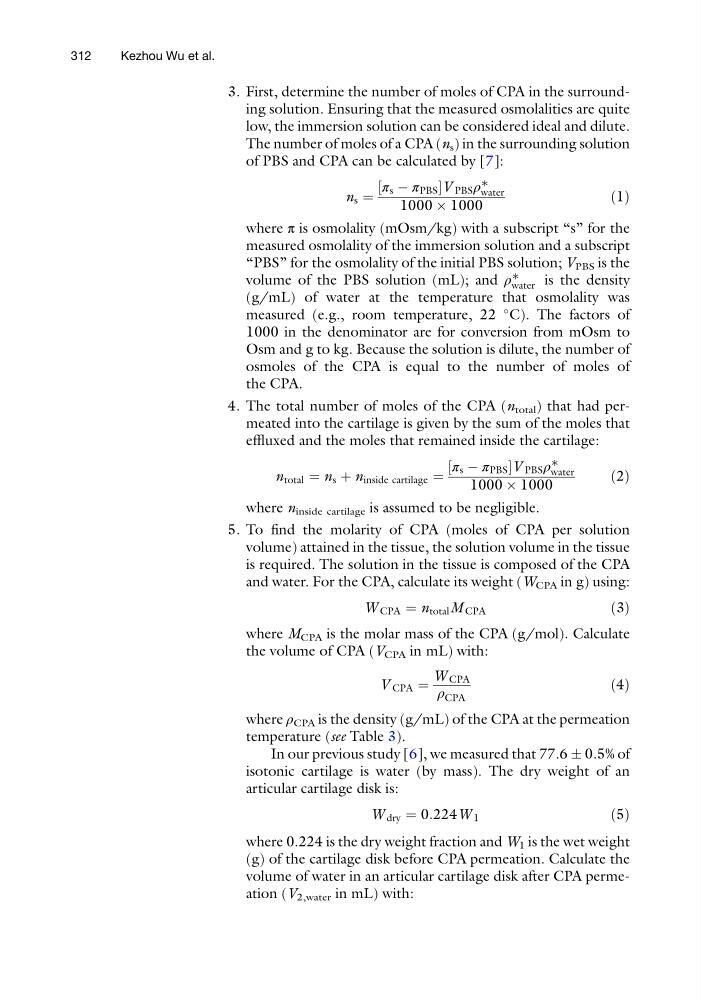
3. First, determine the number of moles of CPA in the surrounding solution. Ensuring that the measured osmolalities are quite
low, the immersion solution can be considered ideal and dilute.
The number of moles of a CPA (n s ) in the surrounding solution
of PBS and CPA can be calculated by [7]:
n s ¼
π s À π PBS
½
V PBS ρ
∗
water
1000 Â 1000
ð1Þ
where π is osmolality (mOsm/kg) with a subscript “s” for the
measured osmolality of the immersion solution and a subscript
“PBS” for the osmolality of the initial PBS solution; V PBS is the
volume of the PBS solution (mL); and ρ
∗
water is the density
(g/mL) of water at the temperature that osmolality was
measured (e.g., room temperature, 22
C). The factors of
1000 in the denominator are for conversion from mOsm to
Osm and g to kg. Because the solution is dilute, the number of
osmoles of the CPA is equal to the number of moles of
the CPA.
4. The total number of moles of the CPA (n total ) that had permeated into the cartilage is given by the sum of the moles that
effluxed and the moles that remained inside the cartilage:
n total ¼ n s þ n inside cartilage ¼
π s À π PBS
½
V PBS ρ
∗
water
1000 Â 1000
ð2Þ
where n inside cartilage is assumed to be negligible.
5. To find the molarity of CPA (moles of CPA per solution
volume) attained in the tissue, the solution volume in the tissue
is required. The solution in the tissue is composed of the CPA
and water. For the CPA, calculate its weight (W CPA in g) using:
W CPA ¼ n total M CPA
ð3Þ
where M CPA is the molar mass of the CPA (g/mol). Calculate
the volume of CPA (V CPA in mL) with:
V CPA ¼
W CPA
ρ CPA
ð4Þ
where ρ CPA is the density (g/mL) of the CPA at the permeation
temperature (see Table 3).
In our previous study [6], we measured that 77.6 Æ 0.5% of
isotonic cartilage is water (by mass). The dry weight of an
articular cartilage disk is:
W dry ¼ 0:224W 1
ð5Þ
where 0.224 is the dry weight fraction and W 1 is the wet weight
(g) of the cartilage disk before CPA permeation. Calculate the
volume of water in an articular cartilage disk after CPA permeation (V 2,water in mL) with:
312
Kezhou Wu et al.
low, the immersion solution can be considered ideal and dilute.
The number of moles of a CPA (n s ) in the surrounding solution
of PBS and CPA can be calculated by [7]:
n s ¼
π s À π PBS
½
V PBS ρ
∗
water
1000 Â 1000
ð1Þ
where π is osmolality (mOsm/kg) with a subscript “s” for the
measured osmolality of the immersion solution and a subscript
“PBS” for the osmolality of the initial PBS solution; V PBS is the
volume of the PBS solution (mL); and ρ
∗
water is the density
(g/mL) of water at the temperature that osmolality was
measured (e.g., room temperature, 22
C). The factors of
1000 in the denominator are for conversion from mOsm to
Osm and g to kg. Because the solution is dilute, the number of
osmoles of the CPA is equal to the number of moles of
the CPA.
4. The total number of moles of the CPA (n total ) that had permeated into the cartilage is given by the sum of the moles that
effluxed and the moles that remained inside the cartilage:
n total ¼ n s þ n inside cartilage ¼
π s À π PBS
½
V PBS ρ
∗
water
1000 Â 1000
ð2Þ
where n inside cartilage is assumed to be negligible.
5. To find the molarity of CPA (moles of CPA per solution
volume) attained in the tissue, the solution volume in the tissue
is required. The solution in the tissue is composed of the CPA
and water. For the CPA, calculate its weight (W CPA in g) using:
W CPA ¼ n total M CPA
ð3Þ
where M CPA is the molar mass of the CPA (g/mol). Calculate
the volume of CPA (V CPA in mL) with:
V CPA ¼
W CPA
ρ CPA
ð4Þ
where ρ CPA is the density (g/mL) of the CPA at the permeation
temperature (see Table 3).
In our previous study [6], we measured that 77.6 Æ 0.5% of
isotonic cartilage is water (by mass). The dry weight of an
articular cartilage disk is:
W dry ¼ 0:224W 1
ð5Þ
where 0.224 is the dry weight fraction and W 1 is the wet weight
(g) of the cartilage disk before CPA permeation. Calculate the
volume of water in an articular cartilage disk after CPA permeation (V 2,water in mL) with:
312
Kezhou Wu et al.