

4. Place the 10 mm diameter cartilage disk into the well plate for
CPA efflux.
5. Use a 100 μL pipette to take 50 μL of the CPA/PBS wash
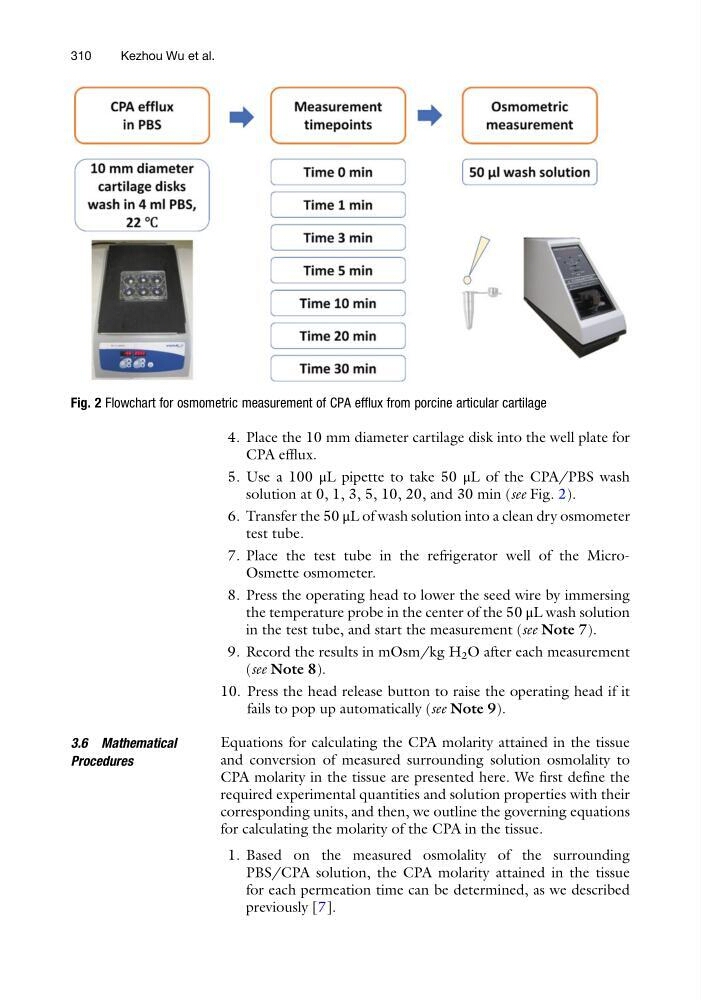
solution at 0, 1, 3, 5, 10, 20, and 30 min (see Fig. 2).
6. Transfer the 50 μL of wash solution into a clean dry osmometer
test tube.
7. Place the test tube in the refrigerator well of the MicroOsmette osmometer.
8. Press the operating head to lower the seed wire by immersing
the temperature probe in the center of the 50 μL wash solution
in the test tube, and start the measurement (see Note 7).
9. Record the results in mOsm/kg H 2 O after each measurement
(see Note 8).
10. Press the head release button to raise the operating head if it
fails to pop up automatically (see Note 9).
3.6 Mathematical
Procedures
Equations for calculating the CPA molarity attained in the tissue
and conversion of measured surrounding solution osmolality to
CPA molarity in the tissue are presented here. We first define the
required experimental quantities and solution properties with their
corresponding units, and then, we outline the governing equations
for calculating the molarity of the CPA in the tissue.
1. Based on the measured osmolality of the surrounding
PBS/CPA solution, the CPA molarity attained in the tissue
for each permeation time can be determined, as we described
previously [7].
Fig. 2 Flowchart for osmometric measurement of CPA efflux from porcine articular cartilage
310
Kezhou Wu et al.
CPA efflux.
5. Use a 100 μL pipette to take 50 μL of the CPA/PBS wash
solution at 0, 1, 3, 5, 10, 20, and 30 min (see Fig. 2).
6. Transfer the 50 μL of wash solution into a clean dry osmometer
test tube.
7. Place the test tube in the refrigerator well of the MicroOsmette osmometer.
8. Press the operating head to lower the seed wire by immersing
the temperature probe in the center of the 50 μL wash solution
in the test tube, and start the measurement (see Note 7).
9. Record the results in mOsm/kg H 2 O after each measurement
(see Note 8).
10. Press the head release button to raise the operating head if it
fails to pop up automatically (see Note 9).
3.6 Mathematical
Procedures
Equations for calculating the CPA molarity attained in the tissue
and conversion of measured surrounding solution osmolality to
CPA molarity in the tissue are presented here. We first define the
required experimental quantities and solution properties with their
corresponding units, and then, we outline the governing equations
for calculating the molarity of the CPA in the tissue.
1. Based on the measured osmolality of the surrounding
PBS/CPA solution, the CPA molarity attained in the tissue
for each permeation time can be determined, as we described
previously [7].
Fig. 2 Flowchart for osmometric measurement of CPA efflux from porcine articular cartilage
310
Kezhou Wu et al.