

7. After 24 h, use a pipette controller with a 5-mL sterile pipette
to mix the CPA/PBS solution, remove 1 mL of CPA/PBS
solution, and insert into a 1.5 mL microcentrifuge tube to
prepare for osmometric measurement. Take 50 μL of the
CPA/PBS solution to determine the osmolality of the solution
using the Micro-Osmette osmometer (see details in Subheading
3.3).
3.5 Cryoprotective
Agent Efflux from
Tissue
and Osmometric
Measurement
An alternative method is to measure the CPA efflux as a function of
time. This procedure documents the efflux of a single type of CPA
from articular cartilage into the surrounding solution for different
temperatures as a function of time. Again, measurement at a series
of temperatures can also be used to give an indication of the
temperature dependence of the CPA efflux process. The procedure
for osmometric measurement of CPA efflux from porcine articular
cartilage at 22
C is illustrated in Fig. 2.
1. Prepare the tissue for CPA efflux after the CPA permeation
procedure. In this example, we prepared the porcine articular
cartilage into 10-mm diameter disks as per our previous
method in Subheading 3.4.
2. Choose the range of the Micro-Osmette osmometer (see
Note 6).
3. Prepare 30-mL beakers with some sterile 1Â PBS solution.
Place a multi-well plate on the orbital mini shaker, and prefill
with 4 mL PBS into each well of the plate. Label the test tubes
for use in the osmometer (50-μL disposable test tube). The
amount of PBS should be sufficient such that the CPA efflux
changes the osmolality of the surrounding solution sufficiently
to be measured but does not overwhelm the osmotic driving
force of the PBS to draw CPA out of the tissue.
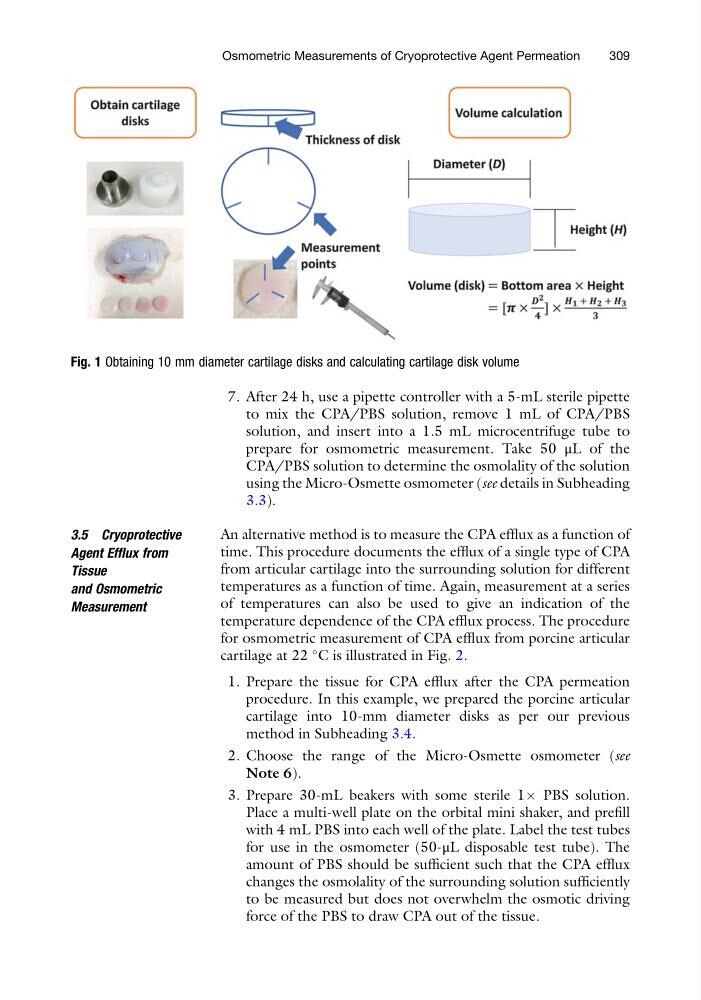
Fig. 1 Obtaining 10 mm diameter cartilage disks and calculating cartilage disk volume
Osmometric Measurements of Cryoprotective Agent Permeation
309
to mix the CPA/PBS solution, remove 1 mL of CPA/PBS
solution, and insert into a 1.5 mL microcentrifuge tube to
prepare for osmometric measurement. Take 50 μL of the
CPA/PBS solution to determine the osmolality of the solution
using the Micro-Osmette osmometer (see details in Subheading
3.3).
3.5 Cryoprotective
Agent Efflux from
Tissue
and Osmometric
Measurement
An alternative method is to measure the CPA efflux as a function of
time. This procedure documents the efflux of a single type of CPA
from articular cartilage into the surrounding solution for different
temperatures as a function of time. Again, measurement at a series
of temperatures can also be used to give an indication of the
temperature dependence of the CPA efflux process. The procedure
for osmometric measurement of CPA efflux from porcine articular
cartilage at 22
C is illustrated in Fig. 2.
1. Prepare the tissue for CPA efflux after the CPA permeation
procedure. In this example, we prepared the porcine articular
cartilage into 10-mm diameter disks as per our previous
method in Subheading 3.4.
2. Choose the range of the Micro-Osmette osmometer (see
Note 6).
3. Prepare 30-mL beakers with some sterile 1Â PBS solution.
Place a multi-well plate on the orbital mini shaker, and prefill
with 4 mL PBS into each well of the plate. Label the test tubes
for use in the osmometer (50-μL disposable test tube). The
amount of PBS should be sufficient such that the CPA efflux
changes the osmolality of the surrounding solution sufficiently
to be measured but does not overwhelm the osmotic driving
force of the PBS to draw CPA out of the tissue.
Fig. 1 Obtaining 10 mm diameter cartilage disks and calculating cartilage disk volume
Osmometric Measurements of Cryoprotective Agent Permeation
309