

12. Adjacent to the previous column, create a new column to
contain values of the Nelson-Aalen estimator of cumulative
hazard. Fill the rows of the new column by computing a
running sum of the values in the previous column, as shown
in Table 2 (see column labeled “A”).
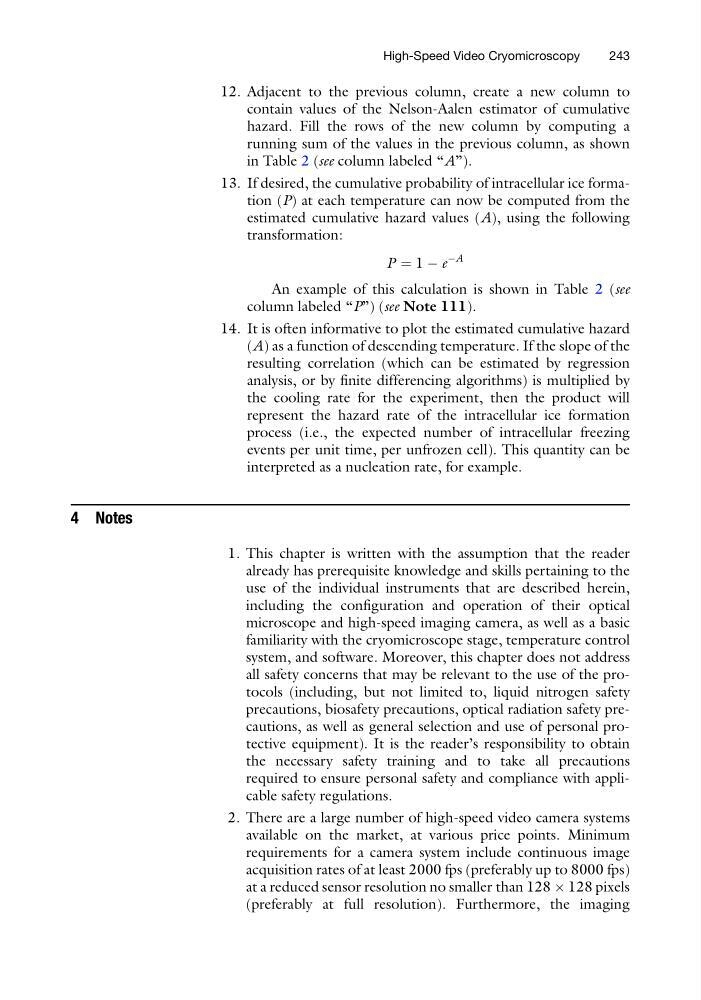
13. If desired, the cumulative probability of intracellular ice formation (P) at each temperature can now be computed from the
estimated cumulative hazard values (A), using the following
transformation:
P ¼ 1 À e
ÀA
An example of this calculation is shown in Table 2 (see
column labeled “P”) (see Note 111).
14. It is often informative to plot the estimated cumulative hazard
(A) as a function of descending temperature. If the slope of the
resulting correlation (which can be estimated by regression
analysis, or by finite differencing algorithms) is multiplied by
the cooling rate for the experiment, then the product will
represent the hazard rate of the intracellular ice formation
process (i.e., the expected number of intracellular freezing
events per unit time, per unfrozen cell). This quantity can be
interpreted as a nucleation rate, for example.
4 Notes
1. This chapter is written with the assumption that the reader
already has prerequisite knowledge and skills pertaining to the
use of the individual instruments that are described herein,
including the configuration and operation of their optical
microscope and high-speed imaging camera, as well as a basic
familiarity with the cryomicroscope stage, temperature control
system, and software. Moreover, this chapter does not address
all safety concerns that may be relevant to the use of the protocols (including, but not limited to, liquid nitrogen safety
precautions, biosafety precautions, optical radiation safety precautions, as well as general selection and use of personal protective equipment). It is the reader’s responsibility to obtain
the necessary safety training and to take all precautions
required to ensure personal safety and compliance with applicable safety regulations.
2. There are a large number of high-speed video camera systems
available on the market, at various price points. Minimum
requirements for a camera system include continuous image
acquisition rates of at least 2000 fps (preferably up to 8000 fps)
at a reduced sensor resolution no smaller than 128 Â 128 pixels
(preferably at full resolution). Furthermore, the imaging
High-Speed Video Cryomicroscopy
243
contain values of the Nelson-Aalen estimator of cumulative
hazard. Fill the rows of the new column by computing a
running sum of the values in the previous column, as shown
in Table 2 (see column labeled “A”).
13. If desired, the cumulative probability of intracellular ice formation (P) at each temperature can now be computed from the
estimated cumulative hazard values (A), using the following
transformation:
P ¼ 1 À e
ÀA
An example of this calculation is shown in Table 2 (see
column labeled “P”) (see Note 111).
14. It is often informative to plot the estimated cumulative hazard
(A) as a function of descending temperature. If the slope of the
resulting correlation (which can be estimated by regression
analysis, or by finite differencing algorithms) is multiplied by
the cooling rate for the experiment, then the product will
represent the hazard rate of the intracellular ice formation
process (i.e., the expected number of intracellular freezing
events per unit time, per unfrozen cell). This quantity can be
interpreted as a nucleation rate, for example.
4 Notes
1. This chapter is written with the assumption that the reader
already has prerequisite knowledge and skills pertaining to the
use of the individual instruments that are described herein,
including the configuration and operation of their optical
microscope and high-speed imaging camera, as well as a basic
familiarity with the cryomicroscope stage, temperature control
system, and software. Moreover, this chapter does not address
all safety concerns that may be relevant to the use of the protocols (including, but not limited to, liquid nitrogen safety
precautions, biosafety precautions, optical radiation safety precautions, as well as general selection and use of personal protective equipment). It is the reader’s responsibility to obtain
the necessary safety training and to take all precautions
required to ensure personal safety and compliance with applicable safety regulations.
2. There are a large number of high-speed video camera systems
available on the market, at various price points. Minimum
requirements for a camera system include continuous image
acquisition rates of at least 2000 fps (preferably up to 8000 fps)
at a reduced sensor resolution no smaller than 128 Â 128 pixels
(preferably at full resolution). Furthermore, the imaging
High-Speed Video Cryomicroscopy
243