

over Fick’s law, but, again, the total volume of the tissue is assumed
constant, and the models are based on the assumption of an ideal
and dilute solution.
3.1.3 Maxwell-Stefan
Diffusion
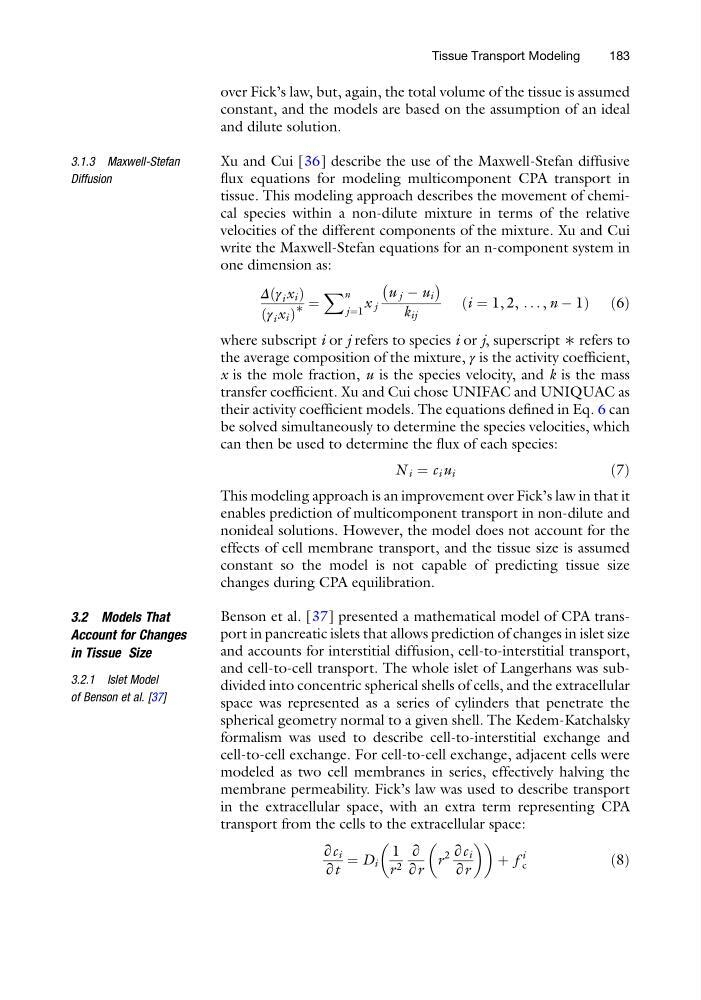
Xu and Cui [36] describe the use of the Maxwell-Stefan diffusive
flux equations for modeling multicomponent CPA transport in
tissue. This modeling approach describes the movement of chemical species within a non-dilute mixture in terms of the relative
velocities of the different components of the mixture. Xu and Cui
write the Maxwell-Stefan equations for an n-component system in
one dimension as:
Δ γ i x i
ð
Þ
γ i x i
ð
Þ
∗ ¼
X n
j ¼1
x j
u j À u i
À
Á
k ij
i ¼ 1, 2, . . . , n À 1
ð
Þ ð 6Þ
where subscript i or j refers to species i or j, superscript ∗ refers to
the average composition of the mixture, γ is the activity coefficient,
x is the mole fraction, u is the species velocity, and k is the mass
transfer coefficient. Xu and Cui chose UNIFAC and UNIQUAC as
their activity coefficient models. The equations defined in Eq. 6 can
be solved simultaneously to determine the species velocities, which
can then be used to determine the flux of each species:
N i ¼ c i u i
ð7Þ
This modeling approach is an improvement over Fick’s law in that it
enables prediction of multicomponent transport in non-dilute and
nonideal solutions. However, the model does not account for the
effects of cell membrane transport, and the tissue size is assumed
constant so the model is not capable of predicting tissue size
changes during CPA equilibration.
3.2 Models That
Account for Changes
in Tissue Size
3.2.1 Islet Model
of Benson et al. [37]
Benson et al. [37] presented a mathematical model of CPA transport in pancreatic islets that allows prediction of changes in islet size
and accounts for interstitial diffusion, cell-to-interstitial transport,
and cell-to-cell transport. The whole islet of Langerhans was subdivided into concentric spherical shells of cells, and the extracellular
space was represented as a series of cylinders that penetrate the
spherical geometry normal to a given shell. The Kedem-Katchalsky
formalism was used to describe cell-to-interstitial exchange and
cell-to-cell exchange. For cell-to-cell exchange, adjacent cells were
modeled as two cell membranes in series, effectively halving the
membrane permeability. Fick’s law was used to describe transport
in the extracellular space, with an extra term representing CPA
transport from the cells to the extracellular space:
∂c i
∂t
¼ D i
1
r 2
∂
∂r
r
2 ∂c i
∂r
þ f
i
c
ð8Þ
Tissue Transport Modeling
183
constant, and the models are based on the assumption of an ideal
and dilute solution.
3.1.3 Maxwell-Stefan
Diffusion
Xu and Cui [36] describe the use of the Maxwell-Stefan diffusive
flux equations for modeling multicomponent CPA transport in
tissue. This modeling approach describes the movement of chemical species within a non-dilute mixture in terms of the relative
velocities of the different components of the mixture. Xu and Cui
write the Maxwell-Stefan equations for an n-component system in
one dimension as:
Δ γ i x i
ð
Þ
γ i x i
ð
Þ
∗ ¼
X n
j ¼1
x j
u j À u i
À
Á
k ij
i ¼ 1, 2, . . . , n À 1
ð
Þ ð 6Þ
where subscript i or j refers to species i or j, superscript ∗ refers to
the average composition of the mixture, γ is the activity coefficient,
x is the mole fraction, u is the species velocity, and k is the mass
transfer coefficient. Xu and Cui chose UNIFAC and UNIQUAC as
their activity coefficient models. The equations defined in Eq. 6 can
be solved simultaneously to determine the species velocities, which
can then be used to determine the flux of each species:
N i ¼ c i u i
ð7Þ
This modeling approach is an improvement over Fick’s law in that it
enables prediction of multicomponent transport in non-dilute and
nonideal solutions. However, the model does not account for the
effects of cell membrane transport, and the tissue size is assumed
constant so the model is not capable of predicting tissue size
changes during CPA equilibration.
3.2 Models That
Account for Changes
in Tissue Size
3.2.1 Islet Model
of Benson et al. [37]
Benson et al. [37] presented a mathematical model of CPA transport in pancreatic islets that allows prediction of changes in islet size
and accounts for interstitial diffusion, cell-to-interstitial transport,
and cell-to-cell transport. The whole islet of Langerhans was subdivided into concentric spherical shells of cells, and the extracellular
space was represented as a series of cylinders that penetrate the
spherical geometry normal to a given shell. The Kedem-Katchalsky
formalism was used to describe cell-to-interstitial exchange and
cell-to-cell exchange. For cell-to-cell exchange, adjacent cells were
modeled as two cell membranes in series, effectively halving the
membrane permeability. Fick’s law was used to describe transport
in the extracellular space, with an extra term representing CPA
transport from the cells to the extracellular space:
∂c i
∂t
¼ D i
1
r 2
∂
∂r
r
2 ∂c i
∂r
þ f
i
c
ð8Þ
Tissue Transport Modeling
183