

to result in a relatively high concentration in the center of the tissue
based on the argument that this would reduce osmotic damage
during CPA removal. Fick’s law was also used in a recent paper by
Benson and colleagues [10] to mathematically optimize methods
for CPA delivery into skin, fibroid tissue, and myometrium. Diffusion predictions were used in conjunction with a volume-averaged
toxicity cost function to design minimally toxic methods for CPA
delivery into these tissues. While promising, these novel methods
have yet to be experimentally validated.
3.1.2 Interstitial Diffusion
with Coupled Cell
Membrane Transport
Several groups have presented mathematical models for CPA transport in tissue that enable prediction of the combined effects of
Fickian diffusion and cell membrane transport. This modeling
approach accounts for both interstitial diffusion and cell membrane
transport, which is an improvement over Fick’s law, but it assumes
that the total volume of the tissue is constant, and it is based on the
assumption of an ideal and dilute solution.
He and Devireddy [12] and Devireddy [13] describe a Krogh
cylinder approach for modeling CPA transport in tissue. Their
model builds on previous work by Bhowmick et al. [34], which
describes adaptation of the classic Krogh cylinder geometry used
for organ perfusion modeling to transport in unperfused tissues.
The Krogh cylinder is typically comprised of a capillary with a
surrounding cylinder of tissue. To adapt this representation to
unperfused tissues, the tissue sample was subdivided into a series
of rectangular tissue compartments, each comprising a central
cylindrical “vascular” space representing all of the extracellular
space and a surrounding volume representing the intracellular
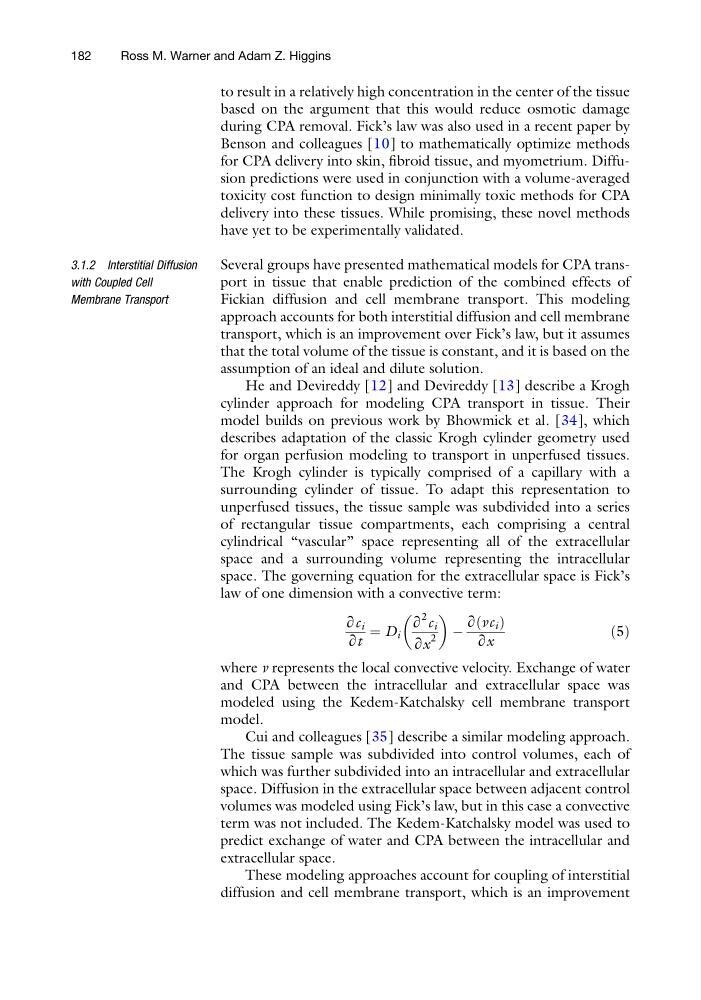
space. The governing equation for the extracellular space is Fick’s
law of one dimension with a convective term:
∂c i
∂t
¼ D i
∂
2 c i
∂x
2
À
∂ vc i
ð Þ
∂x
ð5Þ
where v represents the local convective velocity. Exchange of water
and CPA between the intracellular and extracellular space was
modeled using the Kedem-Katchalsky cell membrane transport
model.
Cui and colleagues [35] describe a similar modeling approach.
The tissue sample was subdivided into control volumes, each of
which was further subdivided into an intracellular and extracellular
space. Diffusion in the extracellular space between adjacent control
volumes was modeled using Fick’s law, but in this case a convective
term was not included. The Kedem-Katchalsky model was used to
predict exchange of water and CPA between the intracellular and
extracellular space.
These modeling approaches account for coupling of interstitial
diffusion and cell membrane transport, which is an improvement
182
Ross M. Warner and Adam Z. Higgins
based on the argument that this would reduce osmotic damage
during CPA removal. Fick’s law was also used in a recent paper by
Benson and colleagues [10] to mathematically optimize methods
for CPA delivery into skin, fibroid tissue, and myometrium. Diffusion predictions were used in conjunction with a volume-averaged
toxicity cost function to design minimally toxic methods for CPA
delivery into these tissues. While promising, these novel methods
have yet to be experimentally validated.
3.1.2 Interstitial Diffusion
with Coupled Cell
Membrane Transport
Several groups have presented mathematical models for CPA transport in tissue that enable prediction of the combined effects of
Fickian diffusion and cell membrane transport. This modeling
approach accounts for both interstitial diffusion and cell membrane
transport, which is an improvement over Fick’s law, but it assumes
that the total volume of the tissue is constant, and it is based on the
assumption of an ideal and dilute solution.
He and Devireddy [12] and Devireddy [13] describe a Krogh
cylinder approach for modeling CPA transport in tissue. Their
model builds on previous work by Bhowmick et al. [34], which
describes adaptation of the classic Krogh cylinder geometry used
for organ perfusion modeling to transport in unperfused tissues.
The Krogh cylinder is typically comprised of a capillary with a
surrounding cylinder of tissue. To adapt this representation to
unperfused tissues, the tissue sample was subdivided into a series
of rectangular tissue compartments, each comprising a central
cylindrical “vascular” space representing all of the extracellular
space and a surrounding volume representing the intracellular
space. The governing equation for the extracellular space is Fick’s
law of one dimension with a convective term:
∂c i
∂t
¼ D i
∂
2 c i
∂x
2
À
∂ vc i
ð Þ
∂x
ð5Þ
where v represents the local convective velocity. Exchange of water
and CPA between the intracellular and extracellular space was
modeled using the Kedem-Katchalsky cell membrane transport
model.
Cui and colleagues [35] describe a similar modeling approach.
The tissue sample was subdivided into control volumes, each of
which was further subdivided into an intracellular and extracellular
space. Diffusion in the extracellular space between adjacent control
volumes was modeled using Fick’s law, but in this case a convective
term was not included. The Kedem-Katchalsky model was used to
predict exchange of water and CPA between the intracellular and
extracellular space.
These modeling approaches account for coupling of interstitial
diffusion and cell membrane transport, which is an improvement
182
Ross M. Warner and Adam Z. Higgins