

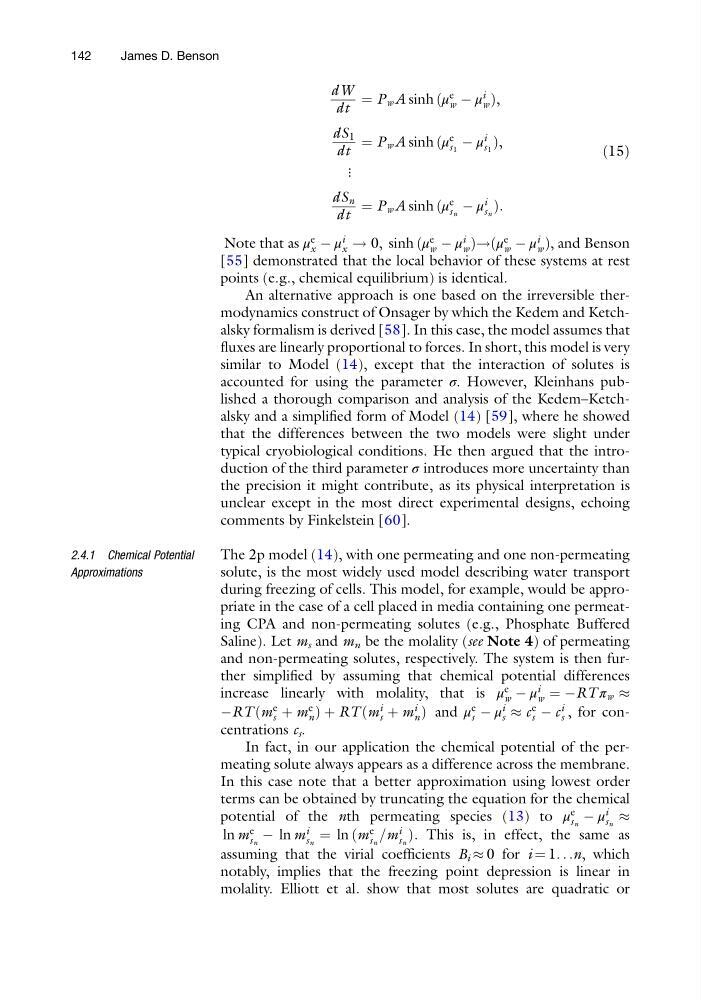
dW
dt
¼ P w A sinh ðμ
e
w À μ
i
w Þ,
dS 1
dt
¼ P w A sinh ðμ
e
s 1
À μ
i
s 1
Þ,
⋮
dS n
dt
¼ P w A sinh ðμ
e
s n
À μ
i
s n
Þ:
ð15Þ
Note that as μ
e
x À μ
i
x ! 0, sinh ðμ
e
w À μ
i
w Þ!ðμ
e
w À μ
i
w Þ, and Benson
[55] demonstrated that the local behavior of these systems at rest
points (e.g., chemical equilibrium) is identical.
An alternative approach is one based on the irreversible thermodynamics construct of Onsager by which the Kedem and Ketchalsky formalism is derived [58]. In this case, the model assumes that
fluxes are linearly proportional to forces. In short, this model is very
similar to Model (14), except that the interaction of solutes is
accounted for using the parameter σ. However, Kleinhans published a thorough comparison and analysis of the Kedem–Ketchalsky and a simplified form of Model (14) [59], where he showed
that the differences between the two models were slight under
typical cryobiological conditions. He then argued that the introduction of the third parameter σ introduces more uncertainty than
the precision it might contribute, as its physical interpretation is
unclear except in the most direct experimental designs, echoing
comments by Finkelstein [60].
2.4.1 Chemical Potential
Approximations
The 2p model (14), with one permeating and one non-permeating
solute, is the most widely used model describing water transport
during freezing of cells. This model, for example, would be appropriate in the case of a cell placed in media containing one permeating CPA and non-permeating solutes (e.g., Phosphate Buffered
Saline). Let m s and m n be the molality (see Note 4) of permeating
and non-permeating solutes, respectively. The system is then further simplified by assuming that chemical potential differences
increase linearly with molality, that is μ
e
w À μ
i
w ¼ ÀRT π w %
ÀRT ðm
e
s þ m
e
n Þ þ RT ðm
i
s þ m
i
n Þ and μ
e
s À μ
i
s % c
e
s À c
i
s , for concentrations c s .
In fact, in our application the chemical potential of the permeating solute always appears as a difference across the membrane.
In this case note that a better approximation using lowest order
terms can be obtained by truncating the equation for the chemical
potential of the nth permeating species (13) to μ
e
s n
À μ
i
s n
%
ln m
e
s n
À ln m
i
s n
¼ ln ðm
e
s n
=m
i
s n
Þ. This is, in effect, the same as
assuming that the virial coefficients B i % 0 for i ¼ 1. . .n, which
notably, implies that the freezing point depression is linear in
molality. Elliott et al. show that most solutes are quadratic or
142
James D. Benson
dt
¼ P w A sinh ðμ
e
w À μ
i
w Þ,
dS 1
dt
¼ P w A sinh ðμ
e
s 1
À μ
i
s 1
Þ,
⋮
dS n
dt
¼ P w A sinh ðμ
e
s n
À μ
i
s n
Þ:
ð15Þ
Note that as μ
e
x À μ
i
x ! 0, sinh ðμ
e
w À μ
i
w Þ!ðμ
e
w À μ
i
w Þ, and Benson
[55] demonstrated that the local behavior of these systems at rest
points (e.g., chemical equilibrium) is identical.
An alternative approach is one based on the irreversible thermodynamics construct of Onsager by which the Kedem and Ketchalsky formalism is derived [58]. In this case, the model assumes that
fluxes are linearly proportional to forces. In short, this model is very
similar to Model (14), except that the interaction of solutes is
accounted for using the parameter σ. However, Kleinhans published a thorough comparison and analysis of the Kedem–Ketchalsky and a simplified form of Model (14) [59], where he showed
that the differences between the two models were slight under
typical cryobiological conditions. He then argued that the introduction of the third parameter σ introduces more uncertainty than
the precision it might contribute, as its physical interpretation is
unclear except in the most direct experimental designs, echoing
comments by Finkelstein [60].
2.4.1 Chemical Potential
Approximations
The 2p model (14), with one permeating and one non-permeating
solute, is the most widely used model describing water transport
during freezing of cells. This model, for example, would be appropriate in the case of a cell placed in media containing one permeating CPA and non-permeating solutes (e.g., Phosphate Buffered
Saline). Let m s and m n be the molality (see Note 4) of permeating
and non-permeating solutes, respectively. The system is then further simplified by assuming that chemical potential differences
increase linearly with molality, that is μ
e
w À μ
i
w ¼ ÀRT π w %
ÀRT ðm
e
s þ m
e
n Þ þ RT ðm
i
s þ m
i
n Þ and μ
e
s À μ
i
s % c
e
s À c
i
s , for concentrations c s .
In fact, in our application the chemical potential of the permeating solute always appears as a difference across the membrane.
In this case note that a better approximation using lowest order
terms can be obtained by truncating the equation for the chemical
potential of the nth permeating species (13) to μ
e
s n
À μ
i
s n
%
ln m
e
s n
À ln m
i
s n
¼ ln ðm
e
s n
=m
i
s n
Þ. This is, in effect, the same as
assuming that the virial coefficients B i % 0 for i ¼ 1. . .n, which
notably, implies that the freezing point depression is linear in
molality. Elliott et al. show that most solutes are quadratic or
142
James D. Benson