

3.2 Modulated
Differential Scanning
Calorimetry (mDSC)
DSC has for several decades been available for measuring eutectic
temperatures in predominantly ionic formulations for the freezedrying of pharmaceuticals and foods. This has been well described
and was a recommended approach for freeze-drying development
[29]. Although this can be delivered with such simple heat flow
profiles, the development of modulated DSC has allowed meaningful analysis of the weaker glass transition points of dilute amorphous formulations. As many biopharmaceuticals are formulated as
amorphous materials then the determination of relevant thermoanalytical properties can only be measured using these techniques
or refinements of them [30].
An illustration of the weak glass transitions in an amorphous
biological formulation can be seen in Figs. 1b, 2b, and 3b. Not only
can weak glass transitions be detected using the more sensitive
modulated technique (note in these examples the T g
0 is seen in all
3 signals—total, non-reversing, and reversing heat flow—although
the value differs by up to 2
C), but this technique can also detect
the presence of crystalline materials such as inorganic salts and the
crystallization of co-formulants such as mannitol, which can exist
either in the amorphous form or in various crystalline states [31]. It
also has the advantage of being applicable to measuring the dry
state glass transition (T g ) and enthalpic relaxation of freeze-dried
materials, which may be useful in predicting stability. This means
that it can be used to study the impact of formulation on the
stability of freeze-dried material and the impact of residual moisture
content and its plasticizing effect [32]. The T g
0 and T collapse of some
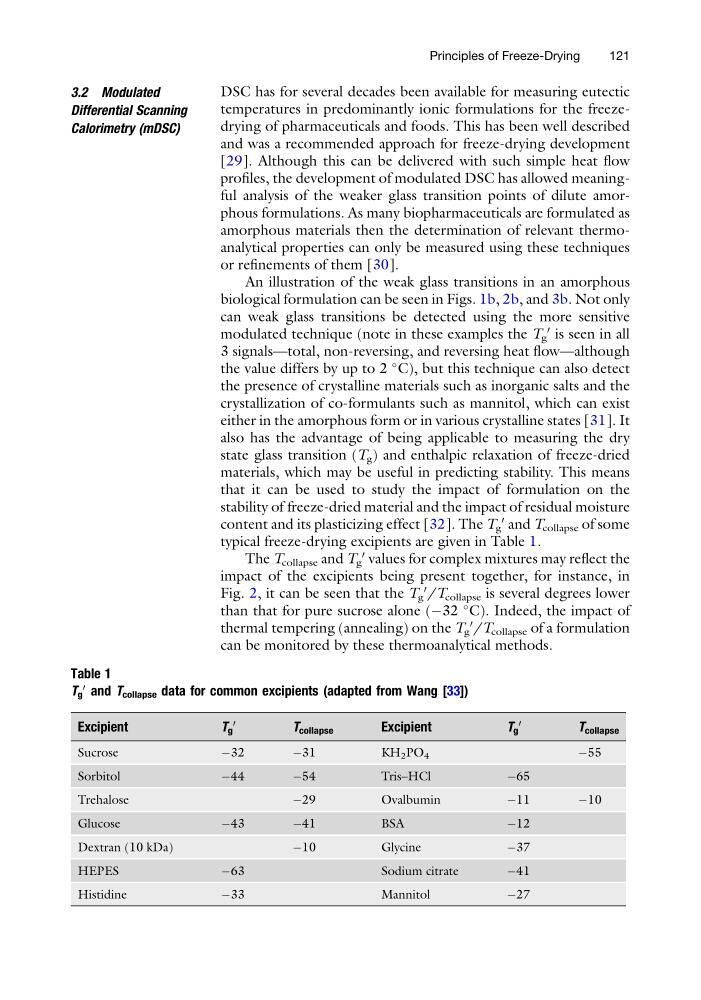
typical freeze-drying excipients are given in Table 1.
The T collapse and T g
0 values for complex mixtures may reflect the
impact of the excipients being present together, for instance, in
Fig. 2, it can be seen that the T g
0 /T collapse is several degrees lower
than that for pure sucrose alone (À32
C). Indeed, the impact of
thermal tempering (annealing) on the T g
0 /T collapse of a formulation
can be monitored by these thermoanalytical methods.
Table 1
T g
0 and T collapse data for common excipients (adapted from Wang [33])
Excipient
T g
0
T collapse
Excipient
T g
0
T collapse
Sucrose
À32
À31
KH 2 PO 4
À55
Sorbitol
À44
À54
Tris–HCl
À65
Trehalose
À29
Ovalbumin
À11
À10
Glucose
À43
À41
BSA
À12
Dextran (10 kDa)
À10
Glycine
À37
HEPES
À63
Sodium citrate
À41
Histidine
À33
Mannitol
À27
Principles of Freeze-Drying
121
Differential Scanning
Calorimetry (mDSC)
DSC has for several decades been available for measuring eutectic
temperatures in predominantly ionic formulations for the freezedrying of pharmaceuticals and foods. This has been well described
and was a recommended approach for freeze-drying development
[29]. Although this can be delivered with such simple heat flow
profiles, the development of modulated DSC has allowed meaningful analysis of the weaker glass transition points of dilute amorphous formulations. As many biopharmaceuticals are formulated as
amorphous materials then the determination of relevant thermoanalytical properties can only be measured using these techniques
or refinements of them [30].
An illustration of the weak glass transitions in an amorphous
biological formulation can be seen in Figs. 1b, 2b, and 3b. Not only
can weak glass transitions be detected using the more sensitive
modulated technique (note in these examples the T g
0 is seen in all
3 signals—total, non-reversing, and reversing heat flow—although
the value differs by up to 2
C), but this technique can also detect
the presence of crystalline materials such as inorganic salts and the
crystallization of co-formulants such as mannitol, which can exist
either in the amorphous form or in various crystalline states [31]. It
also has the advantage of being applicable to measuring the dry
state glass transition (T g ) and enthalpic relaxation of freeze-dried
materials, which may be useful in predicting stability. This means
that it can be used to study the impact of formulation on the
stability of freeze-dried material and the impact of residual moisture
content and its plasticizing effect [32]. The T g
0 and T collapse of some
typical freeze-drying excipients are given in Table 1.
The T collapse and T g
0 values for complex mixtures may reflect the
impact of the excipients being present together, for instance, in
Fig. 2, it can be seen that the T g
0 /T collapse is several degrees lower
than that for pure sucrose alone (À32
C). Indeed, the impact of
thermal tempering (annealing) on the T g
0 /T collapse of a formulation
can be monitored by these thermoanalytical methods.
Table 1
T g
0 and T collapse data for common excipients (adapted from Wang [33])
Excipient
T g
0
T collapse
Excipient
T g
0
T collapse
Sucrose
À32
À31
KH 2 PO 4
À55
Sorbitol
À44
À54
Tris–HCl
À65
Trehalose
À29
Ovalbumin
À11
À10
Glucose
À43
À41
BSA
À12
Dextran (10 kDa)
À10
Glycine
À37
HEPES
À63
Sodium citrate
À41
Histidine
À33
Mannitol
À27
Principles of Freeze-Drying
121