

84
2 The Interaction of Electromagnetic Waves with Water
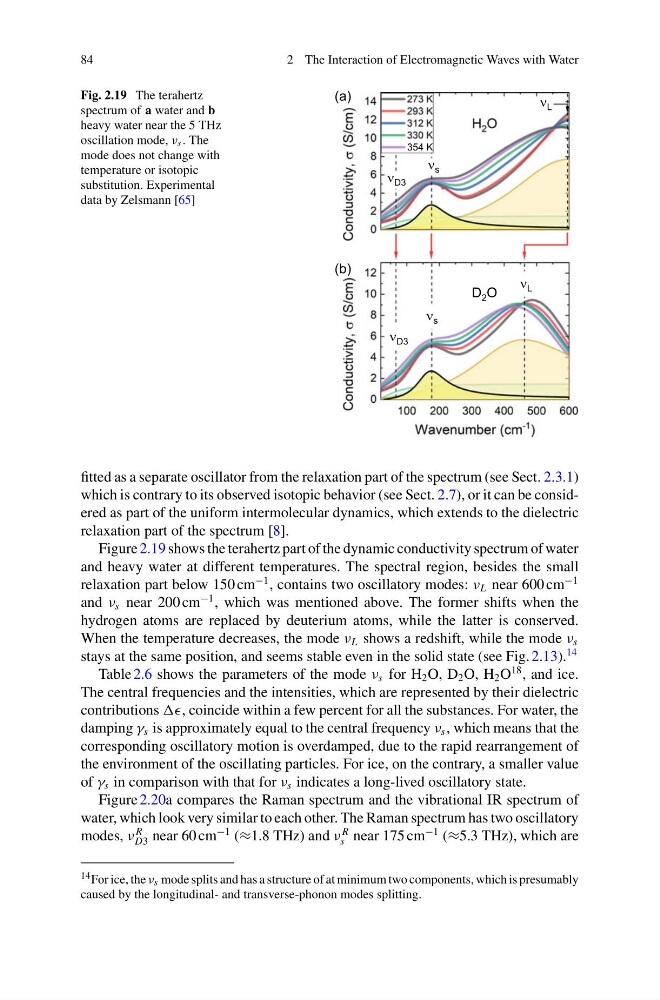
Fig. 2.19 The terahertz
spectrum of a water and b
heavy water near the 5 THz
oscillation mode, ν s . The
mode does not change with
temperature or isotopic
substitution. Experimental
data by Zelsmann [65]
fitted as a separate oscillator from the relaxation part of the spectrum (see Sect. 2.3.1)
which is contrary to its observed isotopic behavior (see Sect. 2.7), or it can be considered as part of the uniform intermolecular dynamics, which extends to the dielectric
relaxation part of the spectrum [8].
Figure 2.19 shows the terahertz part of the dynamic conductivity spectrum of water
and heavy water at different temperatures. The spectral region, besides the small
relaxation part below 150 cm
−1 , contains two oscillatory modes: ν L near 600 cm
−1
and ν s near 200 cm
−1 , which was mentioned above. The former shifts when the
hydrogen atoms are replaced by deuterium atoms, while the latter is conserved.
When the temperature decreases, the mode ν L shows a redshift, while the mode ν s
stays at the same position, and seems stable even in the solid state (see Fig. 2.13).
14
Table 2.6 shows the parameters of the mode ν s for H 2 O, D 2 O, H 2 O
18 , and ice.
The central frequencies and the intensities, which are represented by their dielectric
contributions , coincide within a few percent for all the substances. For water, the
damping γ s is approximately equal to the central frequency ν s , which means that the
corresponding oscillatory motion is overdamped, due to the rapid rearrangement of
the environment of the oscillating particles. For ice, on the contrary, a smaller value
of γ s in comparison with that for ν s indicates a long-lived oscillatory state.
Figure 2.20a compares the Raman spectrum and the vibrational IR spectrum of
water, which look very similar to each other. The Raman spectrum has two oscillatory
modes, ν
R
D3 near 60 cm
−1 (≈1.8 THz) and ν
R
s near 175 cm
−1 (≈5.3 THz), which are
14 For ice, the ν s mode splits and has a structure of at minimum two components, which is presumably
caused by the longitudinal- and transverse-phonon modes splitting.
2 The Interaction of Electromagnetic Waves with Water
Fig. 2.19 The terahertz
spectrum of a water and b
heavy water near the 5 THz
oscillation mode, ν s . The
mode does not change with
temperature or isotopic
substitution. Experimental
data by Zelsmann [65]
fitted as a separate oscillator from the relaxation part of the spectrum (see Sect. 2.3.1)
which is contrary to its observed isotopic behavior (see Sect. 2.7), or it can be considered as part of the uniform intermolecular dynamics, which extends to the dielectric
relaxation part of the spectrum [8].
Figure 2.19 shows the terahertz part of the dynamic conductivity spectrum of water
and heavy water at different temperatures. The spectral region, besides the small
relaxation part below 150 cm
−1 , contains two oscillatory modes: ν L near 600 cm
−1
and ν s near 200 cm
−1 , which was mentioned above. The former shifts when the
hydrogen atoms are replaced by deuterium atoms, while the latter is conserved.
When the temperature decreases, the mode ν L shows a redshift, while the mode ν s
stays at the same position, and seems stable even in the solid state (see Fig. 2.13).
14
Table 2.6 shows the parameters of the mode ν s for H 2 O, D 2 O, H 2 O
18 , and ice.
The central frequencies and the intensities, which are represented by their dielectric
contributions , coincide within a few percent for all the substances. For water, the
damping γ s is approximately equal to the central frequency ν s , which means that the
corresponding oscillatory motion is overdamped, due to the rapid rearrangement of
the environment of the oscillating particles. For ice, on the contrary, a smaller value
of γ s in comparison with that for ν s indicates a long-lived oscillatory state.
Figure 2.20a compares the Raman spectrum and the vibrational IR spectrum of
water, which look very similar to each other. The Raman spectrum has two oscillatory
modes, ν
R
D3 near 60 cm
−1 (≈1.8 THz) and ν
R
s near 175 cm
−1 (≈5.3 THz), which are
14 For ice, the ν s mode splits and has a structure of at minimum two components, which is presumably
caused by the longitudinal- and transverse-phonon modes splitting.