

2.6 The Terahertz Spectrum of Water
83
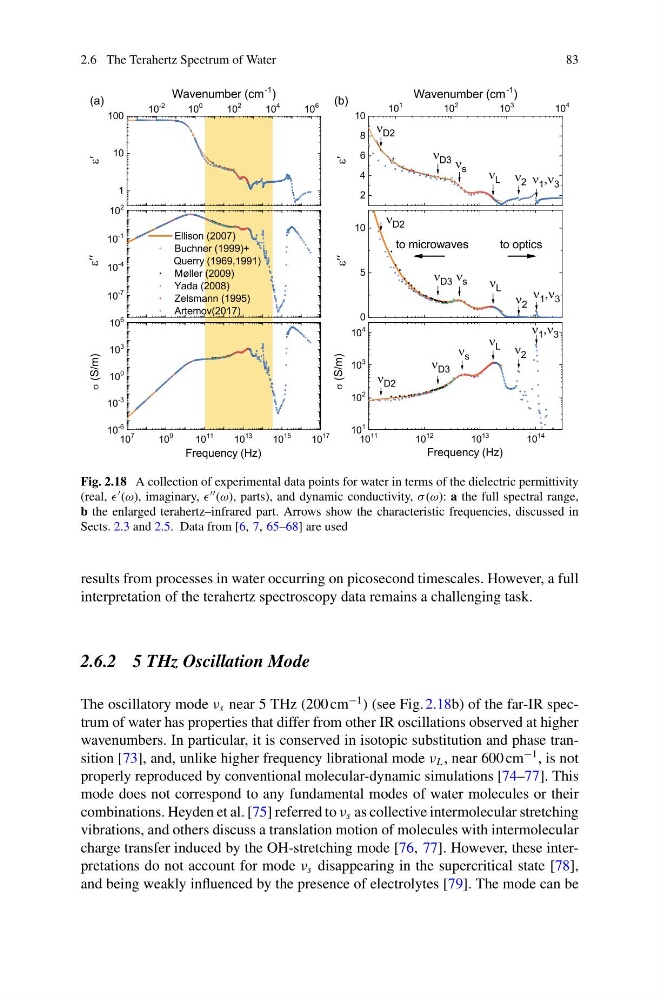
Fig. 2.18 A collection of experimental data points for water in terms of the dielectric permittivity
(real, (ω), imaginary, (ω), parts), and dynamic conductivity, σ (ω): a the full spectral range,
b the enlarged terahertz–infrared part. Arrows show the characteristic frequencies, discussed in
Sects. 2.3 and 2.5. Data from [6, 7, 65–68] are used
results from processes in water occurring on picosecond timescales. However, a full
interpretation of the terahertz spectroscopy data remains a challenging task.
2.6.2 5 THz Oscillation Mode
The oscillatory mode ν s near 5 THz (200 cm
−1 ) (see Fig. 2.18b) of the far-IR spectrum of water has properties that differ from other IR oscillations observed at higher
wavenumbers. In particular, it is conserved in isotopic substitution and phase transition [73], and, unlike higher frequency librational mode ν L , near 600 cm
−1 , is not
properly reproduced by conventional molecular-dynamic simulations [74–77]. This
mode does not correspond to any fundamental modes of water molecules or their
combinations. Heyden et al. [75] referred to ν s as collective intermolecular stretching
vibrations, and others discuss a translation motion of molecules with intermolecular
charge transfer induced by the OH-stretching mode [76, 77]. However, these interpretations do not account for mode ν s disappearing in the supercritical state [78],
and being weakly influenced by the presence of electrolytes [79]. The mode can be
83
Fig. 2.18 A collection of experimental data points for water in terms of the dielectric permittivity
(real, (ω), imaginary, (ω), parts), and dynamic conductivity, σ (ω): a the full spectral range,
b the enlarged terahertz–infrared part. Arrows show the characteristic frequencies, discussed in
Sects. 2.3 and 2.5. Data from [6, 7, 65–68] are used
results from processes in water occurring on picosecond timescales. However, a full
interpretation of the terahertz spectroscopy data remains a challenging task.
2.6.2 5 THz Oscillation Mode
The oscillatory mode ν s near 5 THz (200 cm
−1 ) (see Fig. 2.18b) of the far-IR spectrum of water has properties that differ from other IR oscillations observed at higher
wavenumbers. In particular, it is conserved in isotopic substitution and phase transition [73], and, unlike higher frequency librational mode ν L , near 600 cm
−1 , is not
properly reproduced by conventional molecular-dynamic simulations [74–77]. This
mode does not correspond to any fundamental modes of water molecules or their
combinations. Heyden et al. [75] referred to ν s as collective intermolecular stretching
vibrations, and others discuss a translation motion of molecules with intermolecular
charge transfer induced by the OH-stretching mode [76, 77]. However, these interpretations do not account for mode ν s disappearing in the supercritical state [78],
and being weakly influenced by the presence of electrolytes [79]. The mode can be