

2.3 Microwave Spectrum: Dielectric Relaxation
65
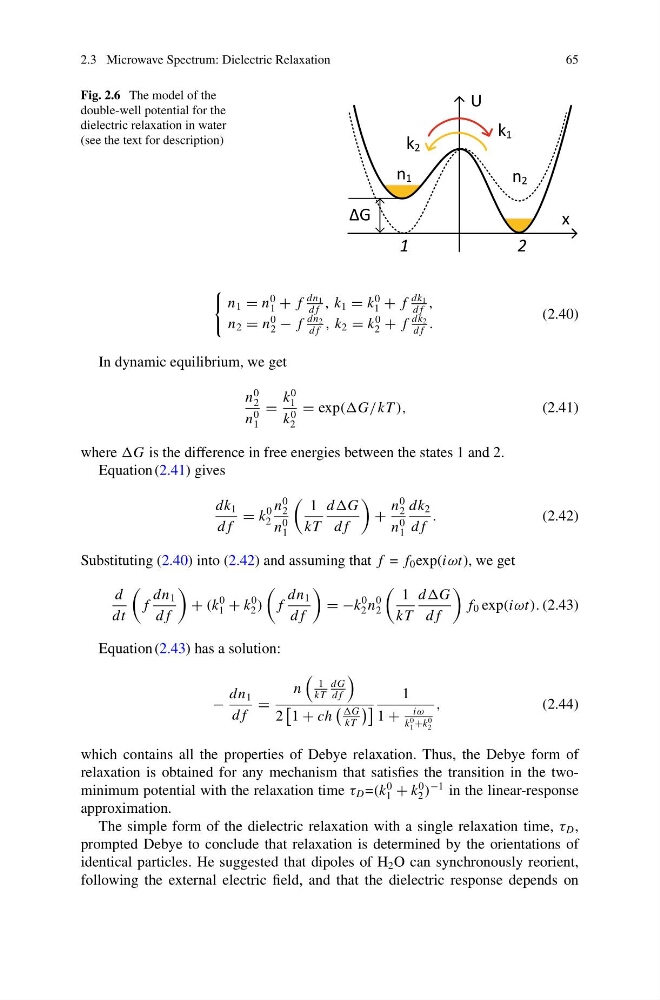
Fig. 2.6 The model of the
double-well potential for the
dielectric relaxation in water
(see the text for description)
U
x
1
2
ΔG
n 1
n 2
k 1
k 2
n 1 = n
0
1 + f
dn 1
d f
, k 1 = k
0
1 + f
dk 1
d f
,
n 2 = n
0
2 − f
dn 2
d f
, k 2 = k
0
2 + f
dk 2
d f
.
(2.40)
In dynamic equilibrium, we get
n
0
2
n
0
1
=
k
0
1
k
0
2
= exp((G/kT ),
(2.41)
where is the difference in free energies between the states 1 and 2.
Equation (2.41) gives
dk 1
d f
= k
0
2
n
0
2
n
0
1
1
kT
d
d f
+
n
0
2
n
0
1
dk 2
d f
.
(2.42)
Substituting (2.40) into (2.42) and assuming that f = f 0 exp(iωt), we get
d
dt
f
dn 1
d f
+ (k
0
1 + k
0
2 )
f
dn 1
d f
= −k
0
2 n
0
2
1
kT
d
d f
f 0 exp(iωt). (2.43)
Equation (2.43) has a solution:
−
dn 1
d f
=
n
1
kT
dG
d f
2
1 + ch
kT
1
1 +
iω
k
0
1 +k
0
2
,
(2.44)
which contains all the properties of Debye relaxation. Thus, the Debye form of
relaxation is obtained for any mechanism that satisfies the transition in the twominimum potential with the relaxation time τ D =(k
0
1 + k
0
2 )
−1 in the linear-response
approximation.
The simple form of the dielectric relaxation with a single relaxation time, τ D ,
prompted Debye to conclude that relaxation is determined by the orientations of
identical particles. He suggested that dipoles of H 2 O can synchronously reorient,
following the external electric field, and that the dielectric response depends on
65
Fig. 2.6 The model of the
double-well potential for the
dielectric relaxation in water
(see the text for description)
U
x
1
2
ΔG
n 1
n 2
k 1
k 2
n 1 = n
0
1 + f
dn 1
d f
, k 1 = k
0
1 + f
dk 1
d f
,
n 2 = n
0
2 − f
dn 2
d f
, k 2 = k
0
2 + f
dk 2
d f
.
(2.40)
In dynamic equilibrium, we get
n
0
2
n
0
1
=
k
0
1
k
0
2
= exp((G/kT ),
(2.41)
where is the difference in free energies between the states 1 and 2.
Equation (2.41) gives
dk 1
d f
= k
0
2
n
0
2
n
0
1
1
kT
d
d f
+
n
0
2
n
0
1
dk 2
d f
.
(2.42)
Substituting (2.40) into (2.42) and assuming that f = f 0 exp(iωt), we get
d
dt
f
dn 1
d f
+ (k
0
1 + k
0
2 )
f
dn 1
d f
= −k
0
2 n
0
2
1
kT
d
d f
f 0 exp(iωt). (2.43)
Equation (2.43) has a solution:
−
dn 1
d f
=
n
1
kT
dG
d f
2
1 + ch
kT
1
1 +
iω
k
0
1 +k
0
2
,
(2.44)
which contains all the properties of Debye relaxation. Thus, the Debye form of
relaxation is obtained for any mechanism that satisfies the transition in the twominimum potential with the relaxation time τ D =(k
0
1 + k
0
2 )
−1 in the linear-response
approximation.
The simple form of the dielectric relaxation with a single relaxation time, τ D ,
prompted Debye to conclude that relaxation is determined by the orientations of
identical particles. He suggested that dipoles of H 2 O can synchronously reorient,
following the external electric field, and that the dielectric response depends on